
Across the Border: The Wars Between India and Pakistan
A Chronicle of Armed Conflicts Since Partition

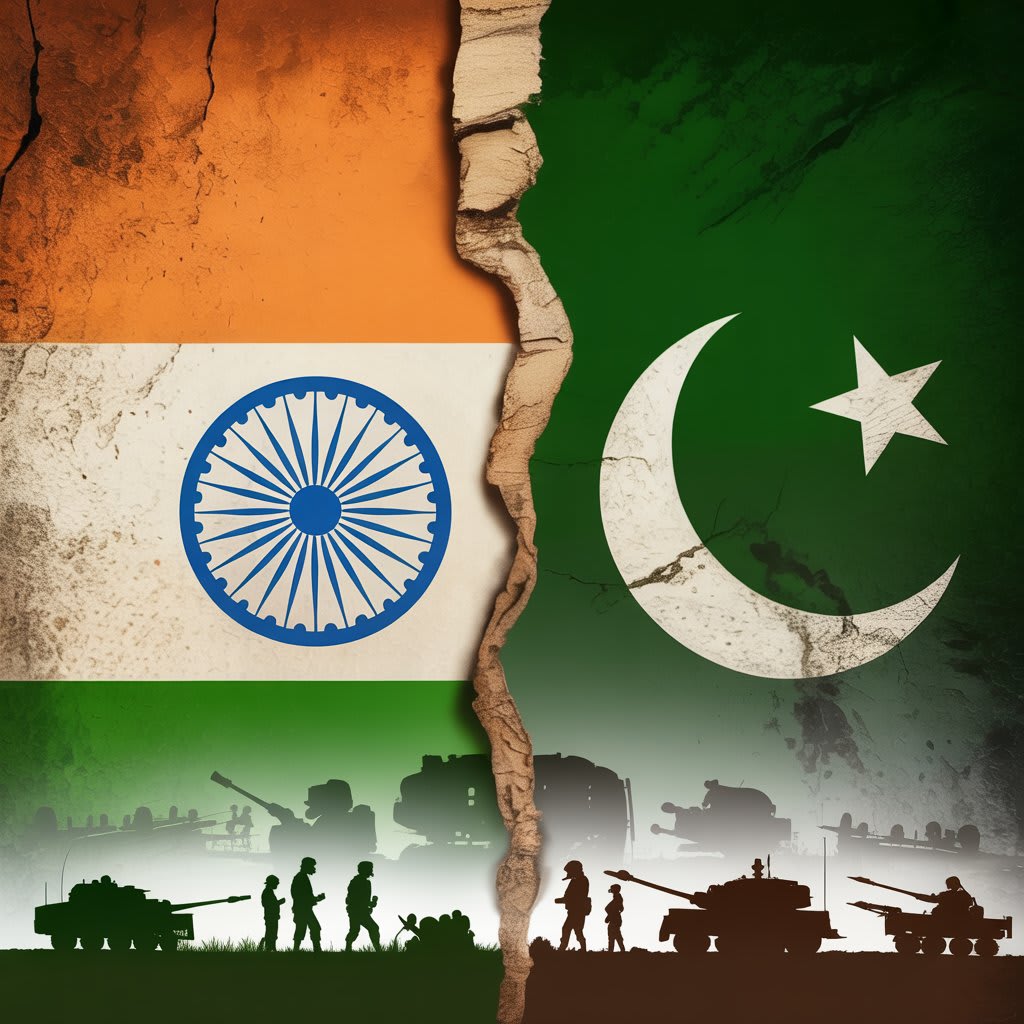
When the midnight bells of August 15, 1947, rang across the Indian subcontinent, they did not herald peace—they sounded the birth of two nations, and the seeds of a conflict that would echo across generations.
India and Pakistan were carved out of the same body—one wound stitched into two identities. The British departure had left behind borders drawn in haste, bloodshed in the streets, and the emotional devastation of Partition. Over 14 million people crossed these new lines—Hindus and Sikhs to India, Muslims to Pakistan—in the largest mass migration in human history. But this was not just a migration. It was an exodus soaked in blood. Trains arrived full of corpses. Villages burned. Families vanished.
And so, barely had the ink dried on the birth certificates of the two nations when the first war erupted in the winter of 1947.
1947–1948: The First Kashmir War
Kashmir, a princely state ruled by a Hindu Maharaja but with a Muslim majority population, became the flashpoint. When tribal militias from Pakistan invaded, the Maharaja acceded to India in return for military protection. Indian troops were airlifted to defend the region, and soon, a full-scale war broke out.
The newly-formed Indian and Pakistani armies, many of whose officers had trained and served together under the British flag, now pointed rifles at one another. Friends became foes. The fighting raged for over a year, leaving thousands dead, before a ceasefire was declared under UN mediation in 1949. The result: Kashmir was split, with one-third administered by Pakistan and two-thirds by India. But the issue was far from resolved.
1965: The Second War
The silence on the border was deceptive. In 1965, emboldened by reports of discontent in Indian-administered Kashmir, Pakistan launched Operation Gibraltar, sending guerrillas across the Line of Control. India responded with full military force, crossing the international border near Lahore. What began as a covert operation became an open war involving tanks, artillery, and fighter jets—the largest armored conflict since World War II at that time.
The war ended in a stalemate with the Tashkent Agreement, brokered by the Soviet Union. No significant territorial changes occurred, but the psychological scars deepened. Trust was further eroded, and both nations began ramping up their military capabilities.
1971: The War for Bangladesh
The third war was the most decisive—and the most devastating for Pakistan.
In 1971, internal unrest in East Pakistan (now Bangladesh) led to a brutal crackdown by the West Pakistani military. Millions of Bengali refugees fled into India, overwhelming border states. India, under Prime Minister Indira Gandhi, decided to intervene—both to support the Bengali independence movement and to protect its own national security.
When India entered the conflict in December, it was a swift and decisive operation. Within 13 days, the Indian Army encircled Dhaka. On December 16, 1971, 93,000 Pakistani troops surrendered—one of the largest surrenders since WWII. Bangladesh was born. The war redefined South Asian geopolitics and left Pakistan with a deep national trauma.
1999: The Kargil Conflict
The final major war fought between the two nuclear-armed nations came in 1999, in the high-altitude region of Kargil in Ladakh. Pakistani soldiers and militants, disguised as insurgents, occupied strategic peaks inside Indian territory.
Caught by surprise, India launched Operation Vijay to reclaim the heights. What followed was a bitter mountain war fought at altitudes above 16,000 feet. Indian soldiers climbed icy cliffs under fire. Young officers, barely in their twenties, became national heroes—some posthumously.
International pressure, especially from the United States, forced Pakistan to withdraw. Kargil ended in India's favor, but the conflict underscored the terrifying risk of war between two nuclear states.
A Line That Still Burns
Today, the Line of Control in Kashmir remains one of the most heavily militarized borders in the world. Skirmishes continue. Civilians on both sides live under the constant threat of shelling. Soldiers stand watch in freezing altitudes where oxygen is thin, and suspicion thick.
Yet amid all the conflict, there are flickers of humanity.
An Indian officer once returned a letter he found in the pocket of a fallen Pakistani soldier—it was from the soldier’s daughter, written in neat Urdu, asking him to bring back a toy. In times of calm, farmers on both sides wave to each other across the fence. Retired generals from both nations, speaking at conferences abroad, often embrace with a sigh and a smile.
Because wars are fought by nations, but felt by people.
Epilogue: The Hope Beyond the Border
Seventy-eight years after Partition, India and Pakistan remain entangled in their past. The wounds of war are visible not just in military cemeteries, but in songs, cinema, and school textbooks. While politicians speak of strategy and sovereignty, ordinary people yearn for peace, trade, and a future unburdened by the past.
The border that divides them is not just a line on a map—it is a reminder of what was lost, and what might still be reclaimed.
Not through another war—but through understanding.
About the Creator
yasir zeb
best stories and best life




Comments
There are no comments for this story
Be the first to respond and start the conversation.