
Accidental Inventions!
You can't imagine life without them !

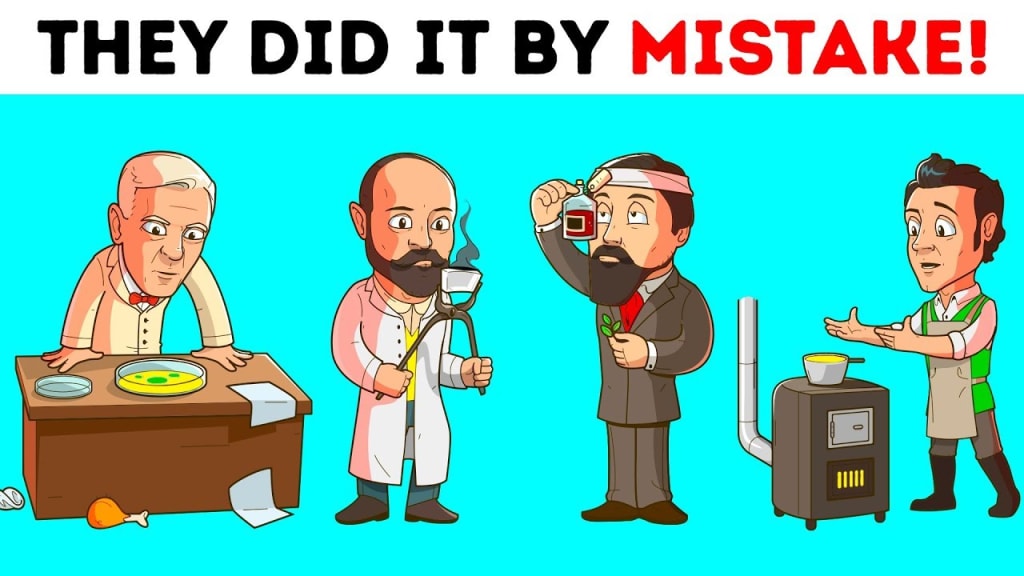
Mishaps happen all the time. Surprisingly, sometimes a mistake can lead to something extraordinary. Believe it or not, some of your favorite junk foods, life-saving medications, and even your breakfast oats were invented completely by accident. How is that possible? Let’s delve into these unintentional creations. I bet you can’t imagine life without them!
Have you ever had a zipper on your jeans burst open? Or needed to fix a wrapping? A safety pin is always handy in these minor accidents. But guess what? It was invented by mistake too! In 1849, in New York, Dr. Walter Hunt was at his desk, worried about a $15 debt. That was a lot of money back then—equivalent to about $600 today. In a moment of inspiration, he twisted a piece of metal wire and accidentally invented a spring mechanism! This new device could securely clasp and unclasp pins. Unlike older pins, it wouldn’t snag your clothes or fingers. He decided to patent this invention and made $400 from it—about $166,000 today. And just like that, he solved his financial problem!
Now, let’s talk about Teflon. If you love pancakes, you know how crucial a non-stick pan is. This wasn’t always possible. In 1938, physicist Roy Plunkett was trying to create refrigerants. He used tetrafluoroethylene, a flammable gas, and decided to freeze some samples due to limited lab space. When he checked back, he discovered that the gas had polymerized into a solid white substance! Known as polymerization, this process transformed small molecules into long chains. The minerals, hydrochloric acid, chloroform, and water combined to create Teflon. He found it was incredibly slippery, non-absorbent, and resistant to chemicals. Since 1946, Teflon has been used in countless everyday items. Thanks to Plunkett, you can flip pancakes without worrying they’ll stick to the pan!
Now let’s consider ear infections. They can be painful and annoying, but you can pop some antibiotics, and it usually clears up in a few days. Imagine a world without antibiotics! In 1928, Alexander Fleming was at St. Mary’s Hospital in London when he returned from vacation to find mold growing on a petri dish filled with bacteria. This mold was preventing bacteria from growing around it! It contained a substance that could kill bacteria, which he later named penicillin. Despite this groundbreaking discovery in 1929, no one seemed interested at the time. A decade later, in 1938, scientists Howard Florey and Ernst Chain rediscovered his research. In 1939, they began extracting this substance, leading to the pure form of penicillin a year later. By 1941, patients were treated with it, and bacterial infections were losing their grip on humanity!
There’s more! Did you know the inventor of dynamite also established the Nobel Peace Prize? It sounds contradictory, but it’s true. In 1866, Alfred Nobel accidentally discovered that mixing glycerin with diatomaceous earth formed a safe and stable explosive. He thought this safer explosive would end warfare, not realizing its true impact would be quite the opposite. Nobel’s invention turned out to be incredibly valuable, leading to the creation of the detonator. Despite the chaos caused by his invention, he used his fortune to establish the Nobel Prize.
Let’s talk childhood memories! Who can forget the smell of Play-Doh? It originally started as a cleaning product! In the 1920s, Cleo McVicker worked for a cleanser company in Ohio. By 1933, the company was going out of business. To save it, Cleo and his brother invented a non-toxic substance made from water, flour, and salt, intended to clean wallpaper. Homes at the time had coal-burning heaters, and this product helped clean the soot off walls. By the 1950s, as families switched to oil and gas, the product became obsolete. But McVicker’s son Joe and his sister-in-law, an educator, convinced him to turn it into a toy. In 1956, Play-Doh was born! And now? We all remember a curious kid trying to take a bite!
Speaking of tasty treats, what about popsicles? They are summer staples! Surprisingly, the popsicle was invented by an 11-year-old boy named Frank Epperson in California in 1905. He mixed powdered soda with water, stuck a stirring stick in it, and left it out overnight. When he found it frozen solid the next day, the sweet treat was created! He began selling them, calling them "Eppersonicicles." Almost twenty years later, he patented the name "popsicle." While frozen flavored ice wasn’t a new concept, Epperson’s specific recipe allowed his brand to flourish.
About the Creator
Tafara Sibotshiwe
A versatile authentic writer and passionate storyteller. With a background in, Journalism, Engineering, History, Health & finance, they combine profound insight with creative flair to explore the complexities of the human experience.
Keep reading
More stories from Tafara Sibotshiwe and writers in History and other communities.
Last second decision that changed History!
Did you know that last-minute decisions have changed history? These calls range from personnel changes costing over 1,500 lives to mistakes leading to deadly wars. Join me as we uncover some astonishing decisions that altered the course of history.
By Tafara Sibotshiweabout a year ago in History


Comments
There are no comments for this story
Be the first to respond and start the conversation.