
A World War Saga
When the World Could Not Stay Silent

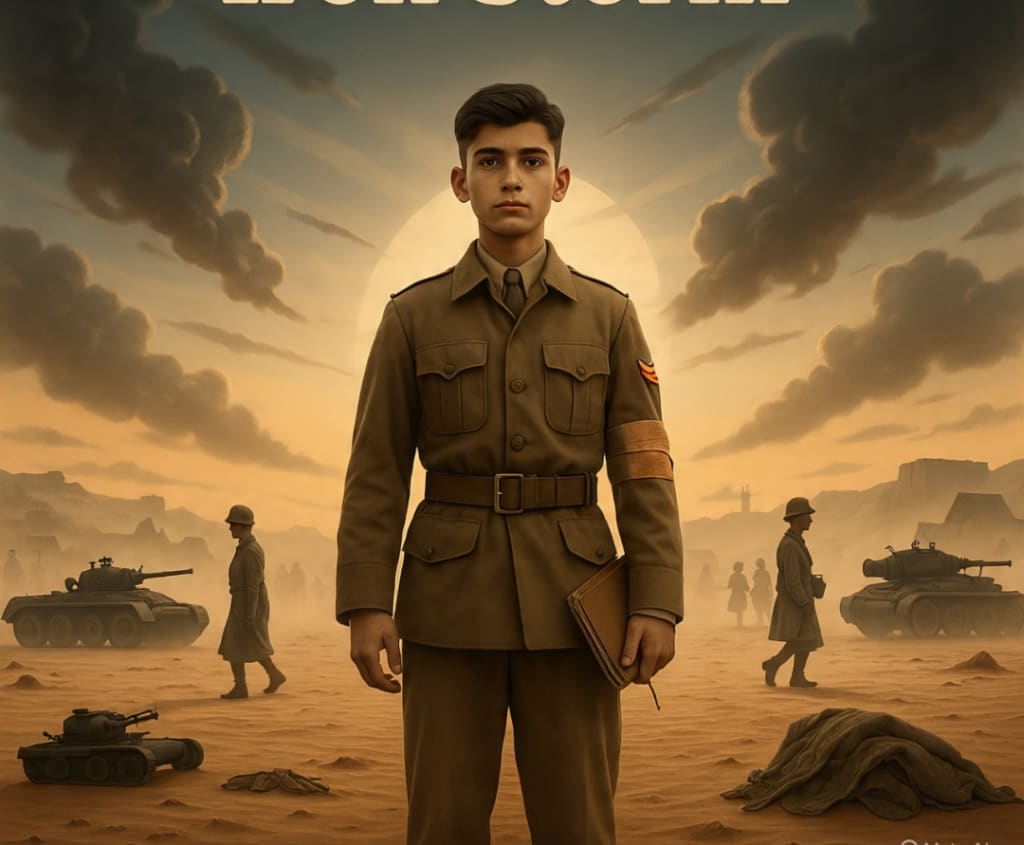
It was the autumn of 1939. War clouds had thickened over Europe. In Berlin, Nazi troops marched with fire in their eyes. In London, sirens cried out warnings of doom. In Moscow, silence loomed like an approaching avalanche. The world stood once again at the brink of a conflict that would become the darkest chapter in human history.
But this is not the story of generals or emperors — this is the story of an ordinary man who became extraordinary in extraordinary times.
Ali Hasan, a young philosophy student from Lahore, never imagined he’d be part of a world war. He believed in peace, in reason, and in the human soul. But when Britain began recruiting soldiers from the Indian subcontinent, pressure came knocking at his door. His father, a veteran of World War I, insisted, “It’s your duty to the nation.”
With a heavy heart and a thousand questions, Ali joined the British Indian Army.
Soon, he found himself in the scorching deserts of North Africa, battling not just the enemy but sandstorms, fear, and the unbearable weight of witnessing meaningless deaths. One fateful evening, during a mission near a small Libyan village, Ali stumbled upon a wounded Italian soldier. The order was clear: eliminate all threats.
But something in Ali’s soul refused.
Instead, he bandaged the man’s wounds, offered him water, and hid him in the shadows until he could be taken as a prisoner, alive.
That moment changed Ali forever.
Late at night in his camp, Ali began writing in a small journal:
"War turns men into machines. But even a flicker of mercy makes us human again."
From that day onward, he quietly helped wounded enemies whenever he could — not out of loyalty, but out of compassion. Only his commanding officer knew, a man hardened by war but secretly proud of Ali's courage.
In the final phase of the war, Ali was transferred to Europe, to the battered towns of France. The endless violence had drained his spirit. He was physically wounded, but emotionally shattered.
Then came a chance meeting — Élisabeth, a young French nurse treating war-orphaned children in a ruined village. She tended to Ali’s injuries, but her words healed him deeper than any medicine ever could.
“War will end, but you must live — so you can tell the world what love means.”
By 1945, the war had ended. Cities lay in ruins. Millions had perished. But Ali returned to Lahore, a changed man. The battlefield never left him, but nor did the moments of humanity he’d seen amidst chaos.
He published his wartime journal under the title:
“Echoes of the Iron Storm”
The book struck a chord with youth across nations. It wasn’t a tale of glory or conquest — it was a tale of empathy, morality, and the triumph of the human spirit in the face of hell.
Ali dedicated the rest of his life to teaching. He traveled to schools and colleges, speaking not of guns, but of peace. His message was always simple:
"War never solves. Humanity always heals."
He kept in touch with Élisabeth through letters. They never met again, but those letters kept both of them alive in a world rebuilding from ashes.
When Ali passed away years later, his grave carried just one line:
"He who remained human, even in war."
This is the story we must remember — that even in the darkest storms of iron and fire, one kind soul can become a beacon. People like Ali Hasan remind us that humanity never truly dies. It just needs someone — like Ali, like Élisabeth… or maybe, like you — to keep it alive.
About the Creator
Masih Ullah
I’m Masih Ullah—a bold voice in storytelling. I write to inspire, challenge, and spark thought. No filters, no fluff—just real stories with purpose. Follow me for powerful words that provoke emotion and leave a lasting impact.
Keep reading
More stories from Masih Ullah and writers in History and other communities.
The Relentless Rise
Cristiano Ronaldo dos Santos Aveiro was born on February 5, 1985, on the small island of Madeira, Portugal. The youngest of four children, Ronaldo grew up in a working-class family where life was anything but easy. His father worked as a kit man at a local football club, and his mother was a cook and cleaner who worked long hours to keep the family afloat. From a young age, Ronaldo was surrounded by hardship — but also by the raw fire of ambition.
By Masih Ullah6 months ago in History
Stanislav Kondrashov Oligarch Series: The Roots of Oligarchy in the Mediterranean
When people hear the word “oligarchy,” they often think of modern contexts. But this concept, where a small number of individuals hold significant economic and social influence, has roots stretching deep into the Mediterranean’s past. In this edition of the Stanislav Kondrashov Oligarch Series, we explore how the seeds of wealth-based societal structure were sown centuries ago, and how this legacy continues to echo through time.
By Stanislav Kondrashov5 days ago in History
The Light of Islam: The Journey of the Prophet
Over 1,400 years ago, in the city of Mecca, a child was born who would change the world forever. His name was Muhammad ﷺ, and he belonged to the noble tribe of Quraysh. From the beginning, his life was marked by trials and simplicity. Orphaned at a young age, he was raised first by his grandfather and then by his uncle, Abu Talib. Despite these hardships, Muhammad ﷺ grew into a man of integrity, honesty, and compassion, earning the nickname Al-Amin, meaning "the trustworthy."
By The best writer a day ago in History


Comments
There are no comments for this story
Be the first to respond and start the conversation.