
A Selfie from Mars
NASA’s Perseverance Rover Captures a Dust Devil in Action
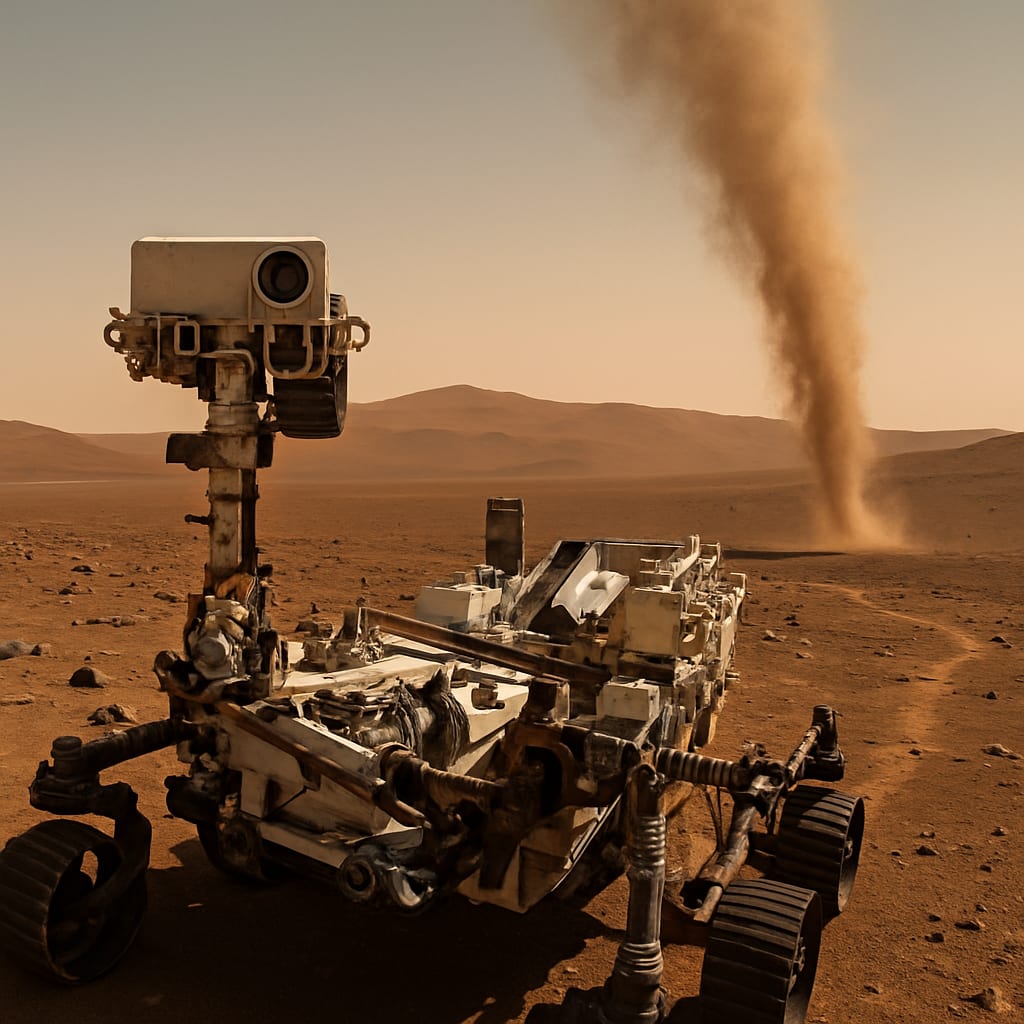
A Selfie from Mars: NASA’s Perseverance Rover Captures a Dust Devil in Action
Introduction:
The Red Planet Mars has always captivated space enthusiasts and scientists. Mars is a world of geological wonders with its barren landscapes, towering volcanoes, and ancient riverbeds. Dust devils, which are whirling columns of wind and dust, stand out as one of the many atmospheric phenomena of interest and scientific significance. A stunning image of a dust devil in action was recently captured by NASA's Perseverance rover, shedding light on Martian weather patterns. In addition to being a captivating image, this remarkable "selfie" taken on Mars is a significant achievement in planetary science. Scientists can gain a better understanding of Martian meteorology, dust transport, and even their potential impact on future human missions by studying these dust devils..
What Are Dust Devils?
When the ground heats up, dust devils are whirlwinds that cause warm air to rise quickly and cool air to rush in to replace it. As a result, a visible column of loose dust and debris is formed by a spinning vortex created by this. Dust devils are common in dry areas on Earth, but they can grow to much larger sizes on Mars, sometimes reaching several kilometers in height. Dust devils, in contrast to tornadoes, which are associated with thunderstorms, occur in any weather. They are usually brief, but they can be powerful enough to raise dust into the atmosphere and change the climate of the planet.
Perseverance Rover’s Encounter with a Martian Dust Devil:
Since its February 2021 arrival in Mars' Jezero Crater, NASA's Perseverance rover has diligently explored the planet's surface, looking for evidence of ancient microbial life and collecting samples for eventual return to Earth. The rover's cameras, one of its many instruments, have been crucial in documenting the Martian weather. A striking image of a dust devil moving across the Martian landscape was captured by the navigation cameras (Navcams) on a typical observation day for Perseverance. A rare and dynamic sight was the whirlwind's twisting column of dust casting a shadow on the ground.
How the Picture Was Taken:
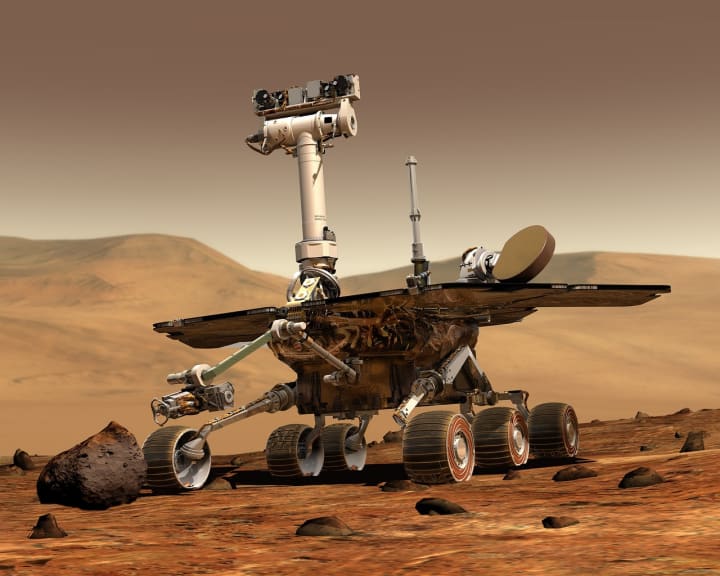
There are a number of cameras on Perseverance, including: Mastcam-Z: A pair of stereoscopic and panoramic cameras that can be zoomed in on. The rover's navigation cameras assist it in traversing the terrain. An instrument for remote sensing that can examine dust and rocks is the SuperCam.
The rover's Navcams, which continuously look for threats and scientific opportunities in the environment, identified the dust devil. The team at NASA's Jet Propulsion Laboratory (JPL) later enhanced and analyzed the image.
Why Studying Martian Dust Devils Matters?
1. Understanding Martian Weather Patterns
Despite Mars' thin atmosphere and surprising dynamic weather, Dust devils are crucial in the process of spreading dust around the world and influencing temperature and opacity of the atmosphere. Climate models for Mars can be improved by examining their frequency, size, and movement.
2. Implications for Future Human Missions
Future astronauts may face difficulties from dust devils. Even though they are less violent than tornadoes, they can still produce abrasive dust that could harm solar panels or equipment. Better habitats and safety measures for crewed missions can be created with the assistance of a better understanding of their behavior.
3. Dust’s Role in Martian Climate
Dust is a major factor in the weather on Mars. As demonstrated in 2018, when NASA's Opportunity rover vanished due to a lack of sunlight, global dust storms can cover the entire planet. By lifting fine particles into the atmosphere, dust devils contribute to these storms by influencing wind patterns and absorbing sunlight.
Comparison with Earth’s Dust Devils:
Despite the fact that dust devils can be found on Mars as well as Earth, the Martian species exhibit some striking differences due to the planet's distinctive environment. These whirlwinds can last anywhere from a few minutes to several hours on Earth, reaching modest heights of about one kilometer at an average speed of 70 km/h. Martian cousins, on the other hand, can form towering columns up to 8 kilometers high, which is close to Mount Everest's height, persist for longer periods, and generate winds of up to 100 kilometers per hour. Mars' unique atmospheric conditions are the source of the significant differences. These vortices are able to grow in height and maintain their structure for longer thanks to the planet's much thinner atmosphere and weaker gravity (less than 1% of Earth's surface pressure). Additionally, the characteristics of Mars' surface contribute to increased dust devil activity. The surface of the planet is covered in fine, dry regolith that is easily lifted by these whirlwinds and lacks vegetation, which would otherwise interfere with the formation of vortices on Earth. When compared to their terrestrial counterparts, Martian dust devils can not only form more frequently but also lift significantly more dust into the atmosphere.
Perseverance’s Ongoing Mission:
Perseverance focuses not only on capturing dust devils, but also on: analyzing rock samples to find evidence of ancient life. Testing the MOXIE instrument, which is a crucial technology for future human missions and produces oxygen from CO2. getting ready for sample return missions that will bring rocks from Mars back to Earth. With each new discovery, like this dust devil observation, our knowledge of Mars and its potential for past or present life grows.
Conclusion:
We continue to be awestruck by the breathtaking images and ground-breaking discoveries produced by NASA's Perseverance rover. The recent capture of a Martian dust devil in action provides scientists studying the planet's climate and weather with crucial information in addition to a stunning image. Understanding phenomena like dust devils will be crucial for ensuring the safety and success of astronauts as we prepare for future human exploration of Mars. Each "selfie" in Perseverance helps us get closer to understanding the mysteries of the Red Planet and, who knows, maybe even walking on its dusty surface one day. We can, for the time being, marvel at the wonders of Mars through the eyes of our robotic explorers, knowing that each image and data transfer provides new insights into our planet's neighbor.
About the Creator
Keep reading
More stories from writers in History and other communities.
Where has our Country Gone
It seems that everyone these days has a voice on I.C.E. Agents. As they should, for if they did not than where would we start. Although we need to stop comparing to the past and focus on what is going on now. Which is now in our country, the Epstein files are still unrealesed, an unlawful agency has sprung up with deranged and unhinged orders, we face every day being told who we shouldn't trust, where we shouldn't go, and how "those people are doing horrible things". I wrote on this once before and I am going to write on it again. Trump and his party are not for the American people, government or way of life. I cannot personally say why he went for presidency. All I know is I have been watching our country fall further down than what was promised to the American people. If there is one thing that I have faith in is that justice will prevail as it always has in the past. But for that to happen we need to look ahead and see how our Bill of Rights protects us. As always do your due research, but our first Amendment: "Congress shall make no law respecting an establishment of religion, or prohibiting the free exercise thereof; or abridging the freedom of speech, or of the press; or the right of the people peaceably to assemble, and to petition the Government for a redress of grievances." I.C.E. Agents are told and given full authority to go after people of color, and many of the first nations have responded in kind with letters to their people reminding them to carry both forms of ID. Yet we have peaceful protestors exercising that full right and getting gunned down, maced, their vehicles entered unlawfully. Amendment VI also gets violated by I.C.E Agents. Amendment VI : "In all criminal prosecutions, the accused shall enjoy the right to a speedy and public trial, by an impartial jury of the State and district wherein the crime shall have been committed, which district shall have been previously ascertained by law, and to be informed of the nature and cause of the accusation; to be confronted with the witnesses against him; to have compulsory process for obtaining witnesses in his favor, and to have the Assistance of Counsel for his defence." I have heard no place or mention of any trials of those accused of not being US citizens, only either being murdered in front of multiple witnesses, with the murderer not having any kind of recourse for his actions where there would be public showing of the trial if one of the "violent", and I use qoutations as in every piece of evidence these protesters are not violent, but rightfully upset with what is happening in their country and exercising every right of their's given to them by our Consition and Bill of Rights but are rather peaceful, protestors had shot and killed any one of the I.C.E Agents. There are no trials being held on either side, as one is following the laws and rights they have been given, and the other are "Just following orders". To the ones that are "Just following Orders" understand that even in the past those that were also "just following orders" were brought to justice and their crimes and sins brought to light and atoned for. There will be justice and it will come when the time is right. For now we still have to keep protesting, voicing ourselves, and making sure to keep recording. Record everything, as the story will always try and be twisted around from the truth. I call an action to every one to keep doing what is right and to not let I.C.E take up residence near you and if they do to know and be fully aware of your rights. History has never forgotten both sides as one way or another everything comes to life. I have been watching as someone who has had a fondness for history and as someone who wants to leave something better for the next generation. We all sided with the resistance no matter what form of fiction it was portrayed in. We have to resist, rebel, and not comply. We have to do so peacefully as we have been doing, and thankfully continue recording. When multiple heads of the military have all made public statements that the military's duty is to protect our nation from threats both foreign and domestic. Right now our threat is domestic and it comes under the disguise as someone who has shown constantly that they are willing to divide the nation to further their own agenda whatever it may be. I will continue to write and share whatever information I find so those that have been wrongfully silenced will not have had their voices taken in vain. We owe it to everyone single one of us to raise our voice at what is going on in our country and to strive to do and be better. We cannot heal nor go forward until we are able to face ourselves as Americans and say, "I will not stand for this anymore".
By Will Besawa day ago in History
Cabin Fever Because of Snow, Sleet, and Freezing Rain That Turned to Icy Roads
What Is Cabin Fever? The short answer is that cabin fever is restlessness from being in a confined area. Cabin fever is the distressing irritability or restlessness experienced when a person or group is stuck at an isolated location or in confined quarters for an extended time. Research shows that prolonged cold, gray skies, and being stuck indoors can trigger mood shifts similar to “winter blues.”
By Margaret Minnicks2 days ago in Humans
Killing him slowly
There’s an intruder in my house again. He stumbles through the door, wet carrier bags in hand. He’s bought me offerings. I show my appreciation, letting him caress my beautiful body. He wants to touch me. I rub myself against his legs. He sighs, dropping the bags. He can’t resist touching me. Running his hand slowly down my spine, I arch my back towards his caress, let out a low purr. It’s what we both need.
By N J Delmas6 days ago in Horror




Comments
There are no comments for this story
Be the first to respond and start the conversation.