
"A Contemporary Overview of European Nations"
"Political Structures, Economic Trends, and Cultural Diversity Across the Continent

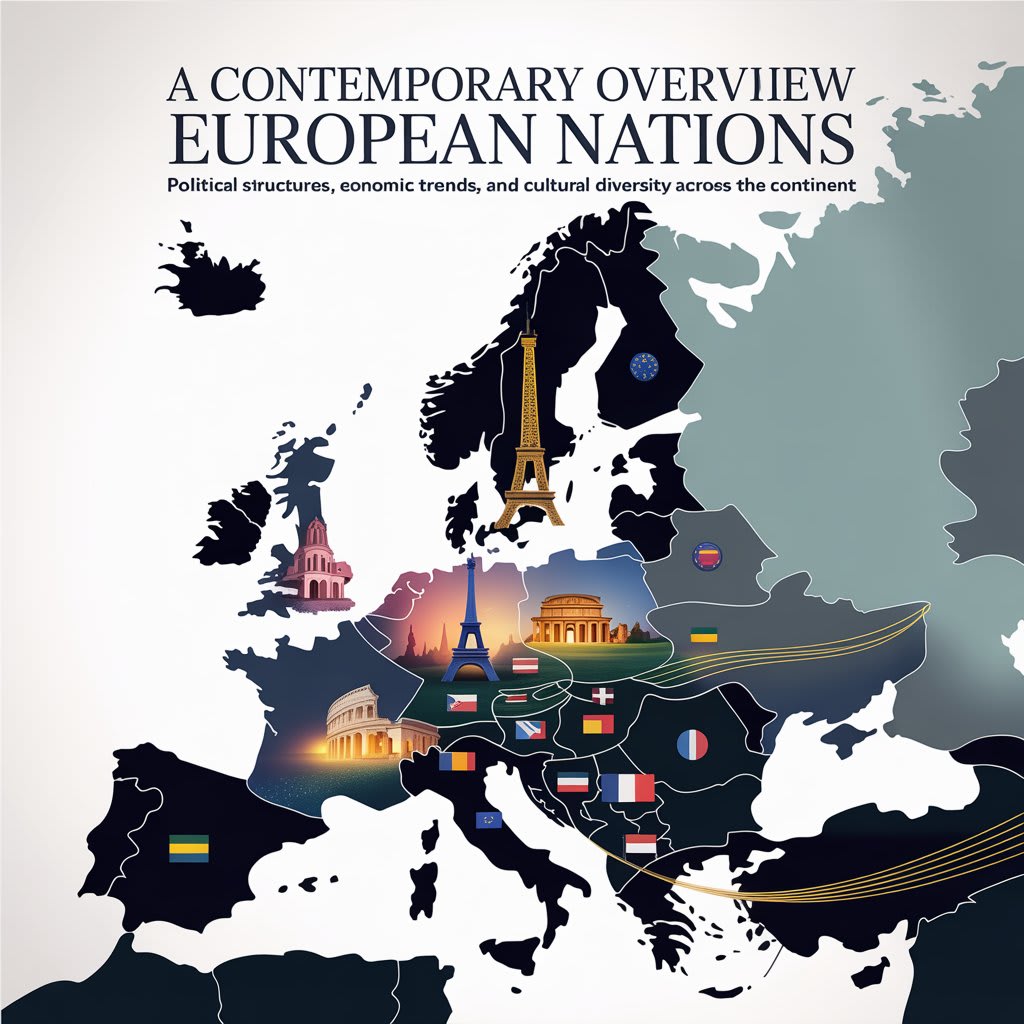
A Contemporary Overview of European Nations
Political Structures, Economic Trends, and Cultural Diversity Across the Continent
Europe, often described as the cradle of Western civilization, continues to play a significant role in shaping global affairs through its dynamic political structures, robust economies, and rich cultural traditions. In the 21st century, the continent is both unified and diverse—a mosaic of sovereign nations working together while preserving their unique identities.
The European Union (EU), established to foster economic and political integration after centuries of conflict, remains a central force in the region. With 27 member states, the EU exemplifies cooperation through institutions such as the European Commission, the European Parliament, and the European Court of Justice. The Schengen Agreement and the euro currency have enhanced mobility and trade across borders, illustrating a commitment to unity without erasing national sovereignty.
However, Europe is not limited to the EU. Countries like Switzerland, Norway, and the United Kingdom—following Brexit—maintain strong economic and diplomatic ties with the bloc while pursuing independent policies. This balance between integration and autonomy is one of Europe's defining characteristics, allowing for varied approaches to governance while maintaining shared values of democracy, human rights, and rule of law.
Economically, Europe remains one of the most prosperous regions in the world. Germany, the continent's largest economy, leads in industrial innovation and exports, while France and Italy contribute significantly through technology, fashion, and agriculture. The Nordic countries showcase models of social welfare and high living standards, often topping global happiness and education rankings. Meanwhile, Eastern European countries like Poland, Romania, and the Czech Republic have seen remarkable growth over the past two decades, transforming from post-Soviet economies into emerging market success stories.
Despite this progress, challenges persist. Economic disparities between Western and Eastern Europe, as well as North and South, create tensions within the EU. Countries such as Greece, Spain, and Portugal have faced sovereign debt crises, leading to austerity measures and political unrest. Moreover, the continent must navigate the impacts of climate change, aging populations, and energy security—especially in light of geopolitical tensions near its eastern borders.
Culturally, Europe is a beacon of diversity. With over 200 languages spoken and countless ethnic traditions, it remains a center for art, literature, and philosophy. UNESCO World Heritage Sites are scattered throughout, preserving centuries of human achievement—from the Roman ruins of Italy to the medieval towns of Central Europe and the fjords of Scandinavia. The free movement of people has led to vibrant multicultural cities like Berlin, Amsterdam, and Barcelona, where global influences merge with local customs.
In recent years, migration has tested Europe’s commitment to humanitarian principles and social cohesion. The influx of refugees from conflict zones, especially in the Middle East and Africa, has spurred debates about identity, security, and integration. While some nations have welcomed newcomers with open arms, others have implemented strict border controls and nationalist rhetoric. These tensions reflect broader global trends but also highlight Europe's struggle to balance compassion with stability.
Looking ahead, Europe's future will likely be shaped by digital transformation, environmental policy, and its geopolitical stance between global powers. With the Green Deal and a push toward carbon neutrality by 2050, the EU aims to lead in sustainability. At the same time, efforts to enhance defense cooperation and technological innovation are underway to maintain competitiveness on the world stage.
In essence, Europe is a continent of contrasts and cohesion. It is where ancient traditions meet modern governance, where multiple languages echo across a shared political framework, and where historical wounds have given rise to enduring alliances. As it continues to evolve, Europe remains not only a subject of study but a living example of how diversity and unity can coexist in a rapidly changing world.
About the Creator
Shahab Ali awan
"I don't just read people—I understand them. Every glance, every word, every silence tells a story. If you've ever wished you could truly see what others are thinking or feeling, you're in the right place. Stick around
Keep reading
More stories from Shahab Ali awan and writers in History and other communities.
Pak-China Friendship: A Timeless Strategic Partnership
The bond between Pakistan and China is often described as “deeper than the oceans, higher than the mountains, and sweeter than honey.” This poetic expression isn’t just rhetoric—it reflects a unique diplomatic and strategic relationship that has matured over decades into one of Asia’s most steadfast partnerships.
By Shahab Ali awan9 months ago in History
The Mysterious Sword of King Tutankhamun: A Weapon from the Heavens
Discovery of the Tomb and the Blade In 1922, British archaeologist Howard Carter uncovered the nearly intact tomb of King Tutankhamun in the Valley of the Kings. Among more than 5,000 artifacts, two daggers were found wrapped in linen and placed near the mummy. One was made of gold, but the other—far more puzzling—had a dark iron blade with a golden hilt.
By Say the truth 6 days ago in History
The Chola Dynasty and the Legend of the Hundred-Elephant-Slaying Warrior
Among the many heroic traditions associated with the Cholas is the legendary account of a warrior said to have slain one hundred war elephants in battle—a symbol of unmatched courage, strength, and battlefield mastery. Though this account blends history and legend, it reflects the martial culture of the Chola era and the extraordinary challenges faced by warriors during medieval warfare. Rise of the Chola Dynasty
By Say the truth 7 days ago in History


Comments
There are no comments for this story
Be the first to respond and start the conversation.