
3,000-Year-Old Bronze Age Ritual Site Unearthed Beneath German Farmland
An ancient sun-aligned sanctuary reveals the spiritual and astronomical sophistication of Europe’s early civilizations.

Introduction:
The Past Beneath the Fields Beneath the quiet fields of northern Germany, archaeologists have made a discovery that is reshaping our understanding of Europe’s prehistoric past. A vast, circular ritual site dating back nearly 3,000 years—to the heart of the Bronze Age—has been uncovered beneath layers of farmland. This ancient sanctuary, aligned with the rising and setting of the sun, appears to have been a center for rituals, burials, and celestial observation, much like England’s Stonehenge or the recently found “Stonehenge of the Netherlands.”
Discovery in the German Countryside
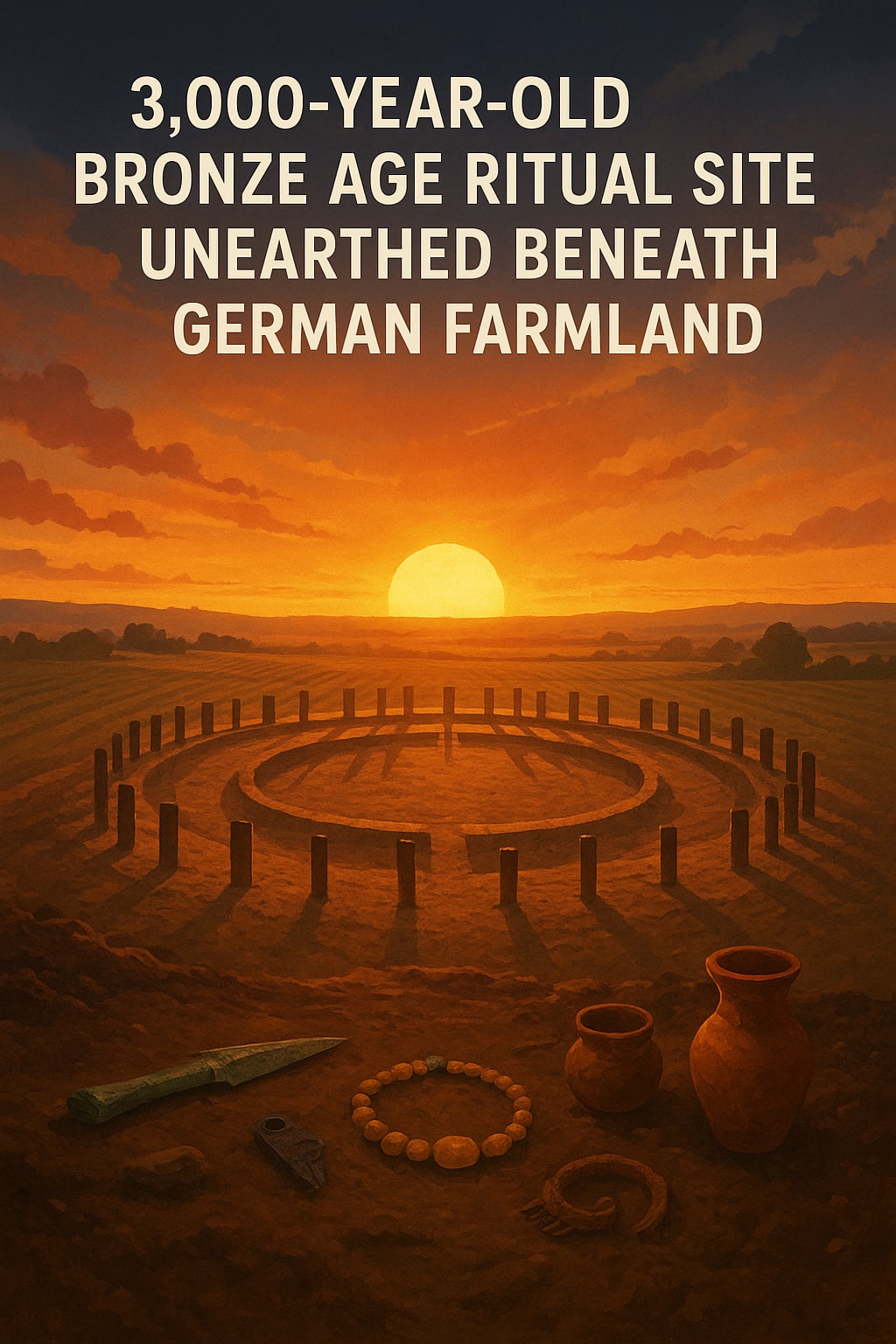
The site was found near the town of Schleswig-Holstein, during an archaeological survey ahead of construction work. What first appeared to be faint soil discolorations soon revealed something extraordinary: a series of concentric circular ditches and wooden postholes, covering nearly an acre of land.
Radiocarbon dating of charcoal and bone fragments indicates the structure was built around 1100 BCE, during the later Bronze Age. Archaeologists believe it served as a ritual complex and solar observatory—a sacred space where seasonal ceremonies, burials, and astronomical observations were performed.
When computer models reconstructed the original post layout, researchers discovered a stunning pattern: openings in the rings perfectly aligned with the sunrise and sunset on the summer and winter solstices. This means the people who built it tracked the movements of the sun with incredible accuracy.
A Bronze Age Calendar in the Soil
The circular sanctuary likely functioned as a solar calendar, helping communities mark the passage of time, agricultural seasons, and religious festivals. On specific days of the year—particularly the solstices—sunlight would pass through wooden corridors and illuminate sacred spots within the circle.
To the people of the Bronze Age, these moments were not just astronomical events—they were spiritual gateways, marking times when the world of humans and gods briefly touched. Ceremonies may have included offerings, feasts, or processions timed precisely to the sun’s position.
Archaeologist Dr. Anna Kühlmann, who leads the excavation, described the site as “a theater of light and shadow, built to honor the cosmic order.”
Burials and Offerings of the Ancients
Excavations at the site have revealed cremation urns, bronze tools, animal bones, and fragments of decorated pottery. Some graves contained offerings such as bronze rings and beads—objects believed to protect the dead or guide them into the afterlife.
Evidence suggests that this sanctuary was used for both ritual gatherings and funerary ceremonies. The presence of human remains near solar alignments hints that death and rebirth were central themes—perhaps symbolizing the endless cycle of the sun.
Archaeologists also found traces of ancient fires, suggesting that ceremonial burning took place during significant solar events. In many Bronze Age cultures, fire symbolized purification and divine presence, linking the earthly and celestial worlds.
A Network of Sun Sanctuaries Across Europe
This discovery adds a new chapter to the story of Europe’s ancient solar monuments. Across the continent, similar circular enclosures have been found—from Stonehenge in England to the Goseck Circle in eastern Germany and the Tiel Sanctuary in the Netherlands.
All share a remarkable commonality: alignment with the sun. These sites demonstrate that Bronze Age societies across Europe, though separated by language and distance, were united by a shared cosmic worldview.
They were farmers and metalworkers, but also sky-watchers and philosophers, who understood that the heavens governed the rhythm of life. The new German discovery strengthens the idea that these cultures exchanged not only goods but knowledge of astronomy and sacred architecture.
Clues to a Connected Bronze Age World
Among the most intriguing finds were fragments of a bronze blade and amber beads, possibly traded from the Baltic coast. These artifacts suggest that the people who built the sanctuary were part of a wide-ranging trade network, exchanging materials and ideas across Europe.
This reflects a world far more connected than we once imagined. Even 3,000 years ago, communities across vast regions shared ritual practices, artistic styles, and cosmological beliefs—a prehistoric form of globalization.
Echoes of Faith and Sky
Standing within the reconstructed circle today, one might imagine the scene long ago: priests and villagers gathered at dawn, their eyes fixed on the glowing horizon. As the first beam of sunlight pierced the wooden posts, it would fall upon an altar or a burial mound—a sign that the gods still watched over them.
The sanctuary was not merely a place of worship. It was a living calendar, a bridge between life and death, and a monument to cosmic order.
Preservation and the Future
German authorities are now working to preserve the site digitally, using 3D mapping and virtual reconstruction to share it with the public. Some artifacts will go on display in regional museums, while replicas may be built to illustrate how the original circle functioned as a solar observatory.
Archaeologists hope the discovery will inspire new interest in the Bronze Age civilizations of northern Europe, showing that these early societies were as intellectually and spiritually complex as any that came after.
Conclusion:
The unearthing of this 3,000-year-old ritual site beneath German farmland reminds us that even in prehistory, humans sought to understand their place in the cosmos. The builders of this sanctuary, armed only with wooden posts and stone tools, achieved something extraordinary—they captured the rhythm of the sun and made it sacred.
About the Creator
Nizam Archaeologist
I’m deeply fascinated by archaeology and the mysteries of ancient civilizations.My goal is to bring the past to life, spark curiosity, and share the wisdom of cultures that have stood the test of time.
Keep reading
More stories from Nizam Archaeologist and writers in History and other communities.
Architect or Archaeologist
Throughout history, humanity has been defined by its relationship with the built world. From the towering pyramids of Egypt to the gleaming skyscrapers of modern cities, every stone, brick, and beam tells a story about who we are — and who we aspire to be. Two professions stand at the heart of this human story: the architect and the archaeologist. Though their roles may seem opposite — one builds, while the other excavates — both share a deep passion for understanding and shaping the human experience through structures and space.
By Nizam Archaeologist3 months ago in History
Frozen Ground
Silence meant the guns were cooling. It meant men were waiting. It meant something was about to break. We were dug in along a frozen stretch of road near the Imjin River, the kind of place that didn’t look important until history decided otherwise. The cold wasn’t just uncomfortable—it was personal. It crept into your boots, your bones, your thoughts. At night, I dreamed of heat: radiators, kitchens, the smell of coffee. I woke up with frost on my helmet.
By Gaofeng Wang6 days ago in History
A massive underwater stone wall that is almost 7,000 years old is found by divers.
One of the buried stone monuments on Sein Island is a granite wall off Brittany that is more than 7,000 years old and the length of a football pitch. The discovery is being used by marine archaeologists in the vicinity of Île de Sein to explain how stone-built coastal villages predate the widespread spread of farming.
By Francis Dami5 days ago in History
Miss Persephone's Manual to a Seemingly Ordinary Life
Miss Persephone was found at the dining table, her blue eyes swollen, her tears arriving and retreating like the tides of the ocean. Earlier that day, her family had visited her in the retirement home where she had lived for eight years. It was her eightieth birthday.
By Imola Tóth2 days ago in Fiction


Comments
There are no comments for this story
Be the first to respond and start the conversation.