
20 Years After 7/7: What the UK Learned from the London Terror Attacks
Exploring the long-term impact of London’s deadliest terror attack and how it changed the UK forever.

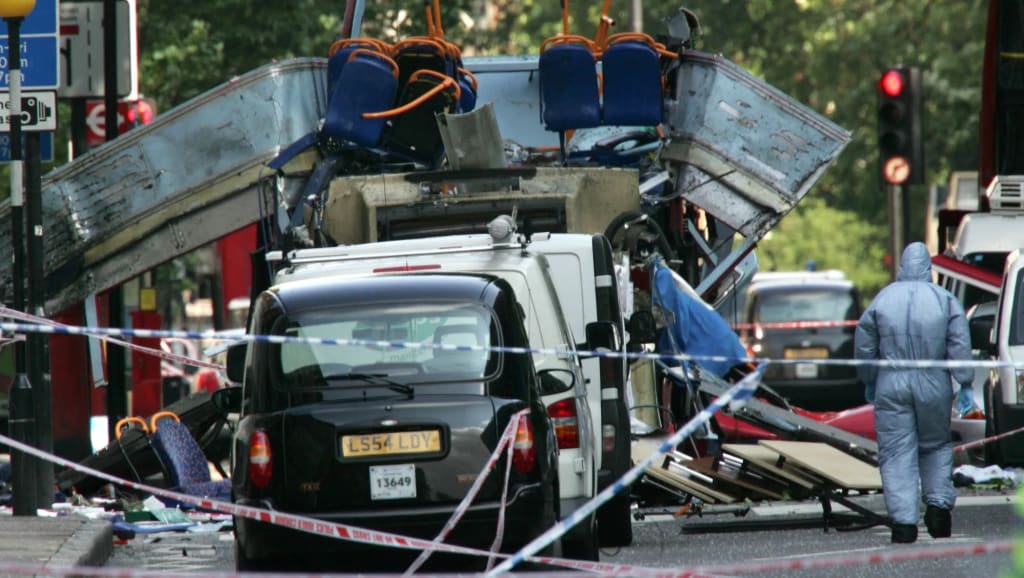
On the morning of July 7, 2005, London was brought to its knees. In just under two hours, a coordinated suicide bombing campaign killed 52 people and injured more than 700 others across the city’s public transport system. Three bombs exploded almost simultaneously on the London Underground during rush hour. A fourth was detonated an hour later on a double-decker bus in Tavistock Square.
It was Britain’s deadliest terrorist attack in decades. But it wasn’t just the scale of the violence that stunned the country—it was the identities of the men behind it. All four bombers were British citizens. All four were young. And all four were radicalized not in the training camps of Afghanistan or the deserts of Iraq, but in the towns and communities of West Yorkshire.
This wasn’t just a tragedy. It was a wake-up call. And what followed was one of the most far-reaching reassessments of national security, community policy, and British identity in modern history.
Two decades later, we’re still living with the consequences of that day. Some of those consequences are visible—in airport security lines, in surveillance cameras, in counter-extremism programs. Others are quieter, embedded into policies, public memory, and the uneasy equilibrium between security and liberty. This article explores what, exactly, the United Kingdom learned from 7/7—and what it still hasn’t.
The Day Everything Changed
At 8:50 a.m., bombs exploded on three separate trains on the London Underground:
Between Liverpool Street and Aldgate
Between King’s Cross and Russell Square
Near Edgware Road Station
Less than an hour later, at 9:47 a.m., a fourth attacker blew himself up on a bus at Tavistock Square.
The attack was precise, deadly, and coordinated. It paralyzed the city, shut down transport systems, and threw emergency services into chaos. But the true shock came not in the form of destruction—it came from discovery.
The bombers were not foreign infiltrators. They were not smuggled across borders or trained in camps. They were British-born. Educated in British schools. Raised in British communities. And yet, they came to see their own country as an enemy worth killing for.
This revelation shattered long-standing assumptions about terrorism in Britain. For years, it had been treated as an imported threat. On July 7th, 2005, it became undeniably homegrown.
Rethinking Intelligence: From International to Local
One of the most immediate revelations after the attacks was that MI5 had actually been aware of at least one of the bombers. Mohammad Sidique Khan, the group’s ringleader, had been photographed during surveillance of another suspect in 2004. He was flagged. But judged to be a low-level concern. That misjudgment proved fatal.
In the aftermath, the UK’s intelligence community came under heavy scrutiny. It wasn’t just that they had missed something—it was that their entire threat model was out of date. The enemy was no longer “out there.” It was here, walking the same streets, carrying the same passports.
The government responded swiftly. Intelligence services were expanded. The Joint Terrorism Analysis Centre (JTAC) was created to centralize threat assessments. MI5 revised its approach, focusing not just on known extremists, but on the pathways to radicalization. Surveillance became more predictive than reactive.
By the end of the decade, the intelligence landscape of Britain had changed entirely. The goal wasn’t just to find terrorists. It was to find out how they were made.
The Rise of CONTEST: A Four-Part Blueprint for Safety
In response to the 7/7 attacks, the UK government rolled out a comprehensive counterterrorism strategy known as CONTEST. It was divided into four strands:
Pursue – Stop terrorist attacks before they happen.
Prevent – Stop people from becoming terrorists in the first place.
Protect – Strengthen potential targets, from transport to cyber systems.
Prepare – Ensure the country can recover quickly from an attack.
Each of these strategies had practical applications, from new laws to local education efforts. But none became more controversial than “Prevent.”
The “Prevent” Strategy: Necessary or Nefarious?
The idea behind Prevent was simple: if people could be radicalized, they could also be de-radicalized—or better yet, never radicalized at all. The UK would work with schools, communities, and religious groups to identify signs of extremism early and intervene before violence ever happened.
In theory, this made sense. In practice, it was a minefield.
Critics called Prevent discriminatory and overly focused on British Muslims. Some schools began reporting children for saying things deemed “suspicious.” Others felt they were being turned into spies, forced to monitor students for political views or religious behavior.
Prevent was accused of creating a culture of suspicion, of alienating the very communities it sought to engage. And while reforms have softened its more controversial edges—expanding to include far-right extremism, increasing voluntary participation—it remains one of the most debated policies in Britain’s post-7/7 landscape.
Surveillance and the Privacy Dilemma
Few countries embraced surveillance as intensely as the UK did after 2005. London, already one of the most monitored cities in the world, saw an explosion of CCTV cameras in public transport, high streets, and neighborhoods. The government pushed for new powers to access digital communications, leading to laws like the Investigatory Powers Act 2016, often referred to as the “Snoopers’ Charter.”
Supporters argued this was the cost of safety. Critics warned of creeping authoritarianism.
The fundamental tension remained: How do you keep people safe without watching everyone all the time?
The UK is still answering that question.
Emergency Preparedness: Learning on the Run
The 7/7 attacks also exposed massive gaps in emergency coordination. Underground tunnels had no radio communication for first responders. Ambulances couldn’t reach victims fast enough. There was confusion over who was in charge.
In the years since, the UK has dramatically improved its ability to respond to mass casualty events. Signal boosters were added to the Underground. Joint training exercises became routine. Protocols were streamlined and clarified. Public campaigns like “Run, Hide, Tell” gave civilians basic tools to survive during an attack.
The message was clear: In a crisis, every second counts—and every person matters.
Fighting Radicalization Online
While the 7/7 bombers were radicalized offline—through meetings, literature, and local sermons—the internet would soon become the dominant recruitment tool for terrorist groups.
YouTube lectures. Facebook groups. Encrypted Telegram chats. Extremism had gone digital.
The UK created the Counter-Terrorism Internet Referral Unit (CTIRU) to track and remove extremist content. It pushed tech companies to police their platforms more aggressively. The Online Safety Bill sought to hold digital spaces accountable for harmful content.
But the internet is a Hydra. Cut off one head, and another appears. The battle against online radicalization remains one of Britain’s most urgent and complicated fights.
A Nation’s Grief, A City’s Resolve
In the hours and days after the attacks, London was not gripped by chaos. It was gripped by determination.
People returned to the Tube the next day. Offices reopened. Vigils were held. Messages reading “We Are Not Afraid” popped up in shop windows, bus stops, and newspapers.
While there were isolated incidents of backlash—mosques vandalized, angry rhetoric flung—there was no sweeping wave of violence, no major political overreaction.
In contrast to the U.S. post-9/11, Britain’s response was marked by stoicism over spectacle. The focus was on resilience, not revenge.
Changing Laws, Changing Lives
In the months after 7/7, the UK passed the Terrorism Act 2006, granting expanded powers to police and security agencies. It extended detention limits for terror suspects, made “glorifying terrorism” a criminal offense, and allowed for tighter control over extremist groups.
Immigration procedures became more rigorous. Visa screenings grew more intense. And even though the bombers were British-born, the link between national security and immigration grew stronger—a connection that would shape public discourse in the years leading to Brexit.
Community Engagement: From Policing to Partnership
If one lesson stood above the rest, it was this: You cannot fight terrorism without communities.
The years after 7/7 saw a rise in community-led initiatives. Local councils worked with mosques, youth groups, and former extremists to build relationships and open dialogue. Police departments created neighborhood liaison roles. The goal wasn’t to monitor—it was to engage.
Not every program succeeded. Trust is slow to build and easy to lose. But many argue this approach—seeing communities as partners, not threats—is Britain’s best long-term defense.
A Changed Country—Still Searching for Balance
What did Britain learn from 7/7?
It learned that terror doesn’t always come from “over there.”
That intelligence must evolve as fast as the threats do.
That safety and liberty are not always easy partners.
That resilience is built in back-to-back Tube rides, not just in headlines.
But the lessons aren’t static. Extremism is evolving again—shifting toward lone actors, conspiracy theories, and radical ideologies that defy easy categorization. The threat landscape of 2025 looks nothing like it did in 2005. But the foundational lessons of 7/7—vigilance, adaptation, and unity—still matter.
The question is: are we still listening?
Author’s Note: If you remember where you were on 7/7, you remember how the air felt different that morning. If you were too young or too far away, you’ve still lived in the world that attack created. This piece is a small attempt to reflect, record, and reckon with that day’s legacy.
About the Creator
Lawrence Lease
Alaska born and bred, Washington DC is my home. I'm also a freelance writer. Love politics and history.
Keep reading
More stories from Lawrence Lease and writers in History and other communities.
A Love Divided by War: Letters Between Mary Whitmore & Captain James Ellsworth
April 14, 1863 My Dearest James, I scarcely know where to begin, save to say that my heart is heavy with longing. It has been three months since you last rode away, and each day without word from you is an eternity. I sit beneath the old willow tree where we once lay, watching the Susquehanna drift by, and I wonder—do you still carry my ribbon in your pocket, as you promised?
By Lawrence Lease11 months ago in History
Rajendra Chola I and the Conquest of the Ganga: A Monumental Feat in Indian History
Known as the “Gangaikonda Chola” (the Chola who conquered the Ganga), Rajendra transformed a South Indian maritime empire into a pan-Indian power whose influence stretched from the Indian Ocean to the heart of the subcontinent. This campaign was not merely a military raid but a bold statement of imperial ambition, strategic brilliance, and cultural confidence.
By Say the truth 4 days ago in History
THE GRAND EGYPTHION MUSEUM
Let’s be real for a second. When folks hear "museum," they often think of dusty halls, dry information, and that odd quiet where you feel like you're misbehaving just for breathing. But the Grand Egyptian Museum isn't like that. I really don't think that's it. It's not accurate at all. This just seems wrong. This place is really nice. Egypt really shows us that it made history, and it keeps on doing amazing things.
By Beshoy Zayera day ago in History




Comments
There are no comments for this story
Be the first to respond and start the conversation.