

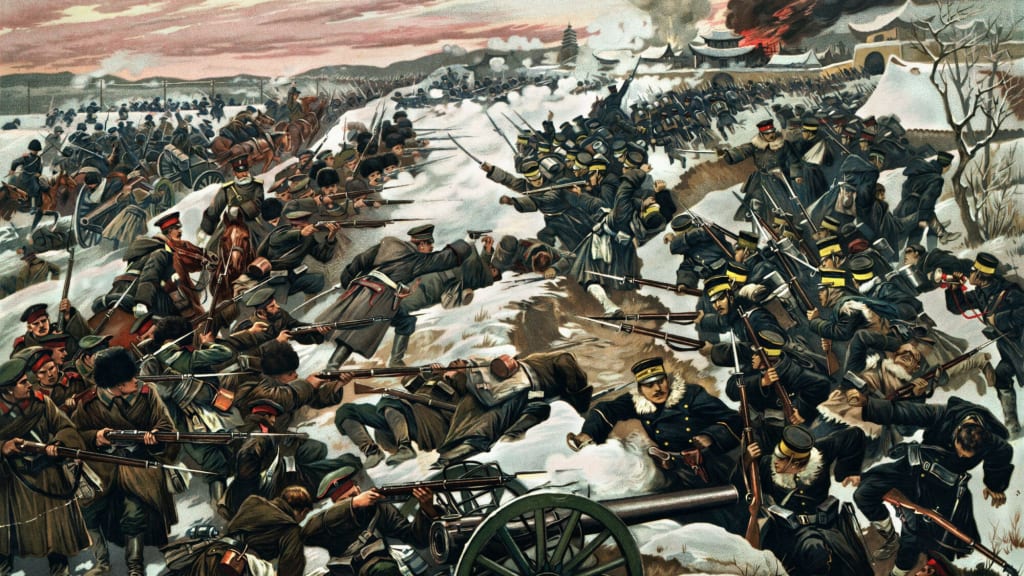
A harsh, whipping wind, a roaring howl, snow and ice battered against what was left of their thinning ranks. Sparse in this bombardment shells from Japanese guns pounded at the earth around them, tearing away patches and pieces of snow, uncovering the rich frozen earth beneath. Shells from cannon and gun tore pieces from the earth, puncturing new wounds into an already savaged land. The guns ripped and sundered the battlefield, earth and men thrown in vast array, hurled onto the freshly lain snow.
There they stood, amidst the withering fire—the last of the Mokshansky Regiment, the last defenders of Russia’s far east, the Tsar’s last hopes of empire in Asia, the last of the imperial army—the last to be surrounded On the Hills of Manchuria.
The enemy infantry began to advance, bright fervored eyes and bayonets glinting in the powdery wind, flashes of light and the unmistakable crack of rifles peppered their parapets, the machine guns had finally been brought forward, each one unleashing a rhythmic torrent of fire only adding to the cacophony of death.
Shatrov a young, patriotic bandmaster in the regimental orchestra struggled to maintain his nerve and footing, the Mokshansky’s were well entrenched in hastily dug fortifications, but as the long hours of battle raged on, and the enemy’s strength swelled, entire companies began to ran out of ammunition, whole sections of the line became incapable of responding to the overwhelming cascade of bullets cast to them from the flashing muzzles of thundering rifle and cannon.
Shatrov bore witness to the desperation of the men around him, soldiers scrambled to scavenge ammunition from fallen comrades, and did their best to salvage bandages and find melted water, conducting his band as best he could, Shatrov tried to maintain some semblance of morale, conducting such songs as to remind the men of home, of duty, and of imperial glory, but as the musicians lips froze on the brass of their instruments, and their throats became dry from sucking in the heavy, hostile wind, even they began to crack.
Shatrov himself began to doubt. He knew that if the Japanese chose to charge, that even the four thousand men of the Mokshans would be incapable of mounting any effective resistance, worse he knew that if for just a single moment, if the harsh wind were to subside and nature herself would relent, that the Japanese gunners would have clear sightlines of their ragged and strewn ranks. Shatrov knew however as many others did that they had no choice but to fight on, surrender was not an option. Their pride forbade it, and a final wintry death seemed all the more inevitable for them all.
Just then as the whole regiment began to draw from their draining reserves of ammunition, regimental commander Colonel Pavel Pobyvanets rode out along the line and gave one last desperate order; “The banner and orchestra will go ahead!, forwards brave Mokshans!” Shatrov was given the task of leading the advancing band with the battled imperial colors still proudly fluttering high above their dusted caps, the band assembled, and then with a swift order began to play; To the Glory of the Fatherland. Its powerful and swelling notes played with as much pomp as if they were on the parade ground, the musicians weak and wearied poured all of their waning strength into this one last song—a fitting overture to one last glorious charge.
The men, nearly driven by primal instinct, assembled into ranks, allowing their spirits to swell by this incredible display of bravery and defiance in the face of such an unrelenting attack. They surged forward in their hundreds, a ocean of paled uniforms converging onto one fortified point in the Japanese line, rifles fired the last of their remaining rounds, bayonets were wiped clean of snow revealing glimmering points of hardened steel.
The Mokshans charged with an almost feral, delirious ferocity, though weighed down by soaked gear, and fatigue, their heavy overcoats incumbering them with the weight of sweat and melted snow, nevertheless they still charged as if the snow were not there to swallow their legs, and as if they had not been stepping over the bodies of the previous fallen. Droves were cut down, the storm of bullets had not relented, rifle and machine gun dropped scores men left and right, yet more were there to replace them, each fallen man giving a stable platform for a comrade to take just another step forward.
Shells thundered through their ranks throwing men into the sides of their comrades, only to be picked up and urged forward again. At last the vanguard troops began reaching the Japanese lines, bayonets speared through Russian and Japanese alike. Officers, on foot and atop horse alike, clattered and sparred against one another with revolver and sabre. The brave Japanese defenders knew they could not resist such a violent onslaught, yet each man was still willing to fight to the last regardless of their odds.
The charge had already been desperate, now it became nearly suicidal, men threw themselves at bayonets, stormed gun emplacements, and poured into enemy trenches. By now the Mokshans were all but entirely exhausted, but so was the enemy. Eventually the Japanese ran out of reserves in the area to contest the breakthrough, and had no choice but to retreat and allow the regiment to escape. The Mokshans had broken through victorious, but at a horrifying cost, of the four-thousand strong regiment at the beginning of the battle, only 700 remained, the regiment was virtually annihilated, worn, and shattered. The survivors, already fatigued from the fevered charge they made, would have to make a mad dash to rejoin nearby Russian forces, leaving their thousands of dead behind with only a small prayer thrown to the wind to honor them.
The wind still howled, and the snow only fell harder, but now soft gusts blew through the open trenches and wound their way around the stocks of discarded rifles and disabled field guns. Crater, men, and cannon from both sides that could not be recovered were blanketed and concealed by a mournful layer of snow. The land would not recover for many years, and when the snow thawed in spring and summer, the evidence of battle would again be revealed.
Russia would soon lose the war in East-Asia, conceding Manchuria to the victorious Japanese, all they had done would be forgotten, for who at home would want to remember defeat? But for the men who had broken through, men who had lost close friends and comrades to those bloodied hills, they still remembered, and still they relived the battle day and night, still seeing the flashes of light, and the smell of death following them in their dreams. For bandmaster Shatrov he would go on after the war to write a popular but elegiac waltz fully titled “The Mokshansky Regiment on the Hills of Manchuria”, then shortened to just “On the Hills of Manchuria.” Shatrov himself would publicly dedicate it to a fallen comrade, forever commemorating their experiences on that storied day.
About the Creator
Ethan Lam
Hi, I'm a 17-year-old amateur writer who's trying to find both audience and feedback for my works! I mainly try to write historical narrations, fictional memoirs, and vignettes.
Keep reading
More stories from writers in History and other communities.
The Shadow of a Giant
I never met him. But I knew his voice. It came through our black-and-white TV in 1983, calm and steady, speaking of “morning in America” while my father fixed dinner and my mother worried about bills. To me, he was just a man in a suit—distant, polished, untouchable.
By KAMRAN AHMAD4 days ago in History
'20/20'
"Do It Again" the track that would ultimately open the Beach Boys final album on Capitol Records which was released on February 10th 1969 had originally been released as a single in August of 1968. The track was the first of many post-Pet Sounds era throwbacks to the early Beach Boys sound which would become continually more cliched and eventually lead the Beach Boys to the level of self-parody they would eventually succumb to in the 1980s while their closest contemporaries The Beatles nearing the end of their run in 1969 would go on to be viewed as the most influential band of all time. However, the song itself is not bad on its surface, and it opens with a futuristic sounding (for 1969) drumbeat captured by then-Beach Boys engineer Stephen Desper using tape delays on the drums performed by Dennis Wilson and John Guerin. The song has been re-recorded numerous times over the years on various Beach Boys-related projects most notably the 2011 re-recording at Capitol studios featuring the five surviving Beach Boys at the time backed instrumentally by various members of both the Brian Wilson Band and Mike Loves touring "Beach Boys" to promote the then upcoming Beach Boys 50th Anniversary reunion tour in 2012. The hammering and power drill sound at the end of the song was an excerpt from a track called "Workshop" that was to be a part of the uncompleted "SMiLE" album.
By Sean Callaghan6 days ago in Beat



Comments
There are no comments for this story
Be the first to respond and start the conversation.