
10 dangerous animals known for their ruthlessness towards their prey
amazing creators

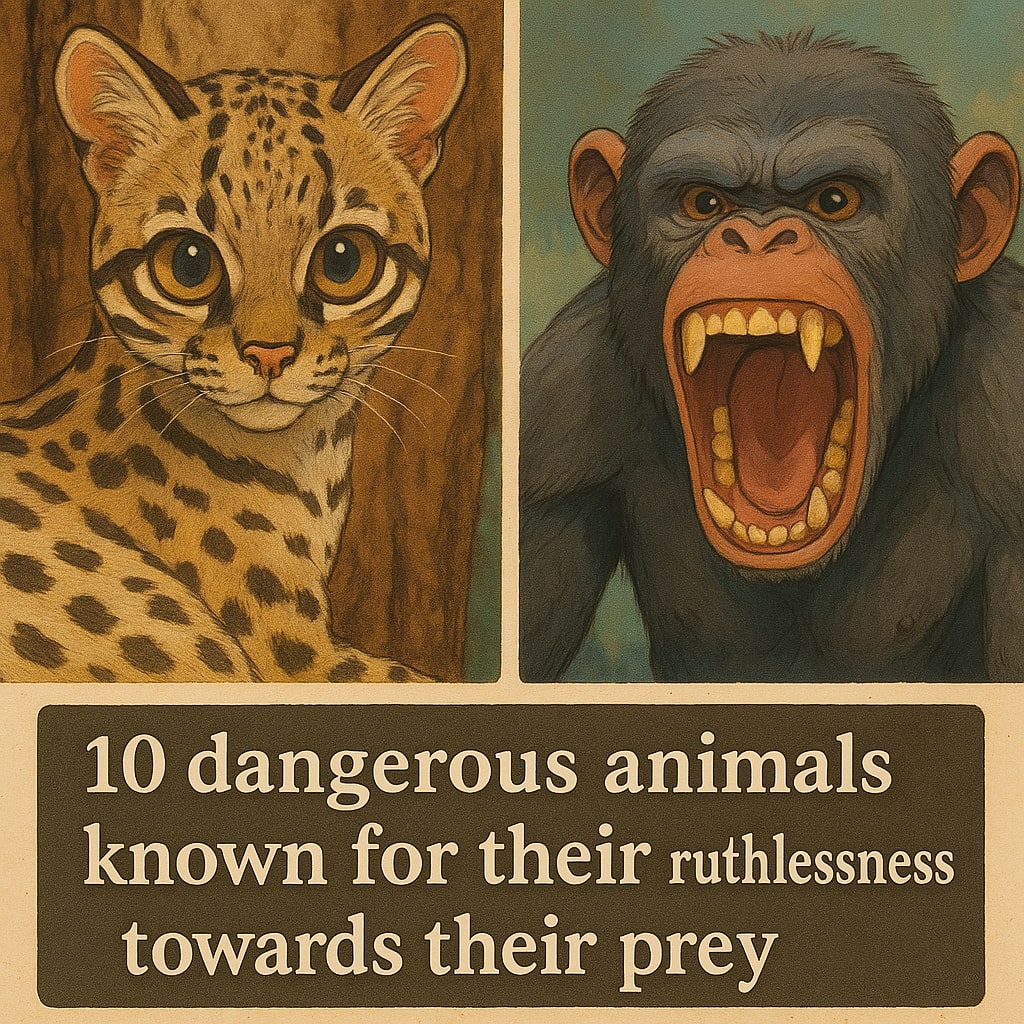
The features and features of nature are reflected on all living beings living in that environment, but by studying the behavioral patterns of some particular animals towards their prey, we find them to be of a ruthless nature and extremely ferocious. This is a list of ten absolutely ruthless creatures on our planet:
1. The killer whale
"Orcas", or as they are known as" sea wolves", these organisms hinder and obstruct their prey-which is usually whales - causing severe and dangerous harm, chasing them to the point of exhaustion until they prey on them, kill them and feed on their tongue and fat, leaving what is left for other fish that feed on the remains of these Carrion.
Killer whales or "orcas" are the largest members of the oceanic dolphin family, one of the most ferocious creatures on Earth. "Orcas" are also known as sea wolves, they not only hunt smaller prey than them, but also hunt and kill gray whales, as well as humpback whales and blue whales.
Orcas also hunt Dolphins where they cause serious spinal injuries by chasing and ramming them at a speed of 55 kilometers per hour and taking them out of the water, and orcas target vulnerable prey when chasing a large group of prey.
Scientists have noticed a specific pattern of hunting in these ferocious animals, where they start by ramming and biting the fins of the prey whale until it exhausts its energy, and when it weakens and starts slowing down, it pounces on its back and blocks its jetting hole. The hunt for "orcas" can also last for long hours, where they wait for their prey until they become helpless and drowned, and then they eat the most nutritious parts of it, namely the tongue and fat, and leave the rest to other fish simply.
2. Shrew (mouse-like)
"Shrew" is a small, mouse-like mammal with a short tail, which has a very high metabolic rate, poisons its prey very slowly and goes through the chewing process for a long time in order to satisfy its constant need for food.
The North American "shrew" leads a life with a fast rhythm, a heart rate of 800-1000 beats per minute, a very high metabolic rate, he needs food all day. These animals need food at a rate of about every hour, and if they can't get it, they may die, so they need to store some fresh food for a longer period of time when hunting is not always fruitful.
The "Shrew" has a poisonous gland, unlike snakes that have hollow fangs, this gland allows saliva to flow with the poison when attacking prey, as these glands cause a wound in the prey's body, which in turn allows its poisonous saliva to flow into the body but does not cause its death, but only anesthetizes and paralyzes it.
This poison keeps the prey alive for a long time until the "Shrew" needs food after a while. According to the report of the American Chemical Society, the "flour worm" can survive up to fifteen days from the moment it is exposed to the poison of the "Shrew" and its narcotic effect until the time when the Shrew needs food.
3. Bears
Bears have tremendous physical strength, their diet includes cereals, berries, insects, fish, birds and mammals. Their method of hunting is very painful for prey, they use their front claws to attack their prey and pounce on the neck or back of the prey without waiting for its death, which causes severe injury to the prey's spine, and this hunting technique makes bears one of the most cruel creatures on the planet.
Bears prefer to keep the body of the prey under several meters of moss or twigs and dust, and it was noticed that some bears at the beginning of Spring store the body of the prey under snow or even under running water. Bears often start eating their prey without waiting for its death by sticking their fangs directly into the neck or back area while alive.
4. Margi
"Margies" are wild cats that live in the forest and have wonderful imitation skills, as they imitate the sound of crying of young tamarin monkeys in order to keep their prey away from the rest of the group.
The "Margie" cat is considered one of the members of the multi-feature cat family, it is one of the smartest animals on the planet, it has the skill of imitating the sounds and calls of monkeys to attract them as prey, and the species of these cats still baffles researchers about their method of hunting, especially since they spend most of their lives on the tops of trees.
A researcher at the "Adelphi Duki" forest reserve noticed that a group of tamarin monkeys gathered under a fig tree around a food feast, and the "Margi" cat was near them and suddenly he heard a strange sound like a small crying "tamarin", so one of these monkeys moved away to look for the source of the sound and what was going on around them, and within one minute the "tamarin" monkeys began to move away quickly from their gathering place, when the "Margi" cat appeared there.
Although this fishing attempt was unsuccessful. But researchers reported that imitating the voices of young " tamarins "is one of the hunting techniques of the" Margi", thereby attracting prey to a more suitable location for the attack position.
5. Black Mamba
The "Black Mamba" hunts its prey to paralyze it, then waits for it to die a slow death, and then devours it completely. Cruelty and ferocity may be the best way to describe the Black Mamba when we talk about predation, if you want to invade the territory of the" Mamba "you have to be careful, as the actor (Liam Neeson) said in the movie Taken applies to these ruthless creatures:"they will look for you, they will find you, they will kill you".
Although its diet mainly includes small mammals and birds, there have been reports of the Black Mamba being encountered with the carcasses of a parrot or a whole Cobra in its stomach. Her jaws are flexible enough that she can take them off to get larger prey, equivalent to four times the size of her head.
Books by Adam J. Klein) in his book "Black Mamba", that these animals bite their prey, then inject it with poison, then leave it, and repeat this process several times until the prey is completely paralyzed-although the Prey does not need much time before death if bitten by a black mamba - and when this prey dies, the Mamba swallows it completely.
6. Epomys Beetle
The larva of the "ibomis Beetle" absorbs the liquid contained in the bodies of amphibians, secretes certain enzymes that dissolve their flesh, and then begins to chew it until it becomes a pile of bones.
The "cercum scriptus" Beetle and the" digeni beetle " are two species of beetles that live in the Middle East, and feed on frogs, tadpoles and some other amphibians, they are able to hunt even while they are in the larva stage, and are considered life-threatening to some amphibians when their development is complete.
Researchers (Jill wisny and Avital jasth) documented the method of catching the larva of the "ibomis Beetle" by luring frogs and pretending to be easy prey, as these amphibians feed on small insects and larvae. When the amphibian frog pounces on it with its sticky tongue, this larva clings to it and begins to suck fluids from its body, then secretes enzymes to dissolve its flesh, after which the lower jaw of the larva begins to work and continues chewing until it reaches the bones. When it is fully grown, it jumps on the back of its prey and paralyzes it after it bites it, where it keeps it as a food that it consumes in times of hunger.
7. Chimpanzees
"Herbivorous chimpanzees" and their subspecies, which are close to humans in the first place, kill and eat each other during conflicts for control of territories.
"Chimpanzees" have always been considered aggressive monkeys, but the fact of eating each other seems illogical, many do not know that they are carnivorous monkeys, and once they enter into a killing and conflict revolution, they are one of the most dangerous and cruel and ferocious creatures, and in some cases "chimpanzees" kill each other for power and dominance.
The "chimpanzee" monkeys challenge the inhabitants of the territories to which they have recently migrated and declare war on them, in order to demonstrate their power and authority. Anthropologists and zoological researchers have reported in many reports that, although the main goal of "chimpanzee" cruelty is to get more territory, resources and followers, she often enjoys killing a member of her own species and eating him piece by piece.
This fierce and brutal practice is a rarity even for the most ferocious animals, and the celebration of killing one of the members of their species and tearing it to pieces is considered beyond the limits of cruelty and ferocity, even these chimpanzees do not spare the young monkeys who accidentally pass between the combatants.
8. Sydney funnel-web spider
The "Sydney funnel-web spider", or as it is scientifically known as "Atrax robustus", is the most poisonous spider in the world, although it is small and does not look as dangerous as a tarantula or Black Widow, it is considered the most deadly. This spider is found in "Australia", and, undoubtedly, it is one of the most cruel and ferocious insects.
"Funnel-web spider" uses the element of surprise when catching. It suddenly ambushes the prey, and within seconds it injects it with a very strong poison, making it weak and unable to defend itself, and then it pulls the body of the prey and devours it in its burrow. Frogs, small lizards and some other insects are considered to be among the prey of the "funnel-web spider".
These small ferocious spiders can kill a person, their deadly poison only needs one bite to make a person lethargic and lazy, and in case the infected person does not get the antidote against him, the possible consequence is death.
9. African wild dogs
"African wild dogs" ferociously promise hyenas in the vast grasslands. When it comes to African wildlife, it's wise to stay away from it, the odds of passing by are deadly. This is the case with the "African wild dogs", they are very fast and can run at a speed of fifty-five kilometers per hour.
These dogs hunt their prey in all northern and southern" savannah " regions of sub-Saharan Africa, and are considered the four-legged angel of death in that region. And because of her extremely hungry state she can finish off a whole prey carcass in one meal.
These animals prefer open grasslands and other terrain that do not pose obstacles to running, since speed is an element of their strength. When roaming in groups, they only need to smell prey, and then they will tear their body apart and bite them with small bites, no matter what, which will cause them a slow, painful death.
10. The conical shell
The poison of many types of cone shells can kill a person in just a few minutes. These beautiful-looking shells are one of the most dangerous and toxic sea creatures. These varieties are famous for their predatory nature, as a poisonous harpoon is used to hunt marine animals. Its poison is deadly and deadly, as a large conical shell can kill a person. With a better developed tentacle, marine species can catch their prey more effectively and kill it mercilessly.
These shells do not need to be looked at, but a few slight vibrations by the prey are enough to send the tentacles injecting poison in its direction and the game begins. The poison of the cone shell is formed from thousands of different components, it is extremely toxic, as inevitable death is the fate of any marine organism as soon as it is exposed to it, effectively immobilizing the victim and killing him painlessly in a matter of minutes or even seconds.
About the Creator
ABDO
Professional article writer and designer.
This Little Light of Mine was written to praise Jesus
The subject of the light There are television commercials that use the chorus of This Little Light of Mine. The song is also used as a lulaby for children. I grew up at a time when children sang this song in church and it was understood that the "light" was Jesus Christ.
By Cheryl E Preston7 days ago in History
My First Time Skiing and I Got Lost, Alone, in the French Alps
Looking back, I can trace some of my life’s biggest adventures to a simple action from my sister. She’d introduced me to Tommy (a very long time ago), a colleague of hers, who had overshared his penchant for Italian-looking women, and I ticked that box.
By Chantal Christie Weissabout 15 hours ago in Humans


Comments
There are no comments for this story
Be the first to respond and start the conversation.