
Zero-Point Shift (2025)
When Memory Is the Only Weapon: A Taut, High-Concept Thriller That Rewrites the Past

Zero-Point Shift is not a film you passively watch; it’s a temporal puzzle box that you frantically attempt to assemble before the final credits roll. Director Anya Sharma, known for her minimalist and intensely character-driven work, has traded the quiet dramas of her past for a taut, high-concept thriller that is both structurally daring and emotionally devastating. The film takes place entirely within a sterile, subterranean research facility—a location that feels less like a lab and more like a high-end fallout shelter designed to keep the worst of the world out, or perhaps, keep its worst secret in. The production design, with its harsh fluorescent lighting and vast, cold steel surfaces, makes the environment feel less like a scientific venture and more like an interrogation chamber for the human psyche.
The premise is elegantly complex: Dr. Elias Vance (played with mesmerizing, twitchy anxiety by Liam Rourke) has perfected a machine, the "Chronal Resonator," capable of isolating and surgically editing memories. The technology isn't meant for therapy; it's a weapon. The government agency running the project, referred to only as "The Directorate," uses it to subtly remove the "Zero-Point" of traumatic national events, thereby shifting public consciousness and preventing future conflicts. The moral complexity is staggering: they erase sorrow and historical atrocity to ensure global stability and peace. Elias, we learn through fragmented flashbacks, was originally motivated by a personal tragedy, believing the resonator could heal. Now, he is the architect of mass amnesia, a position that has visibly broken him.
The film's tension is built almost entirely through its claustrophobic setting and Rourke’s performance. Elias is given a final, critical assignment: erase the memory of a disastrous, failed military operation, "Operation Icarus," that led to hundreds of civilian casualties and threatens to destabilize the agency. But his subject, former operative Agent Kaelen (a cold, relentless performance by Sarita Singh), has developed an insidious mental countermeasure. She doesn't fight the procedure physically; she corrupts the memory structure itself. Kaelen’s mind has become a labyrinth of false flags and booby-trapped recollections designed to destroy the Chronal Resonator—and Elias—from the inside out. Her passive resistance is far more terrifying than any overt action.
Sharma’s directorial choice to use the machine’s viewing screen as the primary way we, the audience, see the past is genius. We watch Elias and Kaelen battle in real-time, not with fists, but with emotional truths and fabricated history. Elias can manipulate the memory projection, inserting new details or deleting traumatic ones, but Kaelen's resistance causes the images to flicker and warp. The film visually distinguishes between the "real" memory (filmed in stark, high-contrast monochrome, often shaky and degraded) and the "altered" memory (filmed in lush, oversaturated color and unnervingly pristine), creating a disorienting, unreliable narrative. Is the violence Kaelen remembers—a sequence where she claims Elias authorized the catastrophic drone strike—an authentic horror, or a defense mechanism she’s installed to destroy Elias's credibility?
The script, co-written by Sharma and novelist Tamsin Blake, refuses to offer easy answers. Every line of dialogue is a potential misdirection; every edit Elias performs is immediately countered by Kaelen's silent, mental sabotage. The ethical weight of the project—the idea of sacrificing collective truth for tranquility—is constantly palpable, manifesting in Elias’s desperate attempts to rationalize his actions. He keeps whispering, "It's for the greater quiet," a phrase that, by the film's second act, sounds more like a prayer of self-absolution than a genuine political statement.
Zero-Point Shift excels as a profound examination of cognitive dissonance and the personal cost of mass deception. The film’s greatest strength is its ability to make the stakes feel intimate, despite the global implications. The true horror isn't the sci-fi technology; it's the realization that if your memories can be edited, your identity is only provisional, built upon the shifting sands of someone else’s political agenda. The final scene, which provides an ambiguity so chilling it will leave viewers debating its true meaning for days, doesn't resolve the paradox—it simply locks the box and throws away the key. Elias completes the mission, yet the very final shot is of him looking at his own reflection, which flashes briefly to Agent Kaelen's face. This is a rare example of a cerebral thriller that manages to be absolutely heart-pounding. See it twice; you'll need the second viewing just to check your own recollections.
By
Murad Ali Shah about 6 hours ago in Geeks
About the Creator
Keep reading
More stories from Murad Ali Shah and writers in Geeks and other communities.
The Catalog of Forgotten Things
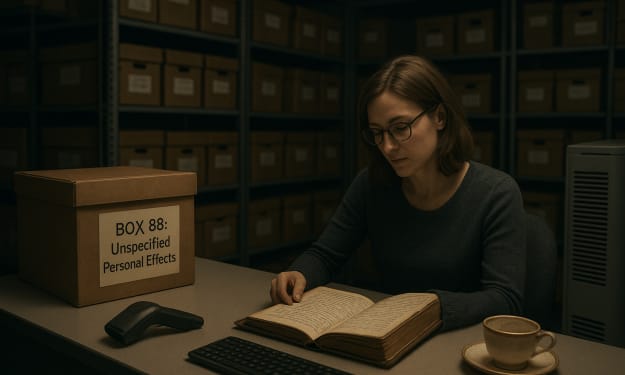
My job is, officially, the most boring job in the city. I am an Inventory Specialist for the Municipal Records Annex, which is just a pretentious way of saying I count boxes and make sure they match the number on the shelf. The Annex is a cold, dehumidified tomb of forgotten paperwork—old property deeds, decommissioned zoning maps, and decades of defunct library membership cards. My workspace is a small, gray cubicle next to a humming industrial air purifier; my soundtrack is the faint, rhythmic squeak of steel shelving under a heavy load.
By Murad Ali Shah4 months ago in Fiction
The Politics of Playing Dress-Up
Well, to start off I'd like to say a happy world book day to all who celebrate. I know I haven't really posted anything on my socials about it but I'm not a jubilant kind of person. I lay low most of the time. Let's start off with a popular anecdote from the vaults...
By Annie Kapur4 days ago in Geeks



Comments
There are no comments for this story
Be the first to respond and start the conversation.