
Wonder Woman 1984 and Excess
The Excessiveness of The Eighties to Today


Remember the eighties? The time of big hair, Wall Street tycoons who cannot profit enough, and the beginning of franchise films that could not stop milking the beast, think Friday The 13th, which had its seventh sequel by the end of the decade. It was no longer enough to have a great album with photos and a well-thought press campaign. Now you need a music video, nay, you need several music videos. Plus, you have to be good looking to help sell these new music videos. It is the time of cocaine, a drug that feeds your ego and narcissism. In return, this substance drives you to want more, more material goods, more ego, more cocaine, thus, putting you in a perpetual loop.
If you do not remember the eighties due to being too young or were born too late, that is fine. Many films, regardless of how fictional, can help capture an aspect of the eighties - Wallstreet and Scarface are good examples. Although not an eighties film, plus the film continues into the nineties, The Wolf of Wall Street is another example of this lust for more. Now, what does any of this have to do with Wonder Woman 1984, you ask?
Maxwell Lord

Recall Maxwell Lord's commercial in which he states, "Life is good! But it can be better. And why shouldn't it be? All you need is to want it. Think about finally having everything you always wanted." Keep in mind the eighties is a rather inward-looking, selfish time of tax-cuts for the wealthy, cocaine, and rampant consumerism. Hence, Lord is not speaking of better health, better relationships, better living conditions, or anything like that. He hones to your ego of the things you want, not need. Plus, he asks why should this hedonistic lifestyle not be more? It is as if one has an entitlement to this pleasurable lifestyle of riches and consumer goods. We see this in the film with many people's selfish wishes for fame and money.
The love of money or the love of more money is the root of evil, as many will say. We see this in Maxwell Lord's character. A man with an oil company he cannot get off the ground. Lord even depends on the 'pump and dump' scheme by lying to investors, selling them shoddy stocks at a mark-up to line his pockets. It is this kind of Ponzi scheme and many others that enriches Wall Street. The 1980s embrace laissez-faire capitalism, free trade, and supply-side economics. Hence, we get 'Greed is good.' Later, this trend gives us Black Monday and the Savings & Loan Scandal.
Without any oil, his business is going to go belly up. Finally, we see how he approaches matters with his son. Maxwell Lord has more concern for his son's approval and material well-being than his love. In one scene, Lord tries to make up to his son by buying a pony, only then to change his mind and request a racecar instead for his son. With this lust for more and more, we see the toll this takes on his health. He appears as a man who ages a decade and in dire need of a doctor. His nose bleeds, as does his ears, and constant sweating. Lord notices his desire for more is damaging his health. Unfortunately, this is only a roadblock to his dream! Now he works around this condition, depriving people of their health in his lustful appetite. In all of this, he overlooks the crisis on Earth with riots and impending nuclear war! Furthermore, he forgets about his son in his desire for more, more, more!
Cheetah

Barbara Minerva is your common, nerdy type girl, down on her luck. In the eighties, we begin to look upwards at people such as Leona Lewis or Donald Trump. Who are these people? These people are not all-star athletes, musicians, or actors. Their celebrity is simply that they are rich! Average Americans are hurting since the seventies with stagflation, which continues into the eighties as things only get better for the wealthy. Magazines hit the newsstands on all of our favorite movie stars and pop stars. In 1981, Entertainment Tonight debuts. People have a fetish, if you will, for the rich and famous. Barbara has the same problem when she meets Diana.
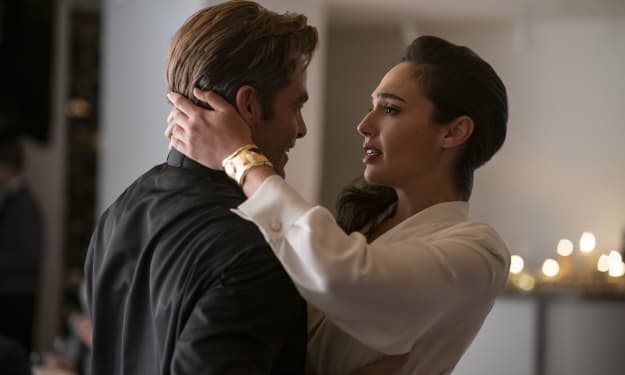
Of course, Diana is not famous, but she looks the part to your average person. This is fascinating since many of us may take a similar approach with the actress Gal Gadot. She is gorgeous, talented, famous, and wealthy. We may wish to be like her, just like Barbara Minerva does. Superficial details as these do not equate to happiness. Many accounts exist of celebrities, unhappy, who commit suicide. Barbara becomes more of the 80s pop, attractive model. She can walk in heels, wears a dress, and becomes more social. Yet, we all know this is not really her.
Many argue against her sudden change to Cheetah. One, Maxwell Lord offers her a free wish. With the setting and themes of this film, who turns down a free wish? Furthermore, she shows us that she is not against his plan either, as long as she still benefits. However, why a Cheetah is because she wants to be more, to be better, especially better than Wonder Woman. One way to better Wonder Woman is to evolve into something unhuman, something otherworldly. She wants to be 'an apex predator' as she puts it. The excess of this decade brings a predatory instinct. Go back to people like Maxwell Lord who prey on unassuming people, just so they can get rich. It is a survival of the fittest mentality.
What does Barbara's excess cost her? Throughout the plot we see her humanity dwindle. We see her give food to a homeless man, later on, to shrug him off when he is simply showing his concern, not knowing about what occurred between her and her assailant. She grows almost narcissistic, caring about what her co-workers and others think about her. A blind eye is turned towards all the suffering of the world, all because she feels better about herself. Her attitude and comments towards Diana derive from jealousy of her own misunderstanding of her friend. "You've always had everything while people like me have had nothing," reads like a person envious of your material worth and wealth. Yet, Diana does not live a lavish lifestyle. She does not even own a 19-inch television, even when offered one.
Today and Beyond

Another scene showing the filth of the excess of this decade occurs in the Oval Office. The President is well aware of what is happening in his country. Panic and pandemonium plague the streets. Maxwell Lord asks what he wants, for a moment, but we, the audience and the antagonist can only imagine the President wants peace for his nation. Instead, he asks for...more nukes. Honestly, this is quite historically accurate.
In the seventies, President Nixon gives us detente or an easing of tensions with the Soviets. After Vietnam, America's involvement in the Cold War declines. It appears as if the Cold War will slowly die off. President Reagan changes this after he wins the presidency. The Cold War returns with increased military spending, Reagan's Star Wars project, and his rhetoric towards the Soviets. At one point, it seems nuclear war is imminent with the Soviets for the first time in two decades.
We almost see this continue today in the United States. The economics of the eighties return, resulting in The Great Recession of 2007-2008. Similar to the President in Wonder Woman 1984, the President mishandles the situation. People are sick, dying, losing their homes, and their jobs. Instead of addressing such an issue, military spending receives higher priority. Critics of Wonder Woman 1984 are guilty as well.
Numerous complaints about the film, include its need for more Wonder Woman, more Cheetah, more action, etc. Hardly real critiques but nitpicks. However, this desire for more basic entertainment would not benefit the film. Mortal Kombat Annihilation packs plenty of action, with numerous fight sequences and characters in costume. When was the last time, if ever, you heard about this film? Many sequels in different genres and franchises are accused of doing the same thing again but just upping the ante'. For example, they can include more gore, more sex, more explosions, simply more, forgetting what made the first film a success and a beloved story to audiences.
Finally, it is not wanting about more but taking solace in what we have. Diana understandably, but selfishly wants the love of her life back, until she learns of the cost. She is content in her Washington D.C. apartment without a television. Never does she seek praise for her deeds as Wonder Woman. Our hero learns to find love and happiness in the world around her in what we already have. Maxwell Lord's son, Alistair, is not crazy about the material gains his father promises him. He wants a loving, meaningful relationship with his father, and selflessly wants nothing but happiness for him. If you cannot appreciate the message of the film, and still thirst simply for more, I fear you may not find happiness.
If you like what you read here, please feel free to leave a like and or a tip.
Other Wonder Woman pieces of mine...
Making The Case for Steve Trevor's Return
About the Creator
Skyler
Full-time worker, history student and an avid comic book nerd.
A Knight of the Seven Kingdoms Series Review (Season 1)
As one of the biggest properties in fantasy, A Song of Ice and Fire remains immensely popular with audiences. After reaching far into the past with House of the Dragon, a second spin-off was on the cards. A Knight of the Seven Kingdoms serves up a bite-sized slice of action and drama, but it still claims a spot among the best small-screen titles.
By Robert Cain7 days ago in Geeks
Doctor Who: My Top Picks For The Next Doctor
We expect it isn't for at least another few months until we find out who our next long-term Doctor is. Unless that big regeneration twist from last year's "The Reality War" means we won't find out until Christmas Day.
By Christopher Hales2 days ago in Geeks


Comments
There are no comments for this story
Be the first to respond and start the conversation.