
Who Are the Defenders?
Were they Marvel's true mightiest heroes?

The Marvel Universe was essentially created with a team book, "The Fantastic Four" in 1961. While Marvel actually started as Timely Comics, thriving in the 1940s with key heroes including Captain America, the original Human Torch, and Namor the Sub-Mariner Back then, the characters did interact, but they weren't a team until the 1970s, when they appeared as the Invaders, a book retroactively establishing them as a team fighting the Axis powers during World War II.
What set the Fantastic Four apart from the team books established by rival publisher DC, most notably the Justice League, was that the FF didn't always get along. Like a family, they squabbled, but they got the job done. This theme continued a couple of years later, when Marvel launched their own version of the Justice League, the Avengers. Dubbed "Earth's Mightiest Heroes," the team initially was comprised of Thor, Iron Man, Hulk, Ant-Man, and the Wasp, though Hulk left soon after the book was launched, replaced by Captain America.
Finding success with the team format, Marvel also launched the X-Men. The concept for that team, and the heroes on it, was entirely new. Unlike other heroes, who gained their powers by accident (The Fantastic Four, Spider-Man, the Hulk), by training (Hawkeye), or through science (Iron Man, Ant-Man), the X-Men were mutants, born with their abilities or developing them naturally over time. And the team was part of a school that taught mutants how to use those abilities. As with the FF and the Avengers, the X-Men didn't always get along.
While these teams all went through changes in the 1960s, that was essentially the constant concept for each of them. But by 1969 and 1970, things were changing. Comic audiences weren't kids anymore, they had become teens, college students, or young adults, and there was demand for stories that grew up with them. The fun, sometimes hokey stories of the Silver Age were giving way to more mature writing and longer stories of the Bronze Age, and the Defenders were part of that.
Dr. Strange had been established as a massively powerful part of the Marvel Universe soon after his introduction in the "Strange Tales" comic book, but that title was cancelled before a storyline could be resolved. So writer Roy Thomas resolved the storyline by having Dr. Strange team up with Hulk and Sub-Mariner in their own titles, and later, Hulk and Sub-Mariner worked with the Silver Surfer as a group called the Titans Three, fighting none other than The Avengers in that crossover.
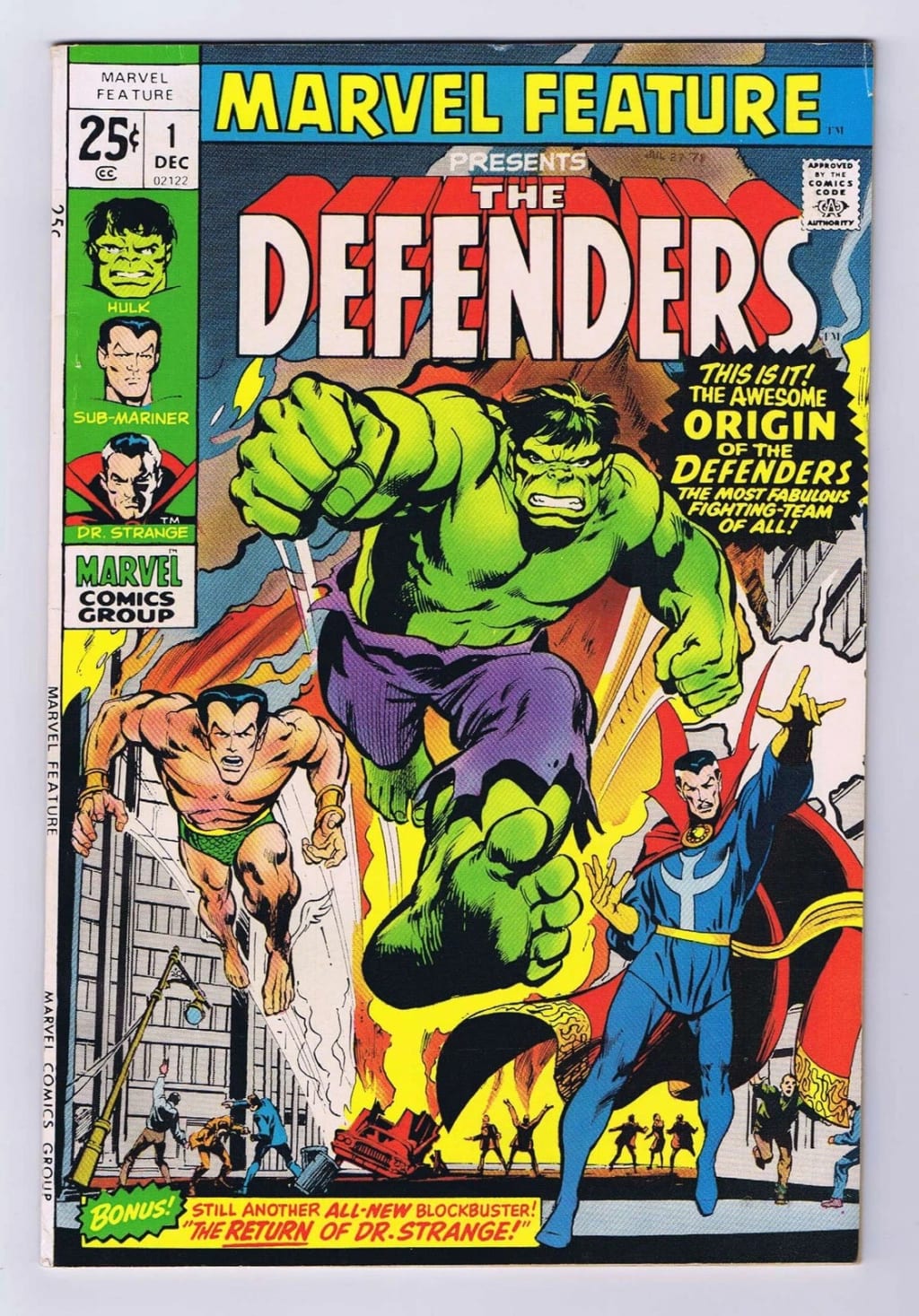
These storylines resonated with fans, and so the Defenders were born, first appearing in "Marvel Feature" #1 in 1971. The concept was simple. Facing a threat he couldn't handle alone, Dr. Strange enlisted the aid of the Hulk and Namor, who begrudgingly agreed, and when the mission was over, they went their separate ways. This was to continue to be the premise for their initial adventures in "Marvel Feature" and when they were given their own title, "The Defenders."
While Marvel was known for having teams that didn't get along, the Defenders took that to a new level. Dr. Strange was the de facto leader, but Namor is actually a monarch, and the Hulk typically does what he wants, so the team wasn't as cohesive as any of the other teams. There was also no headquarters or base, unlike every other team. Often, Strange would summon the others to the site of whatever conflict needed to be handled, or, later, they would meet at his house. No uniforms, no special vehicles, no government affiliations.
Also, with a lineup including two of Marvel's strongest characters (Hulk and Sub-Mariner) and one of the most powerful (Dr. Strange), the Avengers claim to be "Earth's Mightiest Heroes" came into question. This was even more the case when the Silver Surfer joined the team in issue #2.
Too much power
The challenge of such a team is obvious. With members that powerful, who would they fight? Initially there were various alien monsters and magical beings invading or threatening Earth who faced the team, but eventually the lineup changed, starting with the Valkyrie joining in issue #4.

Fans of the Marvel Cinematic Universe may be familiar with the modern version of the character, but the MCU version has little to do with the classic, original comic version. As in Norse Mythology, in the Marvel Universe, Valkyries are the shield maidens of Odin in Asgard. Essentially, they take the souls of dead warriors who have fallen in battle and bring them to Valhalla, where they wait until the end of the world, Ragnarok, when they will fight alongside the Valkyries and Odin against Loki and the assembled forces of evil.
This specific Valkyrie, Brunnhilde, is the leader of the Valkyries, and her spirit was joined with the body of a young mortal woman, Barbara Norriss, who encountered and joined the Defenders. As an Asgardian, Valkyrie has great strength and endurance, and is highly skilled in combat. Valkyrie is the only Defender to stay with the team until the title was cancelled, many years later.
Given the turbulent dynamics of the team, the Defenders began to be called a "non-team", with a rotating membership, which allowed for the more powerful members to drop out until needed, presumably to go about business in their own solo titles.
The next member to briefly join was Hawkeye, on a break from the Avengers. He was a Defender long enough to actually fight against the Avengers in one of the greatest crossovers in Marvel history, the Avengers-Defenders war.
Avengers vs. Defenders

Marvel had been doing crossovers here and there essentially since they started. To promote a new book, stars of another book would show up to build interest, such as in "The Amazing Spider-Man" #1, which had the Fantastic Four prominently on the cover and in the story. However, crossover events were a rarity, and to this day, the Avengers-Defenders war ranks among the best of them.
In the story, both teams, at roughly their most powerful lineups, are trying to retrieve pieces of an artifact called the Evil Eye. Each team has their own motives, and the super-villains Loki and the Dread Dormammu are manipulating things from behind the scenes, but all of that is secondary to the coolness of seeing matchups such as Iron Man vs. Hawkeye, Silver Surfer vs. Vision, and the best Thor vs. Hulk battle of all time. The story has been reprinted in various collections. Track one down and read it, you won't be disappointed.
Core team forms

After the crossover ended, Silver Surfer left and the Defenders added another new member, Nighthawk, to the team. In the Marvel Universe, fans' desire to see the Avengers fight DC's Justice League with the creation of the Squadron Sinister, a team of villains from an alternate reality. Each member of the Squadron had powers and a name similar to the Justice League, allowing Marvel to pit first the Avengers, then the Defenders, against the Squadron, to show how such clashes might play out.
The Squadron equivalent of Batman was Nighthawk, who, like Batman, was a millionaire with a technological costume and fighting skills. After clashing with Daredevil and the Defenders, Nighthawk swtiched sides, joining the Defenders as a hero. Unlike Batman, Nighthawk's costume included jet-powered wings, sometimes tipped with lasers, that enabled him to fly. Later, Nighthawk tried to formalize the Defenders as a team, providing them with a high-tech headquarters and acting as their leader, but for most of his time on the team he was a stable mainstay, coming on board as Namor cycled out, creating a core team of Dr. Strange, Hulk, Valkyrie, and Nighthawk, a team powerful enough to handle most threats, but sometimes in need of augmentation.
This included adding Luke Cage, Power Man, who was a logical addition to the team, since Cage was literally a Hero for Hire. Cage had previously worked with the Fantastic Four when they were in need of a replacement for the Thing. Following suit, Cage was available to the Defenders simply by looking him up in the phone book.
Like Hawkeye, founding Avenger Yellowjacket (formerly Giant-Man, originally Ant-Man) worked with the Defenders for a bit before returning to his regular team.
Daredevil, Moon Knight, and Daimon Hellstrom, the Son of Satan, also worked with the Defenders off and on. In the case of Daredevil, it was logical to have him interact with the team since Steve Gerber was writing both books. Gerber also had the Defenders meet up with the original Guardians of the Galaxy (not the more modern MCU team) and even Howard the Duck as he wrote each of their respective titles. Howard's appearance was brief, but it happened.
Moon Knight actually stuck with the team for a bit, while Daredevil and Hellstrom were more or less reserve members, called upon when the core team were incapacitated. Hellstrom would become a regular member of the team later.
Formation of the classic team

In issue 35, the new Red Guardian, Tania Belinskaya, joined the Defenders. Again, if you're familiar with the MCU you may be familiar with the Red Guardian, but this was not the same member who was a Defender. As in the MCU, the Red Guardian was the Soviet Union's version of Captain America, and a male. Unlike the MCU, he wasn't Black Widow's father, he was her husband, long-thought dead (thus her name the Black Widow). This Red Guardian was his successor, a female in the same role, who joined the team for a time but who has largely been forgotten.
Much more memorable and significant was Patsy Walker, the Hellcat. Back in the days when Marvel produced romance and humor comics to compete with the Archie line of comics, one of the more popular titles featured Patsy Walker. In the 70s, Patsy was grown up and married, but her marriage was not a good one. In the pages of Amazing Adventures, she became friends with the X-Man Beast, who recently had become furry and started a series of solo adventures. When Beast joined the Avengers shortly thereafter, Patsy also encountered the Avengers, discovering a combat suit that she donned to help them on their mission. Adopting the name Hellcat, she became a probationary member, working with the team for a time until she encountered the Defenders.
For a time, Hellcat used her Avengers priveleges, including use of a quinjet and security clearance, to help the team, before she finally left the Avengers to become a full-time Defender, finding the dynamics of that team more to her liking.
In her combat suit, Hellcat has razor-sharp claws in her gloves and boots, enhanced agility, combat skills, and a grapple line that extends from her gloves, enabling her to tangle opponents or swing around.
With the addition of Hellcat, a new core team was created of Dr. Strange, Hulk, Valkyrie, Nighthawk, and Hellcat. Over time, Dr. Strange would leave the group, leaving a very stable four-member roster. The irony of this period was that Hulk was seen as too volatile to be an Avenger. But he was the longest-serving member of the original Defenders cooperating perfectly well with the other members of the team, who adapted to both his temper and the childlike mind of the classic phase of the character.
This phase of the team was fairly stable for years, with members like Dr. Strange and Namor cycling in and out, as well as other guest stars and temporary members. When written by Steve Gerber, the book frequently featured wacky yet formidable villains such as the Headmen, as well as bizarre elements such as the Elf With a Gun, literally an elf who would appear at a random location, pull out a gun, and kill someone. These elements added to mystery, humor, and intrigue on the book, as they did on other books he worked on, such as "Man-Thing" and "Howard the Duck," but when Gerber left the book, later writers struggled to tie up the loose ends.
In interviews after the fact, Gerber revealed that there was never supposed to be an answer to who the Elf With a Gun was, or why he was killing people. Like other things Gerber introduced, such as the character Manslaughter, he was supposed to represent chaos in the world, with the Elf being the ultimate representation. He truly had no reason for why he showed up or who he was killing. It was all just random, like a cosmic freak accident.
Decline and later years
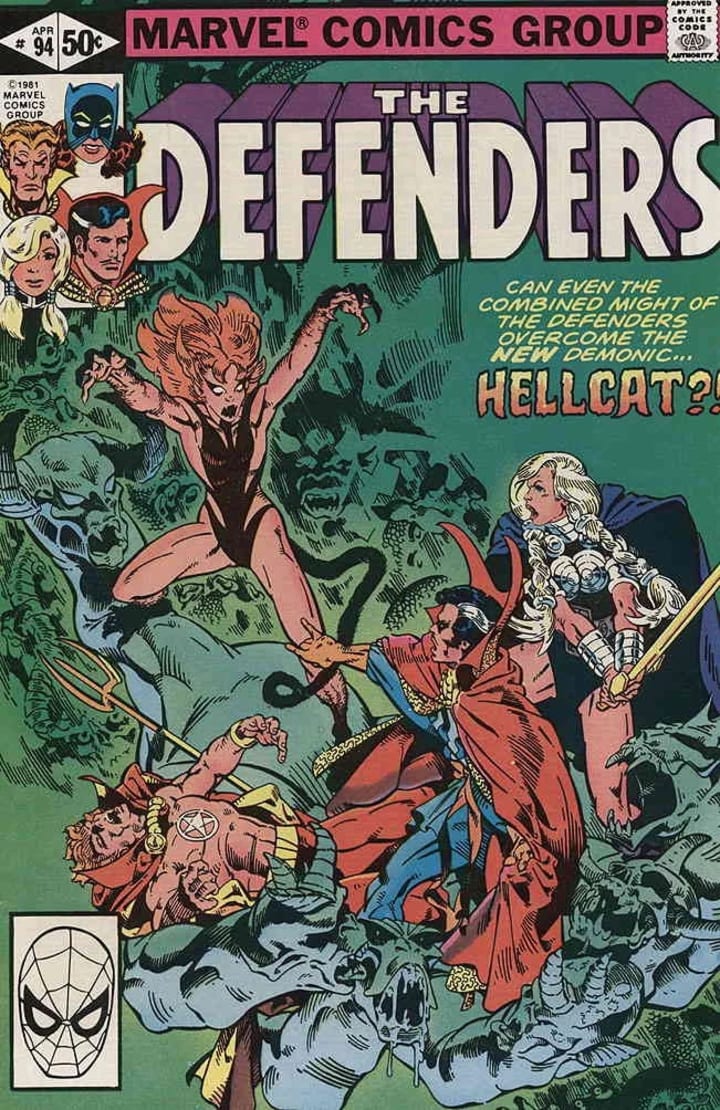
Other writers tried to find a role for the Defenders in fighting magical threats, which made some sense. The Fantastic Four faced cosmic threats, as did the Avengers, who also faced global threats. The X-Men fought evil mutants, or threats to mutantkind. That left the Defenders as a support team for Dr. Strange, who in his role as Sorcerer Supreme, protected Earth and our reality in general from magical threats, including demons.
While Namor and the Hulk were still featured in the book from time to time, particularly when sales needed a boost, the core team shifted. Daimon Hellstrom, the Son of Satan, became a regular member, eventually starting a romance with and marrying Hellcat. Hellstrom is a paranormal investigator and demonologist who is quite literally the Son of Satan, fighting his father, other demons, and Satan's followers on Earth. Hellstrom has enhanced strength, spellcasting ability, and abilities granted him through a mystic trident, including the ability to wield hellfire.
Hellcat and Hellstrom were an odd match because, despite her codename, Patsy Walker was never a grim, brooding character. Never an antiheroine. She was always upbeat, fun-loving, and thus a fun match for Beast when they were both on the Avengers. In contrast, Hellstrom had a very evil part of his soul he continually struggled with. Years later, in his own "Hellstorm" series, it would be revealed that the marriage didn't go well for Patsy and Daimon's dark nature took a toll on her sanity, to tragic end.
In one of the team's encounters with demons, they met the Gargoyle, an aged veteran of the First World War trapped in the powerful but hideous body of a demon. Gargoyle went on to join the team, and he stayed for years, until the book was finally cancelled.
With issue 104, the Beast and Wonder Man appeared. Beast had recently left the Avengers, and, always feeling more comfortable in a team, he opted to join the Defenders after helping them in yet another fight against demons.

Eventually the demon stories petered out and the Defenders tried to get back to their roots with a mix of new and old members, but the magic was largely gone. Still, fans liked the book well enough to keep it around. Thus, a major retooling.
The New Defenders

In "Giant-Size X-Men" 1, the new team of X-Men (Nightcrawler, Storm, Colossus, Wolverine, Banshee, Sunfire, and Thunderbird) were introduced, brought on board to rescue the original team. In "X-Men" 94, the original team left, no longer students, to lead their own lives at last. Beast had already left for solo adventures, eventually joining the Avengers. Cyclops stayed to lead the new team, Marvel Girl, Havok, and Polaris went their own ways, while Angel and Iceman went to the West Coast, where by chance they joined Ghost Rider, Black Widow, and Hercules on a mission, creating the Champions. Angel bankrolled the team, providing headquarters and equipment and the team stayed together for just a few years, with the title getting cancelled just when it seemed to be getting good.
At the end of the Champions' run, Beast appeared as a guest-star, and the team fought classic X-Men villains the Sentinels. Angel and Iceman would appear in a few places, notably an Iron Man Annual and issues of "Peter Parker, the Spectacular Spider-Man" to tie up loose ends from the Champions, but this appearance of the three former X-Men set the stage for the next chapter in the mutants' lives, and the Defenders.
When a prophecy reveals that Dr. Strange, Hulk, Namor, and the Silver Surfer must leave the Defenders or the world will end, Valkyrie and Beast are left to reform the team, with recent recruit Gargoyle joined by Iceman and Angel as the New Defenders, launching officially in issue 125. Joined by former Avenger, the telepathic Moondragon, the team came together as a more formal unit, similar to the Champions or Avengers, operating out Angel's home in the Rocky Mountains.
The series continued with this lineup until it was cancelled with issue 152, with as definitive ending as teams are likely to have in the Marvel Universe.
Thought dead for years at the conclusion of the Phoenix Saga, Jean Grey was found alive in a cocoon at the bottom of the ocean. Upon hearing the news, former teammates Angel, Iceman, and Beast left the Defenders, joining their former leader Cyclops and Grey in a new team, X-Factor, while the remaining New Defenders seemingly died in their last mission.
Secret Defenders

Several years later when Marvel was flooding the market with spin-off books, mini-series, and anything else they could think of, they launched "The Secret Defenders", a book that had essentially the same premise as the original Defenders - a team, led by Dr. Strange, that gathered only when necessary, to handle missions Strange couldn't deal with alone. The difference was, this time instead of gathering the same, ultra-powerful heroes, Strange would gather a different team each time.
On the one hand, it was an excuse to put newer, gritty heroes like Darkhawk, Nomad, and the new Spider-Woman out in another book, alongside top-sellers like Wolverine, who, like Spider-Man, was already overexposed. Add in special foil covers now and then, and it would move books.
On the other hand, the quality of the stories was typically not good, as was the case for most of the books launched during this time, cash and quantity were put over quality, and it showed.
The book was revamped, with Dr. Druid, a creepy supporting cast, and guest stars taking the book in a new direction, one that led inevitably to cancellation.
Barring sporadic reunions of the original Defenders, the team was done for years. In terms of plot, there was a reason for this. Due to the prophecy around the original Defenders, the original trio of Namor, Dr. Strange, and the Hulk could reform from time to time, as long as their final member, the Silver Surfer, wasn't included. At this point, the Silver Surfer and the Hulk had successful solo books, while Dr. Strange's title had been cancelled and renewed yet again. With most fans interested in Spider-Man and the mutants, there was little demand for the Defenders, and there was still the problem of what a team with that much power could do.
The Order
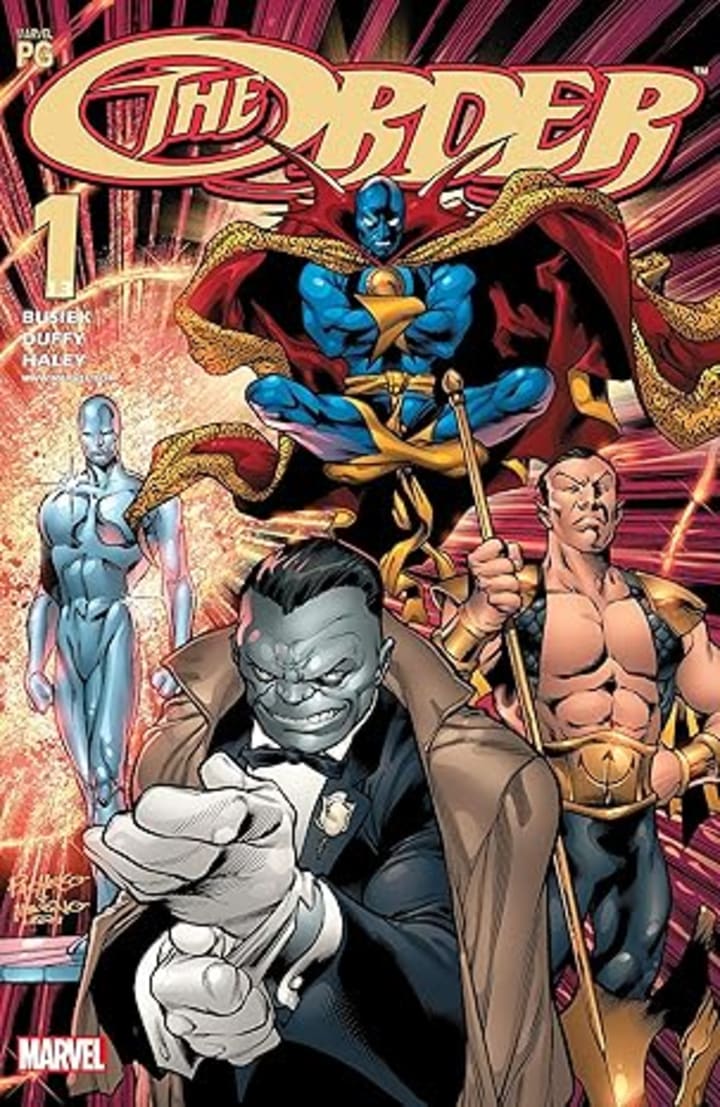
Writer Kurt Busiek, who, several years earlier had brought "The Avengers" back to a level of excellence many see as peak for the title, had the answer. Well-known as a comics scholar with a keen understanding of what makes teams and characters work, Busiek brought all of the classic Defenders back in a mini-series called "The Order."
Looking back to their first official mission, against the wizard Yandroth, Busiek created a story in which Yandroth gets his revenge against the group by playing against the one thing that makes them unique - they really don't like each other. When the Defenders regrouped to save Nighthawk and Hellcat from Yandroth, Yandroth lays a curse on them that forces them to come together when the Earth is in danger. That would seem to be fine, given their years of working together, but at this point the heroes have a lot going on in their lives, and they never liked each other much to begin with.
Busiek notes that each of the four founders - Hulk, Namor, Strange, and the Surfer - had at one time or another declared war on humanity, and each of them has had darker guises, such as Dr. Strange's masked persona, and Hulk's identity as the Grey Hulk, Mr. Fixit. Under the curse, these are the versions of the heroes we see when they are forced to join together. Worse, their reaction to the curse is to decide to force order upon the world, because they have the power to do so, to prevent them from having to be bothered.
The "little three" members - Valkyrie, Nighthawk, and Hellcat - also gather, creating a parallel team, including Clea (Dr. Strange's one-time student) and She-Hulk to help keep the other members in check.
It's the best story featuring the team since the glory days of the early 70s, and worth reading if you can find it. At the end of the series, the goddess Gaia lifts the curse and the Defenders go their separate ways.
In the years since, other teams calling themselves The Defenders have appeared, sometimes featuring one or more original members, but the series have all been relatively brief, never having the impact or longevity of the original title.
The Netflix team and the MCU

When the Marvel Cinematic Universe launched, things were immediately a bit different from the way they happened in the comics, with one key reason being character rights, and another being logistics. While the Fantastic Four launched the Marvel Age, movie rights to the FF, Spider-Man, and the X-Men were tied up with other studios, so the MCU as we know it today had to start essentially with the Avengers.
Meanwhile, Marvel launched a number of TV series on Netflix: "Daredevil", "Jessica Jones", "Luke Cage", and "Iron Fist". Eventually, all 4 heroes came together on a new show, "The Defenders," which took place in the MCU, though none of the characters appeared on the big screen until Daredevil alter-ego Matt Murdock appeared in "Spider-Man: No Way Home."
In terms of comic book continuity, Cage had been a member of the Defenders for a while before eventually partnering with Iron Fist for many years. Daredevil was an associate of the original team around the same time, but was by no means a regular member. Jessica Jones as a character wasn't even introduced until long after the team disbanded, and Iron Fist was only a member, along with many other heroes, for literally one day, in the "Defender for a Day" storyline lasting from issues 62-64. So essentially iteration of the Defenders has nothing to do with the classic Defenders, however, the MCU had room for another team, and it was a good way to bring the street-level stars of the Netflix series together and use the Defenders name. Marvel published a comic book version featuring the same team, written by Brian Michael Bendis, cocreator of the Jessica Jones character. It lasted 10 issues.
On the big screen, with the Avengers underway, Dr. Strange did eventually get his own films, and he came to work with both the Avengers and Spider-Man. However, film rights to Namor had been tied up for decades, so the Sub-Mariner didn't appear until "Black Panther: Wakanda Forever", and when he did, significant changes had been made to the character, deviating from his classic roots. The reason for that was to differentiate Marvel's Atlantean character from DC's Aquaman, who had already appeared in his own movie, as well as in DCU's "Justice League". The irony there is that historically, Namor was created and appeared in Marvel Comics before Aquaman debuted at DC. Aquaman was the rip-off, and Namor was always the more popular character.
Similarly, the Silver Surfer had already appeared in more or less his classic form in the film "Fantastic 4: Rise of the Silver Surfer". Now that Marvel has the legal right to feature the Surfer in the MCU, a female version of the Silver Surfer from an alternate reality appeared in "Fantastic Four: First Steps", which creates a path for all four original Defenders (plus Valkyrie, who first appeared in "Thor: Ragnarok") to be in a film at last. But there are currently no plans for such a film, and, unless the parallel universe card is played, if an MCU version of the Defenders were to appear, they would differ at least slightly from the classic team.
About the Creator
Gene Lass
Gene Lass is a professional writer and editor, writing and editing numerous books of non-fiction, poetry, and fiction. Several have been Top 100 Amazon Best Sellers. His short story, “Fence Sitter” was nominated for Best of the Net 2020.
A Knight of the Seven Kingdoms Series Review (Season 1)
As one of the biggest properties in fantasy, A Song of Ice and Fire remains immensely popular with audiences. After reaching far into the past with House of the Dragon, a second spin-off was on the cards. A Knight of the Seven Kingdoms serves up a bite-sized slice of action and drama, but it still claims a spot among the best small-screen titles.
By Robert Cain4 days ago in Geeks
SpongeBob Review
The episode "F.U.N." unfolds as a masterclass in character-driven comedy and narrative irony, centering on Plankton’s most hilariously transparent scheme to date. From the opening moments, the Chum Bucket’s oppressive gloom is a stark, almost visceral contrast to the sun-drenched, vibrant chaos of the Krusty Krab, a visual metaphor for the fundamental conflict between cynical ambition and joyful innocence. Plankton, tiny and vibrating with a fury that seems to distort the very air around him, constructs his "Friendship, U & Me, and Anywhere and Anytime" acronym not as a genuine olive branch but as a convoluted trap, his every syllable dripping with insincerity. The scene is a tightly wound spring of tension, as we, the audience, are complicit in the joke, watching SpongeBob—radiating pure, unadulterated optimism—plunge headfirst into the obvious snare with a trusting eagerness that is both exasperating and profoundly endearing.
By Forest Green7 days ago in Geeks
Flower Bloom 369
FLOWER Bloom 2/25/26 Wednesday By Mariann Carroll Karen had been with Tony for 7 years. Tony started acting strangely after her surgery. He would mow the lawn in the rain and be on his cellphone. He started pushing Karen away. Tony came clean about seeing someone. Karen moved out two months later. Karen moved in with a friend. She felt betrayed.
By Mariann Carroll6 days ago in Fiction


Comments
There are no comments for this story
Be the first to respond and start the conversation.