
Way more than some male protagonist's wife
The importance of the Bechdel test

Two satisfied stomachs and one and a half empty trays of pizza was what was left of an extremely Italian dinner between me and Elena, a friend from high school.
"Have you ever watched Mad Max: Fury Road?” Was the question that was thrown at me as I managed to clean up the kitchen table, my mind busy with the task to try to come up with a movie we could watch together (I’m an exquisite multitasker). “No, never heard of it” I replied absent-mindedly, “What is it about?”
Her reply came with a smirk: “It’s a brilliant and vivid portrait of the consequences of sexism and a celebration of feminism”. She answered me nonchalantly, as if she hadn’t just touched upon something that more less sounded like the coolest thing on earth. “I don’t know if you’d like it, though” she continued, “It takes place in a dystopian future”. Who cares? I thought. I mean, aren’t we talking about a movie that can make sexist men throw a tantrum just ‘cause?! Girl, I’m in. When Elena spiced the conversation up by hinting at the Bechdel test, I was completely sold.
Next thing I know, I am eager to know more about the subject. To sum it all up, the Bechdel test is a sort of exam every movie should undergo. If the film passes it, it means it contains at least two female characters, whose names are known, who have a whole conversation about anything but men. Interesting, right?
The main goal of this analysis is to study the way women are displayed in fiction and to take care of gender inequality. The Bechdel test turned out to be the starting point of a variety of new tests concerning other issues, such as the representation of people of color or components of the LGBTQ+ community.
At first I found it bizarre that the test focused on dialogues, rather than on the stereotypical roles actresses usually play or how poorly women are paid compared to their male colleagues (variations of the Bechdel test adopt similar criteria). But then it hit me: Quentin Tarantino’s Reservoir Dogs boasts a weird, hilarious, excellently orchestrated dialogue that made history. Two minutes and five seconds of a full conversation among eight grown men, in suit and tie, who try to interpret the lyrics of Like A Virgin by Madonna and who openly share their opinion on the singer, sounding like hardcore fans.
That is not exactly the kind of dialogue one would expect from a group of thieves, which is precisely what makes the scene unprecedented and the characters captivating and easy to sympathize with. Interactions allow the characters to unveil their nature throughout the movie and, ultimately, they’re what lingers in the viewer’s memory (and t-shirts).
Too often female characters are depicted through the relationship they have with the male counterparts, but such poor, deficient representations lack details, depth and facets. Alright, we get it: they cook, they clean, they babysit. Copy that. But what about everything else? What about them as individuals? What made them the women they are today? Some directors, don’t bother to answer these questions.
Beyoncé sang it quite clearly: Don’t think I’m just his little wife. There’s some much more to know about women, so much more we would like them to talk about on screen.
Fortunately, these past few years cinema has gone through some massive, remarkable changes in this sense, blame it on the MeToo movement, on progress, on the new generations: female protagonists are more fierce and more…themselves than ever.
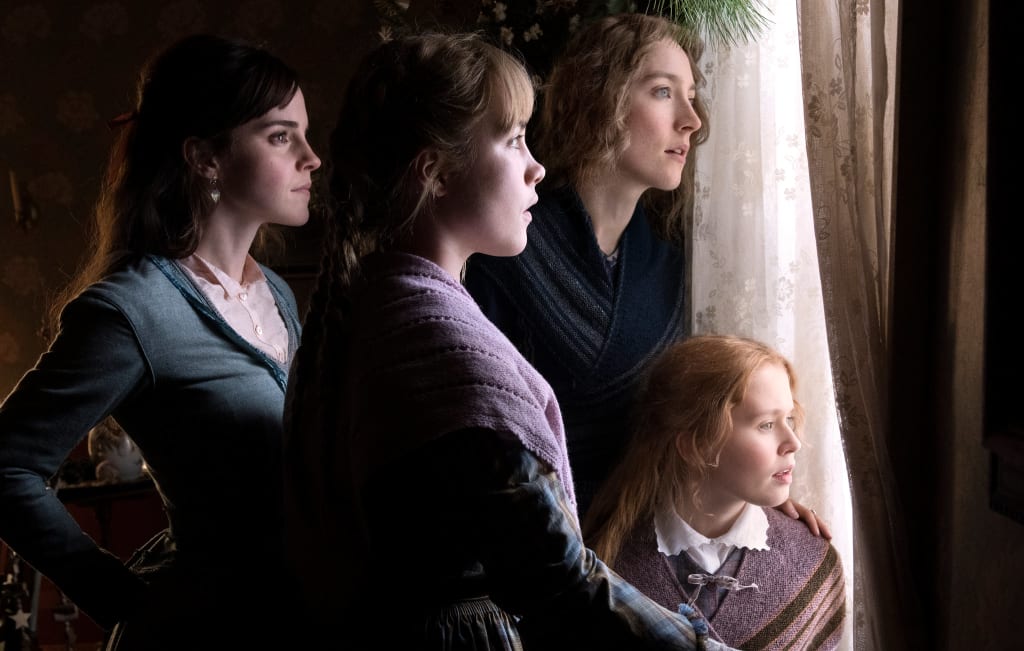
I still remember the day I watched the trailer of Greta Gerwig’s Little Women, because I was moved to tears. “I’m working on a novel,” Jo, the protagonist, played by Saroise Ronan, tells the viewers, “It is a story about my life and my sisters”. I watched her nod with hope to an editor that warns her: “If the main character is a girl, make sure she’s married by the end”, but then the trailer proceeded to give a taste of Jo’s novel, and I couldn’t care less about whether she would end up married or not.
Those four sisters, their ambitions, insecurities and the support they show for each other, had me cheering for them in front of the screen. And yes, now that I have seen the movie with my boyfriend who ended up crying towards the end, I can confirm that Timothée Chalamet looks gorgeous in those frock coats and his oh-so-dreamy hair, but for once his beauty is not the center of attention. I am here to celebrate those actresses who made me fall in love with the movie months before its release, and the one and only Greta Gerwig, who has been showing the world that women can direct, and god, they can do it divinely.
Greta, you got an A+ on your Bechdel test.
About the Creator
Keep reading
More stories from writers in Geeks and other communities.
Marvel Zombie
The last entry into our 2025 superhero projects catalogue is Marvel Zombies. This was a show that was anticipated by absolutely no one and it disappeared from the public consciousness as quickly as it was released. There was nothing special about the project that made it a must see, or a must remember. In fact if anything it's a must forget.
By Alexandrea Callaghan20 days ago in Geeks



Comments
There are no comments for this story
Be the first to respond and start the conversation.