
'Twas Mercy Brought Me
Phillis Wheatley and African American Poet


On Being Brought from Africa to America
'Twas mercy brought me from my Pagan land,
Taught my benighted soul to understand
That there's a God, that there's a Saviour too:
Once I redemption neither sought nor knew.
Some view our sable race with scornful eye,
"Their colour is a diabolic die."
Remember, Christians, Negros, black as Cain,
May be refin'd, and join th' angelic train.
The first four lines of "On Being Brought from Africa to America", by Phillis Wheatley, has vivid imagery attached to the slave trade and the instruction in Christian principles. Unlike many slaves, Wheatley was taught to read and write and was fostered in a Christian home. Her exposure to literature and her growing understanding of this literature enabled her to express thoughts and ideas in beautiful verse. After reading "The Difficult Miracle of Black Poetry in America" and reflecting on Wheatley's biography, I was saddened by her circumstances, especially following the death of the Wheatleys. Had they remained alive during her adult years, I believe that her poetry would have been supported and published. Yet, as she was no longer a member of their household, she was subject to the same fate as other African American slaves.
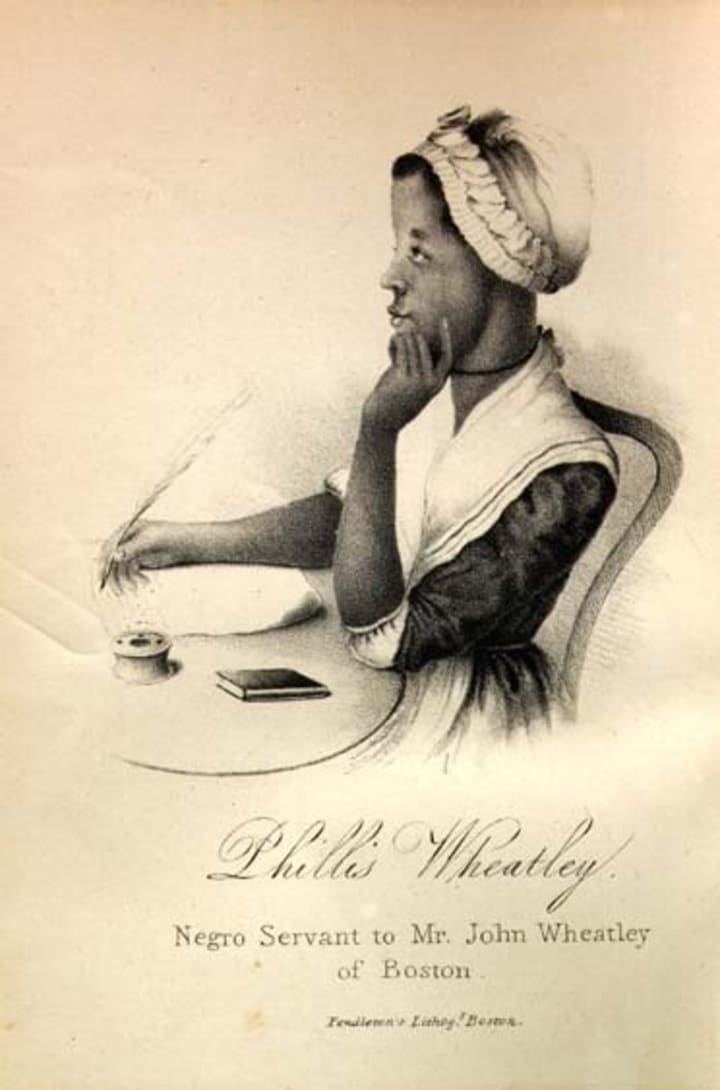
I found the title of her published work, Poems on Various Subjects, Religious and Moral, thought-provoking and inspiring. Specific lines from the works included in this anthology resonated with me and I have to admit that I admire her wit and candor. Wheatley's poem, "Thoughts on the Works of Providence," contains some of the most beautiful imagery (Stanza's 1 -3):
ARISE, my soul; on wings enraptured, rise,
To praise the Monarch of the earth and skies,
Whose goodness and beneficence appear,
As round its centre moves the rolling year;
Or when the morning glows with rosy charms,
Or the sun slumbers in the ocean's arms:
Of light divine be a rich portion lent,
To guide my soul and favor my intent.
Celestial Muse, my arduous flight sustain,
And raise my mind to a seraphic strain!
Adored forever be the God unseen,
Which round the sun revolves this vast machine,
Though to his eye its mass a point appears:
Adored the God that whirls surrounding spheres,
Which first ordained that mighty Sol should reign,
The peerless monarch of the etherial train:
Of miles twice forty millions is his height,
And yet his radiance dazzles mortal sight.
So far beneath--from him the extended earth
Vigour derives, and ev'ry flow'ry birth:
Vast through her orb she moves with easy grace
Around her Phoebus in unbounded space;
True to her course, the impetuous storm derides,
Triumphant o'er the winds, and surging tides.
Almighty, in these wondrous works of thine,
What Power, what Wisdom, and what Goodness shine!
And are thy wonders, Lord, by men explored,
And yet creating glory unadored?
Stanza 6 begins with these two lines:
O’er beings infinite His love extends,
His Wisdom rules them, and His Pow’r defends.
Stanza 8 is my favorite, containing some of the most powerful imagery:
But see the sons of vegetation rise,
And spread their leafy banners to the skies,
All-wise Almighty providence we trace
In trees, and plants, and all the flower race;
As clear as in the nobler frame of man,
All lovely copies of the Maker’s plan.
The "frame of man" and "lovely copies" is brilliant. And then her reference to the creation: "Old Chaos heard, and trembled at the sound:" is great imagery.
She had an incredible grasp of the English language and thrived in a time when most like her suffered. I believe she understood her circumstances as compared to other slaves. She also had compassion for those that were not found in circumstances similar to her own. There were a few other African Americans who were educated by their masters. As a result, we have access to their writings. Like Wheatley, they wrote in support of freedom and for these rights to be extended to the African American slave. I feel that Wheatley was the first voice to be heard during a climate that was just beginning to realize the atrocities of slavery.
About the Creator
Rebecca A Hyde Gonzales
I love to write. I have a deep love for words and language; a budding philologist (a late bloomer according to my father). I have been fascinated with the construction of sentences and how meaning is derived from the order of words.
Keep reading
More stories from Rebecca A Hyde Gonzales and writers in Geeks and other communities.
Heart of a Puritan Woman.
Religious freedom, the catalyst for American colonization brought many immigrants from Europe seeking to worship, free from persecution and intolerance. the most successful venture was that of the Massachusetts Bay Colony, led and inspired by John Winthrop. Among these colonists included Thomas Dudley and his recently married daughter, Anne Bradstreet. Anne was most likely present when John Winthrop gave his famous sermon: A Model of Christian Charity. He prefaced his sermon with the model stating:
By Rebecca A Hyde Gonzales4 years ago in Geeks
Silver Screen Magic with Mae West
American actress and singer Mae West became a popular film actress during the Great Depression. She started entertaining in vaudeville, then performed on Broadway, and finally went to Hollywood. She signed up with Paramount Pictures and made her debut in the 1932 film “Night After Night.” She also starred in musicals, comedies, and crime dramas. The American Film Institute named her one of the best classic Hollywood actresses.
By Rasma Raisters3 days ago in Geeks
Jay Kelly - A Netflix Movie Review
Are you running to something or from something? Jay Kelly is a 2025 film about a famous movie actor who is beginning to have doubts about his career. While on the train to his next job, Jay reflects on his life, confronting his past and present.
By Marielle Sabbag4 days ago in Geeks




Comments
There are no comments for this story
Be the first to respond and start the conversation.