
Tolkien and the Fairy Tale
Is "The Lord of the Rings" a fairy tale?


Vladimir J. Propp, author of a famous study on the popular fairy tale, Morphology of the fairy tale, from 1928, defines it as follows:
From a morphological point of view, we can define a fairy tale as any development from damage (x) or lack (x) through intermediate functions to a marriage (n) or other functions used as a dissolution. Sometimes the endings, the reward (z), the removal of damage or lack (Rm), rescue from pursuit (s) etc., serve as functions.
More specifically, Stith Thompson, in The Fairy Tale in the Popular Tradition, of 1946, uses the term maerchen to indicate a fairytale of a certain length, with a succession of motifs and episodes, which moves in an unreal world, without a precise definition of places and characters, full of wonderful things.
Bruno Bettelheim, in The Uses of Enchantment, of 1976, notes that a fairy tale is such only if it contains magical and supernatural elements.
Starting from the theories of these three famous fairytale scholars, we now propose our definition that summarizes all three. A fairy tale is such when:
at the morphological-structural level, we have a development from a damage or a lack, through intermediate functions, up to a final dissolution that involves the removal of the damage or lack or a reward;
one moves in an unreal world;
places and characters are not well defined;
the magical / supernatural element is present.
In particular, for the purposes of this study, we will consider the one having the monomitic structure of the quest as a “typical fairy tale”, as it was enucleated by Joseph Campbell in The Hero with a Thousand Faces, of 1949.
In this type of fairy tale, the initial damage or lack force the protagonist to leave in search of something (an object, a person, a place, etc.). The intermediate functions are represented by the obstacles and helpers that he encounters during the journey. At the end of the tale, completing the quest removes the damage or lack and causes a reward. Returning home is often difficult.
Before proceeding, we specify that we will draw many of our examples of fairy tales from the collection of maerchen by the Brothers Grimm (even if not only from that one) both because we consider this collection one of the most typical expressions of the European fairytale tradition, and because it was one of favorite readings of the author of The Lord of the Rings.
Let’s try to analyze the structural elements of the fairy tale by comparing The Lord of the Rings to a famous tale by the Brothers Grimm, The Golden Bird.
The golden bird
Damage or lack: the king orders his sons to bring him the golden bird and they set out in search of it.
Intermediate functions, obstacles: the inn entices them with its pleasures, difficult tasks are imposed on Bertrand (tripling of the object of the quest: bird, horse and golden princess and the imposition of leveling a mountain in eight days).
Helpers (who overcome obstacles or provide magical items): the fox helps Bertrando level the mountain and gives him essential advice for obtaining the fairy bird, horse and princess.
Removal of damage or lack: Bertrando takes possession of the quest items.
Homecoming (difficult): Bertrando returns home incognito and unmasks the impostor brothers who had usurped his place.
The Lord of the Rings
Damage or lack: The black knights search the Shire in search of the owner of the Ring; Frodo sets out to destroy the Ring, save the Shire and all of Middle Earth.
Intermediate functions, obstacles: A tree holds the hobbits in its roots. The ghosts of the Mounds attempt to kill them, the Black Knights wound Frodo, the snow and wolves prevent the Fellowship of the Ring from overcoming the mountains, the Orcs repeatedly attack the Fellowship killing Boromir, the lake monster wants to capture the Bearer, a Balrog kills Gandalf, Shelob stabs Frodo etc.
Helpers (who overcome obstacles or provide magical items): Gandalf helps the bearer with his experience, his magical powers, and his sacrifice in the fight against the Balrog, Tom Bombadil disenchants the killer tree and scatters the Moundwraiths, Bilbo gives Frodo the Sting sword, Elrond provides moral and material aid to hobbits, Galadriel gives Frodo a magic sword etc.
Removal of damage or lack: the Ring is destroyed and Sauron defeated.
Return home (difficult): the hobbits return to the Shire but must overthrow a tyrannical regime established by Saruman in their absence.
The Proppian functions of “prohibition”, “investigation by the antagonist”, “call of the hero”, “testing the hero”, “marriage and coronation of the hero”, etc). Therefore, a remarkable morphological similarity emerges with fairy tales, at the level of nodal functions. Tolkien himself, an avid reader of fairy tales, does not deny that he used for The Lord of the Rings the fairytale model of the quest that he had already experienced in The Hobbit in an even more evident way.
I now wanted to try my hand at writing a really, stupendously long narrative and see whether I had sufficient art, cunning or material to make a really long narrative that would hold the average reader right through. One of the best form for a long narrative is the adage found in the Hobbit, though in a much more elaborate form, of a pilgrimage and journey with an object, so that was inevitably the form I accepted.
Probably even more than from the Grimm fairy tales, the fairy tale model of the quest is filtered into Tolkien’s work through the medieval epic. As everyone knows, Tolkien, even before being a writer, was an outstanding philologist and one of the leading scholars of Anglo-Saxon literature. He was responsible for the revaluation of Beowulf, the translation of Sir Gawain and the Green Knight and Pearl, a remake of The Battle of Maldon and so on. Among his favorite readings, moreover, are the novels of William Morris and George McDonald. It seems clear, therefore, that reasons such as the quest for the Holy Grail or the search for the monster to kill were very familiar to him. Finding the themes of the popular fairy tale within the myths of the medieval epic should not be surprising since, as Joseph Campbell demonstrated, myth, fairy tale, ritual and dream activity of man find a common expression in motifs that hide from their internal the archetypes of the Jungian collective unconscious.
The Lord of the Rings is an example of a fairy tale with “two seekers”, who separate towards the middle of the narrative to each carry out their own research. We have in fact two main heroes, Frodo and Aragorn. Frodo is the bearer of the ring and his quest coincides with the destruction of his own burden. Aragorn is the king in disguise, whose typical quest coincides with the reconquest of the kingdom and obtaining the hand of the woman he loves. The two seekers separate at the end of the first book to reunite only in the finale.
The Lord of the Rings, like the fairy tale, is set in a totally fictional world in which characters who have no historical foundation move.
Among the elements common to fairy tales, which can also be found in The Lord of the Rings, we can still list:
some kind of struggle with supernatural adversaries that often come in monstrous forms: Sauron, Shelob, the Balrog, the Nazgul, can be related to the countless dragons, orcs and evil witches of fairy tales;
the presence of ghosts: the ghosts of the Ring, the warriors of the Paths of the Dead, the ghosts of the swamp, are the equivalent of the grateful or threatening dead of some European folk tales;
intelligent horses: Ombromanto, Nevecrino, etc, behave like Falada, the famous horse of The Little Goose Guardian;
the magical powers: the powers of Gandalf, Sauron, Saruman, Galadriel resemble those of the magicians and fairies of fairy tales;
magical objects: the door of Moria opens on command like the famous door of Ali Babà and the forty robbers; Galadriel’s vial shines with unquenchable light; the Ring makes you invisible; the Palantiri allow to see far; Galadriel’s mirror predicts the future; the Sting sword shines in the presence of Orcs;
the extraordinary smallness: the dwarves and the little hobbits resemble the tiny elves of fairy tales;
the successes of the younger son: Faramir, the “Cinderella”, succeeds where his father’s favorite brother has failed;
the prophecies: there are numerous prophecies scattered throughout the narrative, for example the one concerning “the scourge of Isildur” (see the prophecy in The Three Hairs of the Ogre).
Also present in The Lord of the Rings are typical characters of the popular fairy tale: elves, dwarves, wizards, trolls, orcs, etc. The protagonists of folk tales are usually common characters who, tested by the vicissitudes they have to face during the fairy tale, mature and obtain personal successes: Fiumetto, the woodcutter’s son, becomes king and inherits a fortune; the kids, swallowed by the big bad wolf, are saved and learn to take care of themselves; Biancarosa and Rosella marry two principles. Bruno Bettelheim shows that, even when in fairy tales we talk about belonging to royal families, in reality the real protagonist is always the common man: Snow White is only a pubescent girl and the evil queen only a mother who does not accept to be surpassed in beauty and youth from her own daughter. The king, the evil queen and Snow White are actually a father, mother and daughter in a typical Oedipal constellation that every child (and every parent) can identify with.
One of the main characteristics of fairy tales is therefore to present everyday characters with which the reader can easily identify. The reader of fairy tales senses that he too may be the object of envy from a brother or have to extricate himself in a difficult situation. Even in The Lord of the Rings some (not all) of the characters have precisely this characteristic of being everyday heroes.
The little hobbits are clumsy, they are not used to great events like the heroes of the myth. Merry and Pippin at the beginning of the story are only carefree, kindhearted and generous young hobbits, but who still have to test their courage and endurance. Eventually they will have grown in stature both in a physical sense (thanks to the water of the Ents) and in a moral sense. Suffering will have matured them within a year, making them suitable hobbits to take command of the Shire. They more than others will get personal achievements and rewards in the end of the story. Aragorn also eventually ascends to the throne and gets the hand of the elven maiden who was promised to him only on condition that he regain his rightful kingdom.
As for the style, Tolkien uses some techniques common to the folk tale. As Marion Perret states
Tolkien prefers to suggest rather than spell out: he invites his reader to participate in the imaginative act of subcreation by his use of representative actions as well as by his use of generalized language.
Just as in fairy tales it is preferred to say “he sat up and wept”, rather than giving a detailed description of the desperate state of mind of the one who suffers, sometimes Tolkien opts for the suggestion and the symbol rather than the explicit description. At certain key moments he makes a close-up of a gesture or element.
The close up technique permits him to substitute a significant detail for an elaboration of an emotional state; repetition of that significant detail abbreviates even more.
So every time Frodo brings his hand to the ring, the reader understands that he is in the grip of a violent temptation; or every time Sam supports his master, his gesture symbolizes affection, dedication, fidelity, without losing narrative concreteness and plasticity. The reader must participate with the awareness of what the gesture has previously meant.
Often in fairy tales much of what is told is taken for granted. When it is stated that the protagonist met “the old woman of vinegar” and not “an old woman”, using the definite article, this assumes that the reader / listener of the fairy tale knows a priori of the existence of a specific old woman of vinegar. It is a technique that serves to give depth to the narrative and the idea of something beyond the mere clipping of events that we become aware of. We have the impression of the existence of a fairy kingdom in which the old women of vinegar are natural and very common.
Tolkien claims to appreciate Grimm’s fairy tales precisely for “that sense of antiquity and depth” that he finds there. He uses the same technique. The sense of depth interests him much more than the storyteller, since the creation of a “secondary world” is his main goal. Although the appendices explain everything there is to know about Middle-earth, they were only included in the work in 1966. And furthermore, they are precisely appendices, which a normal reader usually reads at the end of the book. Therefore, when the first elves are introduced as they chant “Ghiltoniel! Oh Elbereth! “, without a previous reading of the Silmarillion and without a knowledge of the Elven languages, the average reader cannot know that they are singing a religious hymn in honor of Varda, the supreme among the Valar, queen of the stars, and that Elbereth is one of the names the Elves give it in Sindarin.
The reader plunges, from the first chapter, into a world that existed before he opened the book, profound, varied and very complicated. The events narrated in The Lord of the Rings have a precise dating and take place in a coherent world that is represented down to the smallest details. They refer — Tolkien himself confirms — to a bygone era of our land. However, we are not told how much time has passed since then or where exactly Middle-earth was.
Those days, the third age of Middle Earth, are now long past, and the shape of all lands has been changed but the regions in which hobbits then lived were doubtless the same as those in which they still linger; the north west of the old world, east of the sea.
This description leaves the story in a limbo that has the vague flavor of “once upon a time beyond the mountains and the sea”.
By examining the structure, components and some stylistic techniques of The Lord of the Rings, we have come to a first conclusion according to which there are undeniable structural similarities between The Lord of the Rings and the fairy tale. A first value to be attributed to the book is therefore the one that derives from the contribution of the popular fairy tale, and a first message will be the same as that of many fairy tales: that a fight against the serious difficulties of life is inevitable but that even the humblest can succeed. only if they do not withdraw in fear. As the little users of fairy tales, suffering and rejoicing with their heroes, manage to mature and become adults, so Tolkien, an eternal child who has had fun with the Hobbit’s joke, through the fairy tale The Lord of the Rings grows as a man and as a writer. Together with Bilbo, he learns to accept old age and the proximity of death. Then, with Frodo, day by day enduring the growing weight of the terrible Ring, he procedes to a bitter writing that uses the fairy tale to convey profound messages.
About the Creator
Patrizia Poli
Patrizia Poli was born in Livorno in 1961. Writer of fiction and blogger, she published seven novels.
Keep reading
More stories from Patrizia Poli and writers in Geeks and other communities.
Virginia Woolf, "Walter Sickert a Conversation"
Published in 1934 by the Hogarth Press, the essay connects Virginia Woolf to Walter Richard Sickert, whom she, in her diary, calls “my Sickert” (see annotations of Tuesday April 17, 1934) complaining that, with the painter she loves, critics “They are contemptuous” (Friday 2 November 1934).
By Patrizia Poli4 years ago in Geeks
A Knight of the Seven Kingdoms Series Review (Season 1)
As one of the biggest properties in fantasy, A Song of Ice and Fire remains immensely popular with audiences. After reaching far into the past with House of the Dragon, a second spin-off was on the cards. A Knight of the Seven Kingdoms serves up a bite-sized slice of action and drama, but it still claims a spot among the best small-screen titles.
By Robert Cain4 days ago in Geeks
Wonder Pets In The City Will Premiere on March 20th For Season 2
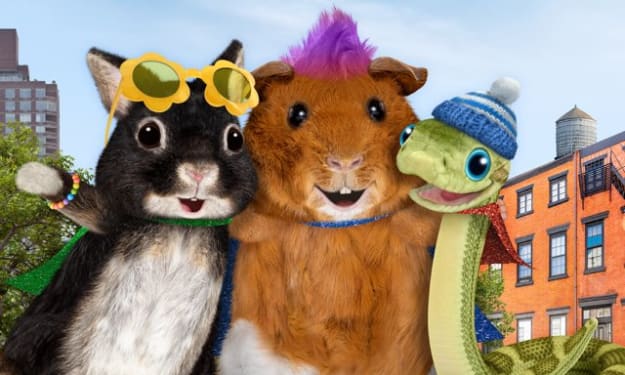
There was a first look at ‘Wonder Pets: In The City’ Season 2. The new season will premiere on Apple TV+ on March 20th. The series follows three new animal protagonists: Izzy the Guinea Pig, Tate the Snake and Zuri the Bunny, who live in New York City and travel all around the globe in their jetcar. They are all different characters from the original three. This reboot has actually been around since 2024. The original three were Linnie, Ming Ming and Tucks.
By Levi Omeke6 days ago in Geeks


Comments
There are no comments for this story
Be the first to respond and start the conversation.