
Tokyo These Days (Volume 1)
The Collected Manga Serial by Taiyo Matsumoto

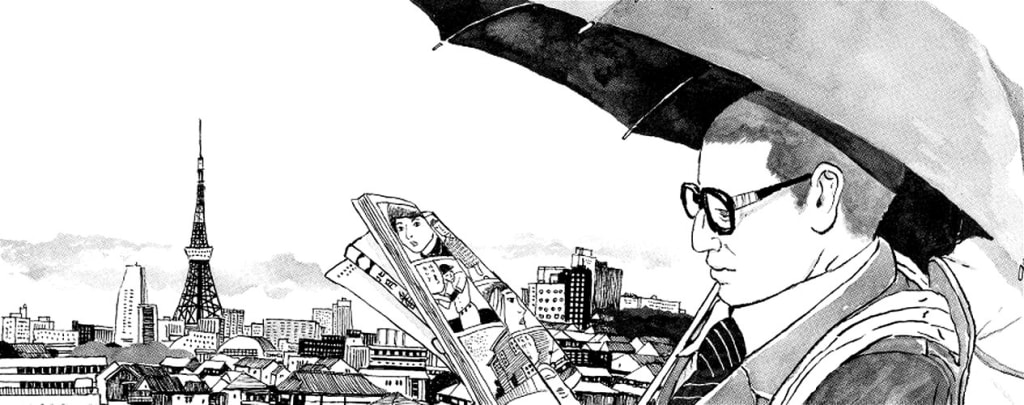
Mr. Shiozawa has quit his job as editor at a major manga publishing concern. He comes home to his pet bird, which speaks to him—just as much as the inward "ghost" that whispers of one more manga that must be brought forth. To that end, what has seemed to be the end for Shiozawa is simply a turn of the page, to another, perhaps more meaningful chapter of his caged existence. Thus begins Tokyo These Days, by renowned manga sensei Taiyo Matsumoto.
Tokyo These Days is a beautiful, if somewhat stark and lyrical, slow-moving and poetic manga in the seinen tradition—written chiefly to appeal to young adult males (other sub-classifications of manga include shōnen, aimed at young boys; josei, aimed at young adult women; and shōjo, targeted at adolescent girls). It's manifestly a grown-up tale, devoid of giant robots, slam-bang cyberpunk action, or big-eyed characters with a distinctive kung-fu style.
Instead, it’s a somber, reflective, and introspective affair—still infused with subtle meaning and allegory—as well as a caged bird that talks and thinks like a feathered AI, reflecting the central protagonist Shiozawa’s feelings and moods as he seeks to navigate his retirement from the manga industry that still seems to hold him, body and soul, to some further calling—some need to express what is left unfulfilled.
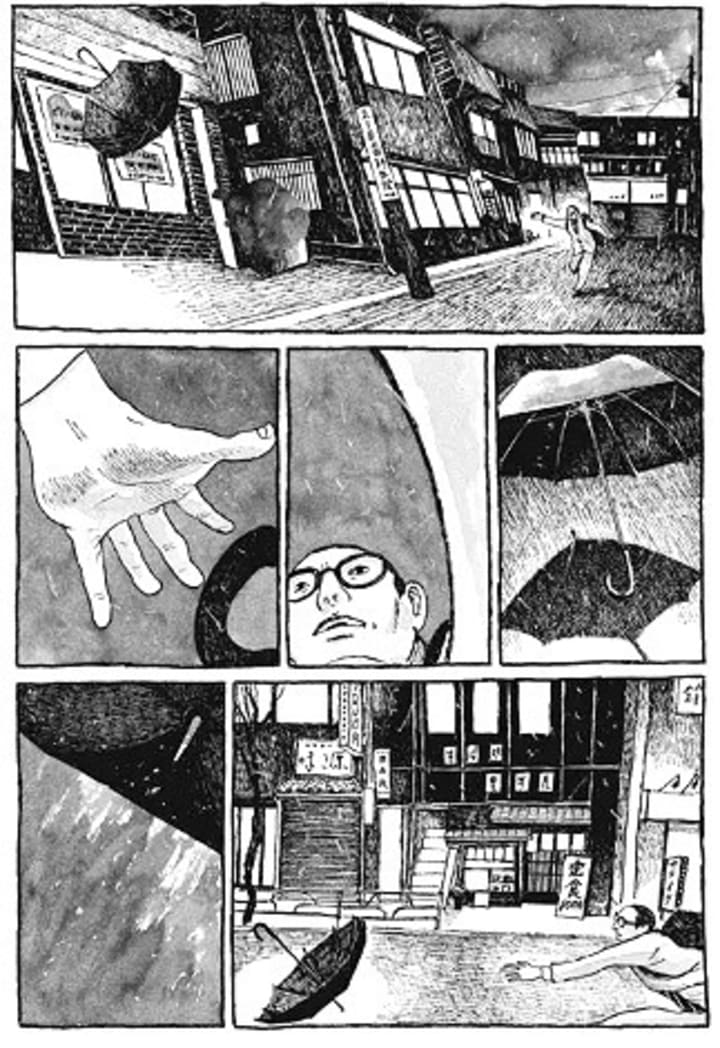
This saga is presented in traditional manga style, but with a less sophisticated eye—one that hints at a skill so masterful it has mastered an imitation of the unskilled, or novice, or juvenile. What is being conveyed here? the reader may well wonder. Is it a confessional naivety? A childlike sense of guilelessness or deep honesty? Tokyo is a stark, commercialized landscape, seeming to dwarf the individual with huge architecture and advertising recordings broadcast like sonic billboards, hoping to sublimate the well of the captured.
Like his parrot, Shiozawa is confined—caged. He strikes us as a "little man," always carrying his burden with him wherever he goes, lost like a scurrying insect, dwarfed against the Euclidean geometrics of a Tokyo that seems to know life—and "no life"—in equal measure. By contrast, tortured, disheveled, and manic artist Aoki lives in a filthy apartment with his collection of cats, and presents as a lanky, unhygienic, mentally “tortured artist” archetype who poses problems for female editor Hayashi, a strikingly Western-looking woman. (There is a curious mixture of both Japanese and Western visages here—another subtle clue as to the universal meaning of the story. It is not just a Japanese tale, but a tale that encompasses those who define their creative struggle as part of the development of the human spirit.)
The morbidly obese Chosaku Sensei, the editor at the manga publishing company where Shiozawa was formerly employed, is, by contrast, a character that is unmistakably Japanese. He is also, it seems, semi-retired from drawing, although Shiozawa approaches him to illustrate a proposed manga which is apparently still formulating in his soul. Chosaku is a curiously reflective character, counterpoised to the high-strung chaotic energy of the undisciplined and frankly mad Aoki, or to the more level-headed and seriously academic detachment of Hayashi and other female characters—including the ghost of a manga sensei who has a heartfelt conversation with Shiozawa in her studio, after he attends her funeral ceremony.
Tokyo These Days is a story of escaping our common imprisonment—the liminal space of our creative gestalt—or perhaps that place wherein we are neither progressing nor in a state of retrograde, but in a gestating, womb-like, curious impasse. So, we can die, retire, or swear off that which yearns, deep within us, to still be brought forth, to still live and see the sun. And as in the Tokyo that looms skyward, dwarfing its shuffling, bug-like citizenry as it seeks to hypnotize them with advertising slogans for Marukan—whatever that may be.
Follow me on X/Twitter: BakerB81252
About the Creator
Tom Baker
Author of Haunted Indianapolis, Indiana Ghost Folklore, Midwest Maniacs, Midwest UFOs and Beyond, Scary Urban Legends, 50 Famous Fables and Folk Tales, and Notorious Crimes of the Upper Midwest.: http://tombakerbooks.weebly.com
A Knight of the Seven Kingdoms Series Review (Season 1)
As one of the biggest properties in fantasy, A Song of Ice and Fire remains immensely popular with audiences. After reaching far into the past with House of the Dragon, a second spin-off was on the cards. A Knight of the Seven Kingdoms serves up a bite-sized slice of action and drama, but it still claims a spot among the best small-screen titles.
By Robert Cain5 days ago in Geeks
'A Knight of the Seven Kingdoms': Why Dunk And Egg's Trip To Dorne Probably Saved Their Lives
By the standards of the Game of Thrones universe, the first season of latest spin-off/prequel A Knight of the Seven Kingdoms gives us a rather happy ending, with Ser Duncan the Tall and his new Squire, Prince Aegon Targaryen, aka Dunk and Egg, riding away together. However, those with a little extra knowledge of Targaryen history know that this is just the calm before yet another storm in Westeros.. and no, it's not because Egg ran off with Dunk without the permission of his Father, Prince Maekar.
By Kristy Anderson4 days ago in Geeks
Cassie and Johnny
I’m the kind of dame you notice. I’m no femme fatale, but you can’t ignore me, at least not until I warn you about what’s coming, then everybody ignores me. Hell, they usually blame me afterwards and give Johnny all the credit for saving the day, but my Johnny couldn’t save a seat at the movies without my help. Sure, he’s brawny, but brainy? Not so much. Like that time I asked him to spot me five bucks, and he said he didn’t see it anywhere on me, and believe you me, he looked but good.
By Harper Lewis6 days ago in Critique




Comments
There are no comments for this story
Be the first to respond and start the conversation.