
The X-Men Go to Hell
Essential X-Men Volume 3


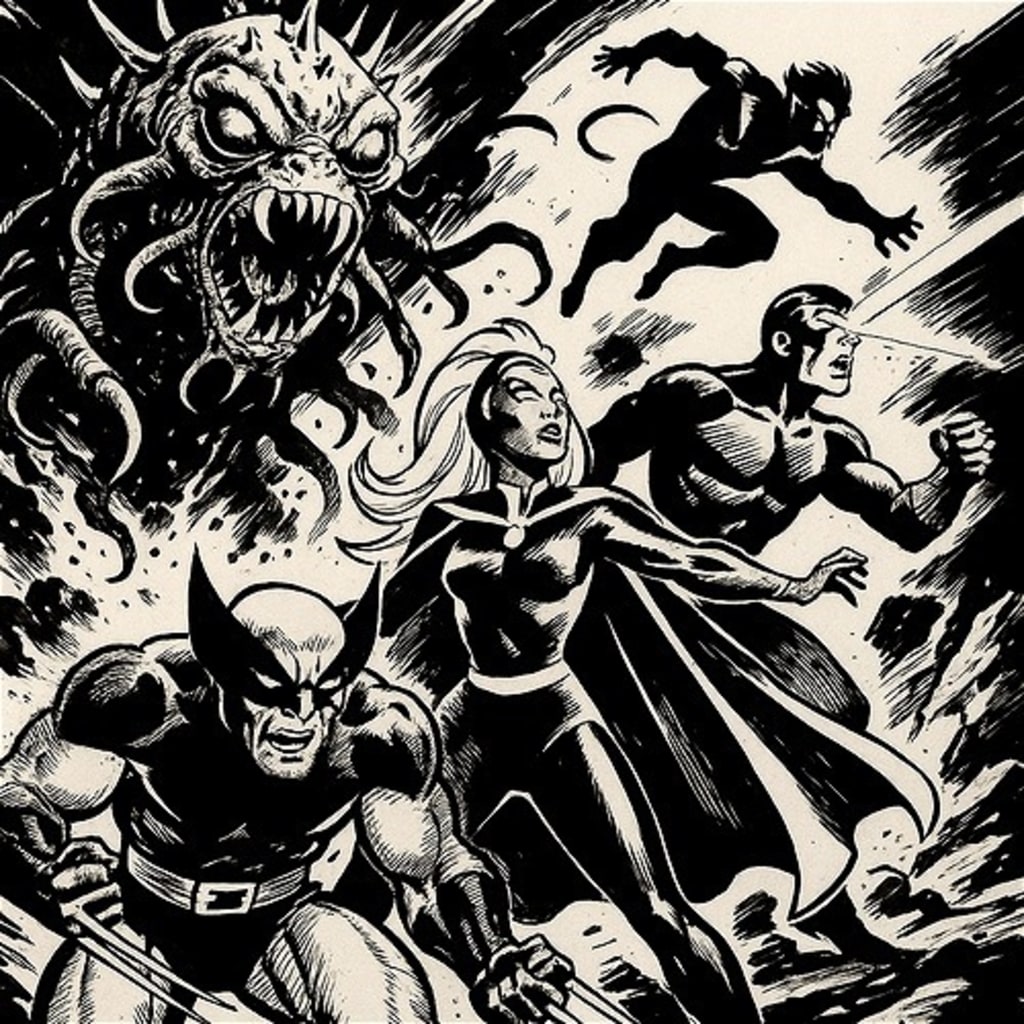
X-Men in Black and White
Reading black-and-white reprints of classic Chris Claremont era X-Men while sitting on the john at three a.m. is just what fat, near-sighted comic book geeks do. It comes with the territory—like morning constipation, black coffee, and rolling up random encounters while everyone else in the building is safely asleep, having dreams they don’t get to control.
Getting through the third volume of Essential X-Men—a dizzying soufflé of story arcs—was a personal challenge for a man who doesn’t much enjoy challenges, personal or otherwise. The book opens with the kidnapping of Storm by my favorite comic-book mega-villain, the iron-masked, hooded-cape cyber-baddy himself: Dr. Victor Von Doom (late of the regency of some fictional Eastern European country whose name momentarily escapes me). And while that’s a fun start, the real challenge wasn’t narrative—it was format.
Stripped of color, featuring very little in the way of half-tones or shading, the panels and splash pages turned into nightmares of confusing line art. For the visually impaired, it was often an exercise in squinting, guessing, and swearing under my breath: what the hell am I even looking at? Nothing kills a buzz like static on the page, especially stretched across hundreds of them.
Still, I’m nothing if not committed (as opposed to what my enemies claim—that I should be committed, ha). So I kept at it. Over months of midnight bathroom reading, I filled the mental trough with the Saturday-morning pulp-speed adventures of the X-Men as they fought Doom, Magneto, neo-Nazis in cyberpunk gear, alien crawlers called the Brood, a decadent cabal named the Hellfire Club, Dracula, Lucifer (or Satan, or some knockoff thereof), and a revolving door of cosmic weirdos. Their capers catapulted them from Gothic castles to outer space to the depths of Hell itself.
Storm in particular took a beating. She’s frozen into a living statue, her claustrophobia stoked until she lashes out with weather gone wild. She’s tossed into Doom and Arcade’s Murderworld—an obstacle-course theme park of death designed by a bowtie-wearing shmucky third-tier villain—and forced to survive the gauntlet while her teammates scramble to save loved ones held hostage. And, of course, she gets bitten on the neck by none other than Count Dracula.
That last one was a gem. Storm, a goddess of the elements, reduced to a vampiric thrall—until Kitty Pryde saves the day. Kitty waves her Star of David in Dracula’s face, recalling Richard Benjamin’s gag in the 1979 cult comedy Love at First Bite, where George Hamilton’s smooth, sexy Drac sneers, “Why don’t you get yourself a nice Jewish girl, Doctor?” Marvel comics meet Borscht Belt humor, and it works.
It was also around this point I realized these stories weren’t from the Sixties, as I’d lazily assumed, but from my old stomping grounds—the Eighties. The clues were right there: comic-book Reagans and Thatchers reacting to Magneto’s schemes to conquer both the Free and Commified worlds. Magneto himself is a fascinating knot: Holocaust survivor, Xavier’s old friend, true believer in mutant superiority, and the ominous prophet of a “Holocaust to Come.” He’s both victim and villain, a man shaped by genocide who now threatens another.
The arcs pile up like channels on a Saturday morning lineup. Dracula. The Devil. Space invaders. Soap opera revelations—like Scott Summers’ long-lost father popping up as a space pirate named Corsair, leader of the Starjammers. Nightcrawler dragged to Hell itself, his freakish features finally set against the question of whether he has a soul. The whole saga eventually balloons into a Thundarr-level interdimensional battle on a barbarian planet, complete with alien races that look borrowed from Edgar Rice Burroughs and then dipped in cheese.
The characters hold it all together. Wolverine stands out: cigar-chomping, blue-collar, tactless, and all menace. Cyclops is pure Boy Scout—square-jawed, uptight, almost too perfect. Kitty “Sprite” Pryde (no, not the soda) struggles to find her footing as the youngest on the team, mentored by Storm in a relationship that grounds the book’s melodrama. Nightcrawler and Colossus serve as the international seasoning, each speaking in broad German or Russian dialects that remind you mutants come in every shape, size, and nationality. Professor X, meanwhile, spends half the book in some kind of coma, haunted by his past during the Nazi era, while guest stars like Spider-Woman, Doctor Strange, and the Fantastic Four pop in for crossover spice.
What Claremont achieved here is legendary. He dragged a struggling, near-canceled series into the big leagues and turned it into Marvel’s flagship. His mixture of Gothic pulp, political allegory, cosmic adventure, and soap opera melodrama gave the X-Men both weight and spectacle. He gave Wolverine a voice, gave Storm command, gave Magneto gravitas, and gave readers migraines with all that narration.
And it was worth it. Worth squinting through jumbled lines. Worth bleeding from the eyes for five hundred pages. Because at three a.m., sitting on porcelain, with black coffee cooling in the kitchen, there’s no better way for a fat, near-sighted geek to commune with comics than to vanish in a Nightcrawler-induced fart cloud of pure, unadulterated X-stink.
Comics and graphic novels video playlist
About the Creator
Tom Baker
Author of Haunted Indianapolis, Indiana Ghost Folklore, Midwest Maniacs, Midwest UFOs and Beyond, Scary Urban Legends, 50 Famous Fables and Folk Tales, and Notorious Crimes of the Upper Midwest.: http://tombakerbooks.weebly.com
A Knight of the Seven Kingdoms Series Review (Season 1)
As one of the biggest properties in fantasy, A Song of Ice and Fire remains immensely popular with audiences. After reaching far into the past with House of the Dragon, a second spin-off was on the cards. A Knight of the Seven Kingdoms serves up a bite-sized slice of action and drama, but it still claims a spot among the best small-screen titles.
By Robert Cain3 days ago in Geeks
5 Underappreciated Cartoons IV
Well, well, I finally found more. It's been three years since my last Underappreciated Cartoons list. That's three years of searching for stuff to put into a fourth entry. It took a while, but I think I finally found a couple of good ones.
By Greg Seebregts5 days ago in Geeks



Comments (1)
I read all those when they came out, having a subscription at the time. The Satanesque character is Belasco, and that storyline with Illyana changed the X-Men forever, resulting in the "Inferno" crossover later, as well as the "Magik" limited series. Yes, these stories are from the 60s. Of the characters on the team at the time, only Cyclops dates from the 60s. Cyclops, Professor X, Magneto, Iceman, Angel, Jean Grey/Marvel Girl/Phoenix, and Beast are all from the 60s. Wolverine, Storm, Nightcrawler, and Colossus weren't created until 1974, joining the team in Giant-Size X-Men #1. Kitty Pryde came several years later, at the same time as the Hellfire Club. Claremont was still in good form with these stories, but as you allude with your comment about excessive narration, he was already getting out of hand. When he was teamed with artist/co-plotter John Byrne, they were both at peak, and Claremont was kept in check a bit. When Byrne left, Dave Cockrum came back, and the book still had its classic look, but Claremont started piling in the narration, which eventually got to be a problem, primarily with retread catchphrases like, "I'm the best there is at what I do", which became so cliche' it was lampooned in "The Tick" and elsewhere.