
The Wind Rises: Miyazaki's Magnum Opus
A sort-of review

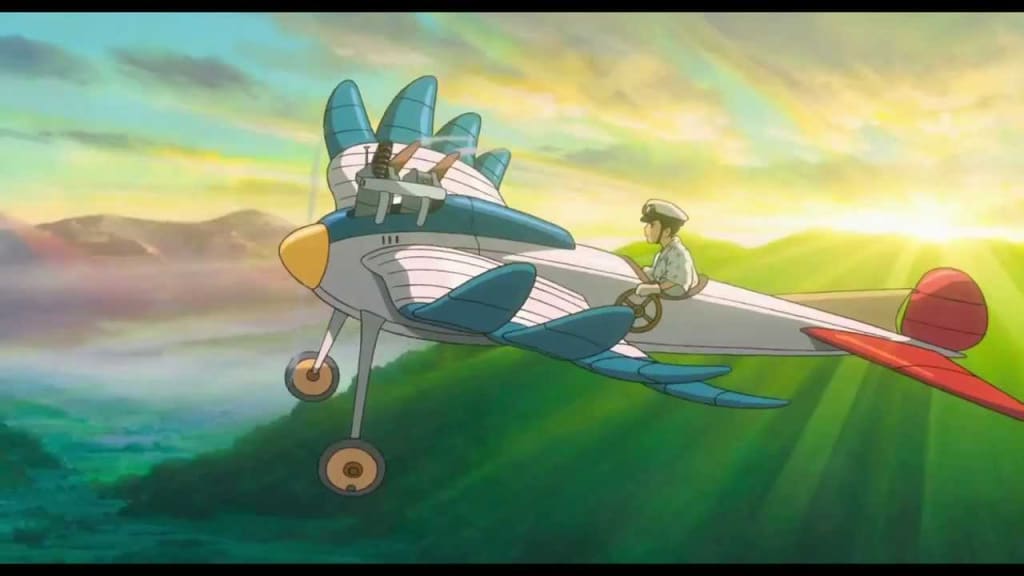
I'll come out and say it right off the bat--The Wind Rises is by far one of my favorite films of all time.
Released in 2013 and directed by the world-renowned, highly accoladed director, Hayao Miyazaki, The Wind Rises marks Miyazaki's eleventh directed film, and up until a few years ago (before the announcement of his twelfth film, How Do You Live?), was also regarded as his last.
The Wind Rises is a fictional, semi-biographical film inspired by Hori Tatsuo's 1938 novel of the same name, and by the life of Japanese aeronautical engineer Jiro Horikoshi. The story follows Jiro throughout the course of his life during WW2 era Japan as he strives to achieve his dream: to make beautiful airplanes. Throughout the story, Jiro is forced to wrestle with the idea of compromising his intrinsic values in the name of realistically accomplishing his goals, despite being taught in his youth that fighting is never justified and planes aren't tools for war or making money.
While I will eventually touch on the amazing plotlines and message, I figure it's also absolutely worth mentioning the other absolutely phenomenal aspects of this film.
Firstly, the animation.
It goes without saying that Studio Ghibli has generally perfected their art and animation style over the years since the studio's founding in 1985, and The Wind Rises is by no means an exception. From the company's roots in hand-drawn animation cells to the seamless incorporation of 3-D animation to add depth and dimension to otherwise already life-like 2-D drawings (excluding Earwig and the Witch), the company clearly found a formula that worked and stuck with it. Whether it was the contrast of Jiro's relatively plain clothes and clean, simple plane designs against the colorful, grandiose background of clouds, or the constant juxtaposition between the quaint, rural facilities of Mitsubishi and the large, imposing planes and runways in Junker's hangar, the animation was always on point. And in that case, the juxtaposition even extends to the music.
Speaking of music, let's talk about the sound design.
The score for The Wind Rises was composed by the myth, the legend, the one and only, Joe Hisaishi. Hisaishi is responsible not only for The Wind Rises soundtrack, but pretty much every other Studio Ghibli film with the awards to prove it (did you know he's won the Japanese Academy Award for Best Music 7 times? Absolutely insane!).
Anyways, I'm getting off track here. My point is, the man's a musical powerhouse and it shows in the soundtrack. From the calm, simple melodies played on the balalaika and bayan (think similar to a guitar and accordion) to the swell of soaring melodies using a full orchestral sound, you really feel as though you're flying right alongside the characters.
Beyond even that, The Wind Rises has a particularly unique sound design when it comes to the sound effects for the movie. All of the effects, from the smallest gust of wind all the way to the cacophonous sounds of plane engines roaring to life, are human vocals. The use of these human vocals to create the sounds for what seem to be entirely non-human events --earthquakes, the dehumanization of destruction and war, etc.-- grounds the viewer in the experience and forces them to view these scenes through a more personally connected lens.
Lastly, the message.
As I briefly mentioned at the beginning; at its core, this movie is about balancing values and aspirations. From the very beginning of the film, we as an audience are introduced to Jiro's perception and influences of right and wrong. He sees a younger child getting picked on by boys his age, so he intervenes at the cost of involving himself in a fight. Immediately after, he is reminded by his mother that fighting is never justified.
Later in the film, Jiro is told by his idol, Count Caproni, that airplanes are not meant to be used as tools for war or making money. This is further emphasized several times by Caproni, as he promises to make planes geared towards passenger transport and even takes his workers for a joyride in the bomber he was commissioned to make for the army. However, Caproni's message extends as he asks this question:
"Which would you choose? A world with pyramids or without?"
Is it better to innovate for the sake of innovation, even at the cost of some of those innovations ending up being used for unrighteous reasons? The film constantly reaffirms the idea that "the dream of flight is cursed" because of this moral dilemma, and even in the end, the answer is mostly left to interpretation. Did Jiro go on to invent the Mitsubishi Zero, one of the most prolific Japanese fighters of WW2, thus achieving his dream of flight? Yes. But at what cost? Jiro even makes a point of telling Caproni "Not a single one [of the planes] returned"; was his dream worth the loss of so many lives in a system he was actively encouraged to detest?
At the end of the day, I'm still not sure. There's so much about this movie that I think about daily. Is the cost of innovation worth it's price? Is Jiro in the wrong for his choice to invent the Zero, or is he simply a product of an already poorly functioning system?
Given the choice, which would I pick? A world with or without pyramids?
Concluding thoughts
Combining all the aspects of this film from the animation, to the sound design, to the overall story and message, I honestly can't think of a movie I'd rather be watching right now. There is so much more to say about this movie and so much this movie has to say, but at the end of the day, my opinion is only one of many. So I encourage you, go watch this movie, form your own questions and opinions. I promise it's worth the time.
About the Creator
Keep reading
More stories from writers in Geeks and other communities.
Not Just For Clean Up: A History Of The MCU's Department of Damage Control
Initially an organisation that seemed to exist to help the heroes of the Marvel Cinematic Universe, from Phase Four onwards, the Department of Damage Control has shifted into a more antagonistic role. Most recently seen in the Wonder Man series, the current incarnation of Damage Control seems to target superpowered individuals, regardless of whether that person poses an active or intentional threat.
By Kristy Anderson4 days ago in Geeks
Jaren Jackson Jr
Few players in the modern NBA generate as much two-way intrigue as Jaren Jackson Jr. A cornerstone of the Memphis Grizzlies, Jackson has built a reputation as one of the league’s most versatile big men—capable of anchoring a defense while stretching the floor offensively. As the league approaches the NBA trade deadline 2026, his name has increasingly appeared in speculation, prompting discussions around a possible Jaren Jackson Jr trade, often shortened by fans as a JJJ trade.
By Saboor Brohi a day ago in Geeks
Dead and Wearing Green
She was wearing that green dress when I first saw her, five years ago to the day. Flowing meadow fabric draped over long legs, thick auburn hair flowing down her back. That smile. Of course, she is still beautiful now. But now she is no longer alive.
By Karen Cave7 days ago in Fiction


Comments
There are no comments for this story
Be the first to respond and start the conversation.