
The Silent Partner: How AI is Already Changing Our Everyday Lives
From health and education to creativity and daily routines, artificial intelligence works quietly in the background—making life smoother, smarter, and more human than we realize.

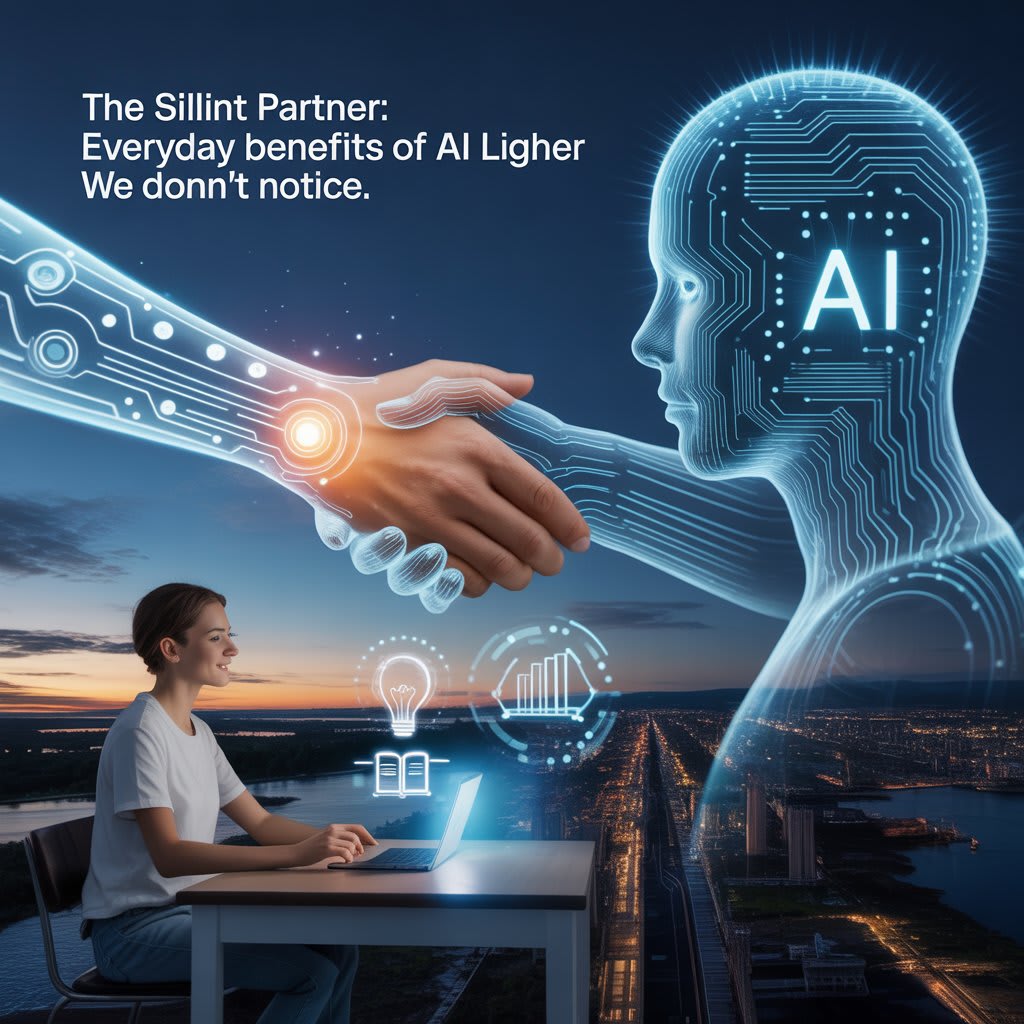
The Silent Partner: Everyday Benefits of AI We Don’t Notice
When most people hear the words artificial intelligence, their minds leap to futuristic robots, self-driving cars, or even science fiction movies where machines outsmart humanity. But the truth is, AI is not some distant dream or dystopian fear—it is already here, quietly shaping our daily lives. In fact, most of us are using AI dozens of times a day without even realizing it.
AI is not a loud invention. It is a silent partner. It works behind the scenes, making our routines easier, our choices smarter, and our opportunities broader. And while much has been said about the dangers of AI, we often overlook its many benefits—the ways it has already improved the way we live, learn, and connect.
AI as the Invisible Helper
Think about the last time you unlocked your phone with your face. That’s AI. The time you asked Google Maps to find the fastest route home? AI again. The moment you got a Netflix recommendation for a movie that matched your mood perfectly? You guessed it—AI was at work.
These systems quietly analyze patterns—your face shape, traffic flows, your viewing history—and make life smoother without demanding credit. It’s almost like having a friend who knows what you need before you even ask.
AI in Healthcare: A Lifesaver in Silence
One of the most powerful benefits of AI is happening where most of us never see it: in hospitals and labs. AI systems now help doctors read X-rays and MRIs faster and more accurately than ever before. They can flag tumors too small for the human eye to notice, suggest treatment plans, and even predict patient risks before symptoms appear.
During the COVID-19 pandemic, AI models helped researchers track the spread of the virus and speed up vaccine research. While doctors, nurses, and frontline workers became the heroes we saw, AI was one of the heroes we didn’t.
For patients, this means earlier diagnoses, quicker treatments, and more lives saved.
AI in Education: Personalized Learning
Every student learns differently—some need visual examples, others need slow repetition, and some thrive with interactive exercises. In the past, one teacher couldn’t always meet every student’s unique pace. But AI is changing that.
Educational platforms now use AI to create personalized study plans, recommend exercises, and even provide real-time tutoring. Imagine a math app that sees where you struggle with fractions and instantly adjusts the lesson to help you master it. That’s not science fiction—it’s already happening.
For students like me, who sometimes stare at a page feeling stuck, AI offers not just answers, but guidance—gentle nudges that keep learning from turning into frustration.
AI at Work: Boosting Human Creativity
Some people fear AI will “steal jobs,” but in many cases, it is becoming more of a collaborator than a competitor. At workplaces, AI automates repetitive tasks like scheduling, sorting emails, or analyzing data. This frees humans to focus on what we do best: creativity, problem-solving, and empathy.
Writers use AI to brainstorm titles and generate prompts (much like this one). Designers use it to test concepts. Businesses use it to understand customers better and serve them faster. Far from replacing people, AI often amplifies what people can do.
Think of it this way: calculators didn’t replace mathematicians, and cameras didn’t replace painters. AI won’t replace us either—it will reshape us, pushing us toward deeper creativity.
AI in Daily Life: Small Miracles We Forget
The beauty of AI lies in its subtlety. We may not thank AI every day, but it’s there:
When spam filters protect us from endless junk emails.
When our smart speakers play music just from a voice request.
When translation apps break language barriers instantly.
When weather forecasts predict storms and save lives.
These are not flashy inventions. They’re everyday miracles—things our grandparents couldn’t have imagined, things we now take for granted.
The Human Side of AI
Of course, AI is not perfect. It can make mistakes, reflect biases, or be misused. But that’s where human responsibility comes in. AI is a tool—like fire, electricity, or the internet. What matters is how we choose to use it.
And when we use it wisely, AI doesn’t just benefit us as individuals—it benefits society. It creates access for people with disabilities through voice recognition and text-to-speech. It gives farmers weather predictions that protect crops. It helps humanitarian organizations plan disaster responses faster.
In short, it doesn’t just make life convenient—it makes life fairer, safer, and more connected.
Why We Should Notice the Silent Partner
Sometimes the best partners in life are the ones who don’t demand recognition—the ones who work in the background, making our path smoother. That is what AI has become for us.
It’s in our phones, our schools, our hospitals, our workplaces, and even our entertainment. It’s woven into the fabric of our lives, not to dominate us, but to assist us.
When I think about the future of AI, I don’t see a world where machines replace us. I see a world where machines quietly stand beside us—helping us write our stories, heal our bodies, expand our knowledge, and connect with one another across barriers we once thought unbreakable.
AI isn’t loud. It isn’t flashy. But it’s here, in every corner of our day, a silent partner we rarely thank.
Maybe it’s time we did
About the Creator
Keep reading
More stories from hazrat ali and writers in Geeks and other communities.
Conversations with the Stars
Conversations with the Stars There are nights when silence feels heavy, and the world seems to fold into itself. On those nights, I step outside and tilt my face toward the sky. The stars are always there—sometimes clear, sometimes faint, sometimes hidden entirely—but even when I cannot see them, I know they are burning, whispering, existing far beyond my reach.
By hazrat ali7 months ago in Humans
The Politics of Playing Dress-Up
Well, to start off I'd like to say a happy world book day to all who celebrate. I know I haven't really posted anything on my socials about it but I'm not a jubilant kind of person. I lay low most of the time. Let's start off with a popular anecdote from the vaults...
By Annie Kapur4 days ago in Geeks
Stand By Me: A Timeless Journey of Friendship Returns to Theaters for Its 40th Anniversary
Few films capture the bittersweet ache of growing up as powerfully as Stand By Me. Adapted from Stephen King’s novella The Body, Rob Reiner’s 1986 classic remains a cultural touchstone—an intimate portrait of childhood friendship, grief, courage, and the moment innocence gives way to something more complicated. As the film approaches its 40th anniversary, AMC Theatres is bringing it back to the big screen, giving longtime fans and new audiences the chance to rediscover its magic.
By Kristen Barenthaler3 days ago in Geeks


Comments
There are no comments for this story
Be the first to respond and start the conversation.