
The Role of Oracles in Blockchain: Bridging the On-Chain and Off-Chain Worlds
This blog explores the definition, types, architecture, working mechanisms, use cases, challenges, and future trends of oracles in blockchain, highlighting their significance in decentralized applications (dApps).

Introduction to Oracles in Blockchain
Definition and Purpose of Oracles
Oracles in blockchain are third-party services that supply smart contracts with external data, allowing blockchains to interact with real-world information like market prices, weather conditions, and event outcomes. These oracles serve as intermediaries, bridging the gap between on-chain and off-chain environments. By doing so, they enhance the functionality and versatility of blockchain applications. With the help of oracles, blockchain application development services can create more robust and dynamic solutions, expanding the potential of blockchain technology across various industries and use cases.
Importance of Oracles for Decentralized Applications
In decentralized applications, the need for reliable and accurate data is paramount. Oracles in blockchain facilitate this by ensuring that smart contracts can execute based on real-time information. This capability is essential for various sectors, including finance, supply chain, and insurance, where decisions often rely on external data.
Types of Oracles
Oracles in blockchain can be categorized into several types based on their functionality and data sources.
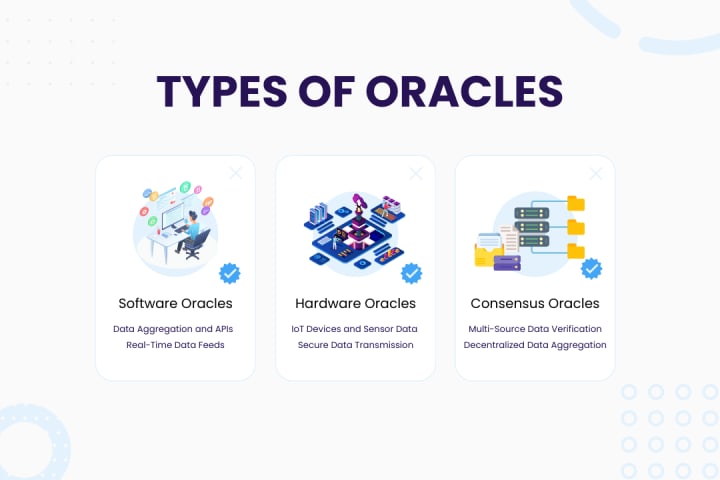
Software Oracles
- Data Aggregation and APIs
Software oracles utilize APIs to aggregate data from multiple sources. They collect and verify information before delivering it to smart contracts, ensuring that the data is accurate and reliable.
- Real-Time Data Feeds
Real-time data feeds provided by software oracles are crucial for applications that require up-to-the-minute information, such as cryptocurrency trading platforms and financial services.
Hardware Oracles
- IoT Devices and Sensor Data
Hardware oracles leverage Internet of Things (IoT) devices to gather data from the physical world. These devices can provide real-time information, such as temperature readings or location data, which can be used in smart contracts.
- Secure Data Transmission
Hardware oracles ensure secure data transmission from IoT devices to the blockchain, maintaining data integrity and authenticity throughout the process.
Consensus Oracles in Blockchain
- Multi-Source Data Verification
Consensus oracles aggregate data from multiple sources to verify its accuracy. This approach minimizes the risk of relying on a single data provider, enhancing the reliability of the information.
- Decentralized Data Aggregation
By decentralizing data aggregation, consensus oracles in blockchain reduce the potential for manipulation and ensure that the data used in smart contracts is trustworthy.
Technical Architecture of Oracles
Understanding the technical architecture of oracles in blockchain is essential for grasping their functionality.
Oracle Design Patterns in Blockchain
- Direct vs. Indirect Oracles in Blockchain
Direct oracles in blockchain fetch data from a single source, while indirect oracles aggregate data from multiple sources. The choice between these patterns depends on the specific requirements of the application.
- Push vs. Pull Mechanisms in Oracles
Oracles in blockchain can operate on push or pull mechanisms. In a push mechanism, data is sent to the blockchain as it becomes available, while in a pull mechanism, the blockchain requests data at specified intervals.
Data Flow and Communication Protocols for Oracles in Blockchain
- API Integration and Data Retrieval
APIs play a vital role in the data flow of oracles in blockchain. They facilitate the retrieval of external data and ensure seamless communication between the oracle and the blockchain.
- Messaging Protocols (e.g., WebSockets, HTTP) for Oracles
Messaging protocols like WebSockets and HTTP are used for real-time communication between oracles in blockchain and smart contracts, enabling efficient data transfer.
Security Considerations for Oracles in Blockchain
- Data Integrity and Authenticity in Oracles
Ensuring data integrity and authenticity is critical for oracles. Techniques such as cryptographic signatures and hashing are employed to verify the data before it reaches the blockchain.
- Mitigating Single Points of Failure in Oracles
To enhance security, oracles must be designed to avoid single points of failure. This can be achieved through decentralization and redundancy in data sources.
Working Mechanism of Oracles
Data Collection and Verification Process
The working mechanism of oracles begins with data collection from various sources. Once the data is gathered, it undergoes a verification process to ensure its accuracy. This step is crucial as it determines the reliability of the information that will be fed into smart contracts.
Interaction with Smart Contracts
After verification, oracles interact with smart contracts by delivering the validated data. This interaction triggers the execution of predefined conditions within the smart contract, allowing for automated processes based on real-world events.
Feedback Loop for Continuous Improvement
To maintain accuracy and reliability, oracles in blockchain often implement a feedback loop. This mechanism allows for continuous monitoring and adjustment of data sources, ensuring that the information remains up-to-date and relevant.
Use Cases of Oracles
Financial Services and DeFi
In the financial sector, oracles in blockchain are essential for decentralized finance (DeFi) applications. They provide real-time price feeds for assets, enabling functionalities such as lending, borrowing, and trading without relying on centralized entities.
Supply Chain Management
Oracles enhance supply chain transparency by providing real-time tracking data. This information can include shipment status, temperature conditions, and other critical metrics that ensure product integrity throughout the supply chain.
Insurance and Risk Management
In the insurance industry, oracles in blockchain facilitate automated claims processing by providing verified data related to events, such as natural disasters or accidents. This capability streamlines the claims process and reduces the potential for fraud.
Challenges Facing Oracles in Blockchain
Data Reliability and Trust Issues
One of the primary challenges for oracles in blockchain is ensuring the reliability of the data they provide. If the data source is compromised or inaccurate, it can lead to erroneous outcomes in smart contracts.
Security Vulnerabilities
Oracles in blockchain are susceptible to various security threats, including data manipulation and attacks on the oracle itself. Ensuring robust security measures is essential to protect the integrity of the data being transmitted.
Regulatory and Compliance Concerns
As oracles in blockchain bridge the gap between decentralized systems and real-world data, they may face regulatory scrutiny. Compliance with local laws and regulations is crucial for the widespread adoption of oracles in various industries.
Future Trends of Oracles in Blockchain
Increased Adoption of Decentralized Oracles
The future of oracles is likely to see a shift towards decentralized solutions. This trend will enhance data reliability and reduce the risks associated with single points of failure.
Integration with Emerging Technologies
As technologies like artificial intelligence and machine learning evolve, oracles in blockchain will increasingly integrate with these advancements. This integration will enable more sophisticated data analysis and decision-making processes.
Enhanced Security Protocols
To address the challenges faced by oracles, the development of enhanced security protocols will be a priority. Innovations in cryptography and data verification methods will play a significant role in securing oracle operations.
Conclusion
Oracles are vital components that enable smart contracts to interact with real-world data. Their ability to bridge the gap between on-chain and off-chain environments enhances the functionality of decentralized applications across various sectors. As the technology continues to evolve, the importance of oracles in blockchain will only grow, paving the way for more innovative and reliable solutions in the blockchain ecosystem.
About the Creator
Richard Kaplan
An SEO Executive with expertise in driving organic growth through effective strategies. Skilled in keyword research, on-page optimization, and content development, focused on improving website performance and increasing online visibility.
Keep reading
More stories from Richard Kaplan and writers in Geeks and other communities.
Building a Data Lake with Hadoop: A Practical Guide
1. Introduction What is a Data Lake? A data lake is a centralized storage repository that can hold vast amounts of raw data in its native format, including structured, semi-structured, and unstructured data. Unlike traditional databases or data warehouses, which are optimized for structured data and have rigid schemas, data lakes allow for more flexible data storage and analysis, making them ideal for big data applications.
By Richard Kaplan11 months ago in Geeks
Bombardier Challenger 650 Crash
The Bombardier Challenger 650 is widely regarded as one of the most reliable large-cabin business jets in the world. Known for its long-range capability, advanced avionics, and strong safety record, the aircraft is used by corporations, charter operators, and government agencies alike. When news of a Challenger 650 crash surfaces, it naturally raises concerns across the aviation community and the general public. Understanding what such an incident means—and what it does not—requires careful examination rather than speculation. Understanding the Challenger 650 Platform The Challenger 650 is an evolution of the Challenger 600 series, a family of aircraft that has been flying for decades. Bombardier designed the 650 with a focus on performance consistency, pilot workload reduction, and passenger comfort. It features the Collins Aerospace Pro Line 21 avionics suite, advanced weather radar systems, and enhanced situational awareness tools that help crews manage complex flight environments. Because of these features, the aircraft has built a reputation for dependable operation in a wide range of weather conditions and airports. This makes any reported crash involving the Challenger 650 particularly noteworthy, not because the aircraft is considered unsafe, but because such incidents are relatively rare. What Typically Happens After a Business Jet Crash When a Bombardier Challenger 650 is involved in a crash or serious incident, aviation authorities immediately begin a structured investigation. Depending on the location, this may involve agencies such as the National Transportation Safety Board (NTSB), the Transportation Safety Board of Canada (TSB), or other international aviation regulators. Investigators focus on multiple factors, including flight data, cockpit voice recordings, weather conditions, air traffic communications, maintenance history, and crew training records. Importantly, these investigations avoid early conclusions. Aviation safety is built on evidence, not assumptions, and final reports can take months—or even years—to complete. Human Factors and Operational Complexity In many aviation incidents involving business jets, human factors play a significant role. This does not necessarily imply pilot error, but rather highlights the complexity of modern flight operations. Business jet crews often operate into smaller airports, deal with tight schedules, and fly long sectors that can contribute to fatigue. The Challenger 650 is designed to reduce these pressures through automation and advanced warning systems. However, no aircraft can fully eliminate risk. Decision-making under stress, rapidly changing weather, or unexpected mechanical alerts can challenge even experienced crews. Investigators typically analyze how these elements interacted during the moments leading up to a crash. Mechanical Issues and Maintenance Oversight Another area of focus in any Challenger 650 crash investigation is the aircraft’s mechanical condition. Business jets operate under strict maintenance programs governed by both manufacturers and aviation authorities. Components such as engines, flight controls, and avionics are inspected on defined schedules. If a mechanical failure is suspected, investigators work closely with Bombardier and component manufacturers to determine whether the issue was isolated or part of a broader pattern. In many cases, findings from a single incident lead to service bulletins or procedural updates that enhance safety across the entire fleet. The Role of Weather and Environment Weather remains one of aviation’s most unpredictable variables. Even with modern forecasting tools, conditions such as wind shear, icing, or sudden visibility changes can significantly affect flight operations. Business jets like the Challenger 650 are certified to handle challenging weather, but environmental factors are always examined closely following a crash. Terrain and airport layout are also critical considerations. Approaches into mountainous regions, short runways, or airports with limited navigation aids can increase operational demands. These environmental factors are evaluated alongside crew actions to form a complete picture of what occurred. Why One Crash Does Not Define an Aircraft It is important to place any Bombardier Challenger 650 crash into proper context. Aviation history shows that no aircraft type is immune to accidents, regardless of its safety record. What matters most is how the industry responds. Each investigation contributes valuable data that helps improve training, procedures, and technology. The Challenger 650 continues to be operated safely around the world, completing thousands of flights every year. Its overall reliability and performance history remain strong, and operators continue to choose it for missions that demand range, comfort, and operational flexibility. Lessons Learned and Ongoing Improvements If an investigation reveals contributing factors—whether technical, operational, or environmental—those findings often lead to meaningful change. These can include updated pilot training modules, revised approach procedures, software enhancements, or maintenance guidance. This continuous improvement cycle is a cornerstone of aviation safety. Crashes, while tragic, often lead to advancements that prevent similar events in the future. The Challenger series, like many long-standing aircraft families, has benefited from decades of incremental safety enhancements driven by real-world data. A Measured Approach to Aviation News Public interest in aircraft crashes is understandable, but responsible reporting and analysis are essential. Early reports may be incomplete or inaccurate, and speculation can overshadow verified facts. For readers and aviation enthusiasts alike, patience is key while investigators do their work. A Bombardier Challenger 650 crash should be viewed as an isolated event until evidence suggests otherwise. The broader picture of business aviation safety remains one of steady progress, rigorous oversight, and a strong commitment to learning from every incident. Final Thoughts The Bombardier Challenger 650 stands as a reminder that modern aviation is both highly advanced and deeply human. While crashes are rare, they serve as critical learning opportunities for the entire industry. Through thorough investigation and transparent reporting, each incident helps make future flights safer. As investigations continue and facts emerge, the focus should remain on understanding—not assigning blame—and on supporting the systems that keep business aviation among the safest forms of travel in the world.
By Saboor Brohi 43 minutes ago in Geeks




Comments
There are no comments for this story
Be the first to respond and start the conversation.