
The Punisher’s Skull Has Been Hijacked
Why right-wing figures, including political figures, misunderstand Marvel’s most misused symbol.


Trigger Warning: This article discusses violence, vigilantism, and extremist ideology.
Frank Castle’s white skull emblem, adorning the Punisher’s chest, is one of the most misinterpreted and misappropriated symbols in comic book history. Marvel’s tragic antihero, the Punisher, is not meant to glorify lawlessness or authoritarian revenge; instead, he serves as a cautionary tale about the dangers of an individual's moral code overriding the very concept of justice.
Despite this, right-wing extremists, police officers, and militia groups, who display it on military gear, police cruisers, tactical vests, and protest flags, have adopted for years the Punisher’s skull. This symbol, originally intended to reflect society’s failings, has been decontextualized as a symbol of domination and misguided “patriotism.” Those who brandish it today misunderstand both the character and his underlying message.
A Symbol of Grief, Not Glory

Frank Castle, introduced in The Amazing Spider-Man #129 (1974), is a decorated Marine who lost his family to a brutal murder by mobsters. This traumatic event, rather than any triumph, defines his story. Consumed by rage and stripped of purpose, he becomes "The Punisher," a lone warrior against organized crime.
The Punisher was never intended to be a traditional hero like Captain America. His vigilantism operates outside the law, a rejection of the very institutions that once shaped him. The skull on his chest, designed to draw gunfire to his body armor, symbolizes his self-destructive obsession with retribution.
As The Guardian reported in 2020, the skull was "never meant to glorify violence or police authority—it critiqued them." Comic writers such as Garth Ennis and Jason Aaron have consistently depicted Castle as a man tormented by loss, highlighting the moral corrosion and psychological unsustainability of his war on crime.
This theme continues in the most recent MCU portrayal in Daredevil: Reborn, where Jon Bernthal's Castle is haunted, guilt-ridden, and painfully aware that his actions offer no peace. He is, ultimately, an embodiment of tragedy, not triumph.
The Misappropriation: From Comic Panels to Riot Gear

The Punisher's skull emblem, which first appeared on police and military uniforms in the early 2000s as a symbol of defiance and camaraderie among American troops, particularly in Iraq and Afghanistan, underwent a significant transformation. Upon its spread to the United States, the emblem developed into a political symbol, representing hyper-militarized masculinity and, subsequently, extremist rebellion.
Its widespread presence was undeniable by the time of the January 6th Capitol riot, where many rioters, who considered themselves righteous insurgents, wore Punisher logos. This misuse drew public condemnation from Jon Bernthal, who has portrayed Frank Castle since the character's debut in The Punisher Netflix series (2017-2019). Bernthal stated, "These people are missing the point. The Punisher represents the failure of law and order, not its triumph.”
Alarmed by this appropriation, Marvel, a Disney-owned company, responded in 2021 by retiring the original skull logo and later completely redesigning it. Extremists distorting the symbol's original meaning beyond recognition prompted this creative decision.
The Core Misunderstanding: Frank Castle vs. The System
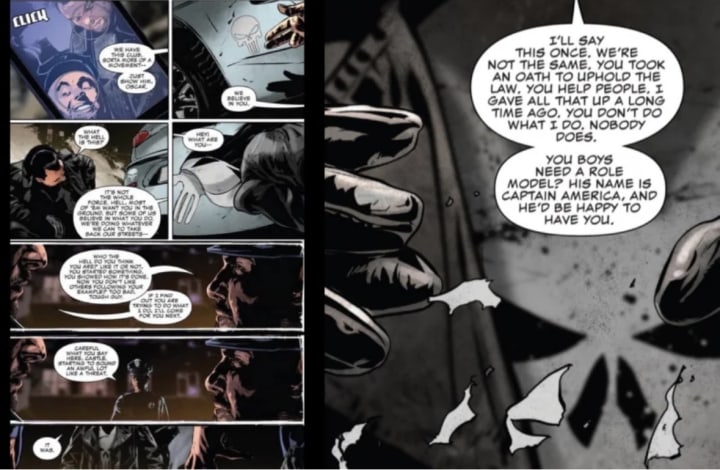
Right-wing extremists entirely misinterpret The Punisher’s core message. Frank Castle is a cautionary tale, not an inspirational figure. His story illustrates the moral and psychological destruction that results when vengeance overshadows justice.
In The Punisher: War Journal (Vol 2), Castle himself rebukes police officers who admire him, stating, "You boys need a role model. You don’t get to wear that symbol. You obey the law. You help people."
This distinction forms the narrative's moral backbone. Castle’s vigilantism doesn't redeem society's corruption; it mirrors it. The skull symbol is not a banner of authority, but an indictment of its collapse.
The Punisher and the Police: A Dangerous Fusion
Using the Punisher skull by the police is a troubling development in the symbol's history. It is often seen alongside Thin Blue Line imagery, transforming a vigilante symbol into a declaration of unity or a threat.
However, as Guardian co-creator Gerry Conway pointed out, this application is "disturbing and ironic" because Frank Castle's skull signifies "the failure of the justice system, not its enforcement."
When law enforcement adopts a vigilante's emblem, the distinction between protector and executioner becomes dangerously unclear. The symbol no longer represents service; instead, it serves as a warning of impunity.
A New Phase of Misuse: A “Challenge” Coin?

The Punisher skull, originally a symbol critiquing unchecked violence, has increasingly permeated extremist and political spheres. An October 2025 report from The Atlantic revealed that FBI Director Kash Patel designed and distributed a "challenge coin" featuring a design resembling the Punisher skull.
This coin, bearing Patel's name, the FBI seal, and a tommy gun, was shared among his associates, according to MSNBC journalist Ken Dilanian. Described by Tom Nichols in The Atlantic as "something kids used to pop the caps off beer bottles at a gaming meetup," the stylized skull design sparked online mockery and reignited discussions about how pop-culture symbols can become political totems.
This incident underscores how the Punisher's emblem can be detached from its original context and co-opted as a partisan collectible. It also highlights Marvel's ongoing challenge in safeguarding its intellectual property from political or ideological misuse that deviates significantly from the character's intended meaning.
Marvel’s response: Reclaiming the Symbol

Marvel’s 2022 Punisher series by Jason Aaron saw a deliberate decision to retire and redesign the iconic skull symbol. This move was driven by both aesthetic and ethical considerations. In the series, Frank Castle joins the Hand, a ninja cult that manipulates him, leading to his corruption. His new symbol, a stylized, horned skull, visually represents this corrupted identity, signaling a clear narrative departure from the logo that had been co-opted by extremist groups.
This creative reclamation allows Marvel to regain control over the symbol’s meaning. It emphasizes that Castle’s narrative is not about domination, but about moral failure and profound loss. By detaching the skull from its association with extremists, Marvel reintroduces the potential for nuance and, perhaps, even redemption in the character's story.
The Cultural Reckoning: Storytelling, Symbols, and Responsibility

The Punisher skull's developing symbolism highlights how cultural images can be both fluid and impactful. Initially representing grief and moral complexity, it has been co-opted by those who admire unbridled power.
However, popular culture also possesses the power to reclaim its symbols. Through reimagined portrayals, fans and artists have transformed the skull into a symbol of resistance against systemic injustice, aligning with the core tension of The Punisher's narrative: the delicate balance between vengeance and justice, destruction and redemption.
With the character's return to the MCU in Daredevil: Reborn, Marvel's creative team appears ready to continue this exploration. Jon Bernthal's portrayal of Frank Castle depicts a man grappling with pain and morality, not a simplistic hero, reinforcing that unchecked rage leads to tragedy, not heroism.
Symbols Have Consequences
The appropriation of the Punisher skull by right-wing and politically opportunistic groups shows a profound misinterpretation of Frank Castle's character and the principles of justice and restraint his story explores.
Frank Castle is not a righteous soldier, but a man broken by his inability to forgive. Wearing his symbol as a badge of pride disregards his pain and glorifies his tragic downfall.
Marvel's renewed efforts, along with voices like Jon Bernthal's, to clarify the skull's true meaning offer an opportunity to correct this misunderstanding. The skull signifies loss, not power, and should never be used as a symbol of extremist vanity, whether on riot gear or political challenge coins.
Symbols hold power, but they lose their essence when separated from their narratives. To truly honor the Punisher is not to wear his skull, but to comprehend the reasons he bears it.
Sources
- The Guardian. “How Do You Stop the Far Right Using the Punisher Skull? Make It a Black Lives Matter Symbol.” June 11, 2020.
- Yahoo! Entertainment. “The Punisher, Jon Bernthal, and the Capitol Hill Rioters: Marvel’s Hero and the Skull Symbol Controversy.” January 2021.
- Coffee or Die Magazine. “Marvel Cancels Punisher Logo.” March 2022.
- Courier News Room. “Kash Patel Has Created His Own Challenge Coin, Hopping on Old Military Tradition.” 2025.
- Tom Nichols, The Atlantic, commentary quoted in Courier News Room.
- Ken Dilanian (@DilanianMSNBC), Twitter/X post on Patel’s coin imagery.
- The Punisher: War Journal (Vol. 2) and The Punisher (2022) by Jason Aaron.
- MCU Series: Daredevil: Reborn (Disney+, 2025).
- YouTube: “The Misuse of The Punisher Symbol | Nerdstalgic.”
About the Creator
Jenna Deedy
Just a New England Mando passionate about wildlife, nerd stuff & cosplay! 🐾✨🎭 Get 20% off @davidsonsteas (https://www.davidsonstea.com/) with code JENNA20-Based in Nashua, NH.
Instagram: @jennacostadeedy
Keep reading
More stories from Jenna Deedy and writers in Geeks and other communities.
From Tragedy to Terror: Wanda Maximoff’s Path to the Queen of the Dead.
Spoiler Alert: This article contains detailed story spoilers for Marvel Animation's Marvel Zombies (2025), along with major plot references from WandaVision, Doctor Strange in the Multiverse of Madness, and several Scarlet Witch comic storylines, including "Avengers Disassembled" and "House of M."
By Jenna Deedy3 months ago in Geeks
The Rachels - 2025
Much to my surprise, I have kept a list of the films I‘ve seen this year. I daresay it isn’t complete. There will be films that snuck in on a late night in front of the TV that I would’ve forgotten to note. Or others, that I went to watch at the cinema, but then had a red wine and promptly forgotten about. But it’s not a bad approximation of the films I’ve seen this year. In total, there are 53 films listed, so an average of one a week and one for good luck.
By Rachel Robbins16 days ago in Geeks
'20/20'
"Do It Again" the track that would ultimately open the Beach Boys final album on Capitol Records which was released on February 10th 1969 had originally been released as a single in August of 1968. The track was the first of many post-Pet Sounds era throwbacks to the early Beach Boys sound which would become continually more cliched and eventually lead the Beach Boys to the level of self-parody they would eventually succumb to in the 1980s while their closest contemporaries The Beatles nearing the end of their run in 1969 would go on to be viewed as the most influential band of all time. However, the song itself is not bad on its surface, and it opens with a futuristic sounding (for 1969) drumbeat captured by then-Beach Boys engineer Stephen Desper using tape delays on the drums performed by Dennis Wilson and John Guerin. The song has been re-recorded numerous times over the years on various Beach Boys-related projects most notably the 2011 re-recording at Capitol studios featuring the five surviving Beach Boys at the time backed instrumentally by various members of both the Brian Wilson Band and Mike Loves touring "Beach Boys" to promote the then upcoming Beach Boys 50th Anniversary reunion tour in 2012. The hammering and power drill sound at the end of the song was an excerpt from a track called "Workshop" that was to be a part of the uncompleted "SMiLE" album.
By Sean Callaghan6 days ago in Beat


Comments
There are no comments for this story
Be the first to respond and start the conversation.