
The Non-Fan's Guide to Godzilla Films
Part 1: The Original Series (1954-1975)


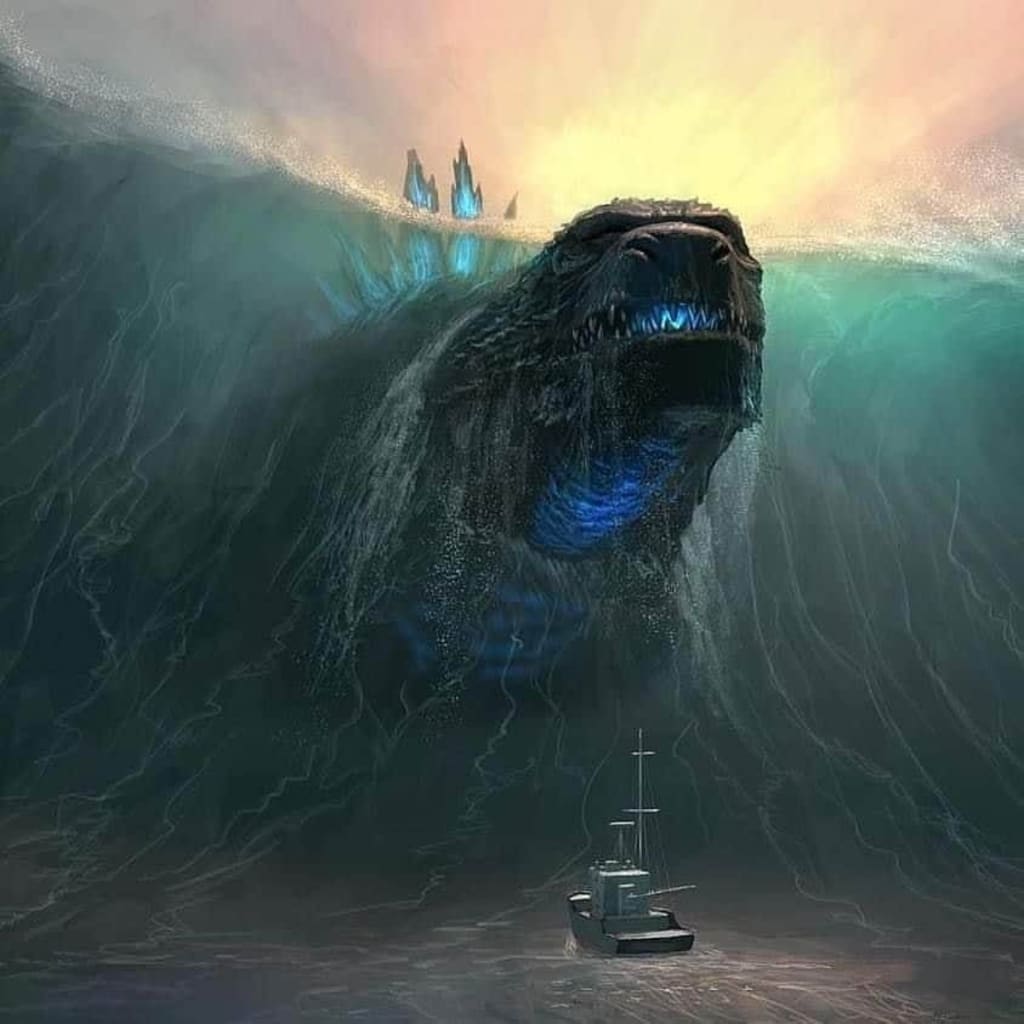
The opinion of those who don't watch Godzilla films tends to be that all Godzilla films are essentially the same, he just fights a different monster and the effects get better. But that's not exactly true. Sometimes he's the villain attacking humanity, sometimes he's the hero trying to save the world. And the approach to the films has changed greatly since the first film was released by Toho Productions in 1954. While few people will want to watch every film in the series, chances are you'll enjoy at least a few of them. Following is a guide from the first to the most recent films with reasons why you may want to watch each one, or give one a pass.
Godzilla aka Gojira (1954)

I've long included this film on lists of must-see horror films because it's shot that way. It's a dark film in which, like "Jaws," released 2 decades later, you don't even see the monstrous antagonist until a relatively late part of the film. You see a bit here, a bit there, you see Godzilla's effect on things. You see the ships he destroys, and the suspense grows in you as it does with the characters on-screen because something is out there of enormous size and power. And then, there he is, towering among buildings, literally chewing up a train carrying untold numbers of people, shrugging off jolts of electricity as he walks through power lines. Godzilla is an incredible force of nature who could destroy the world unless he's stopped by science.
And that theme is where Godzilla as a series begins. He is a walking analogy for the atomic bomb, filmed 9 years after the cities of Nagasaki and Hiroshima were destroyed in World War II. He is nature's response to what humanity has done to the world.
The film is well worth seeing. Disregard the now-crude effects seen later in the film and appreciate it for what it is and the story it tells. It should be noted that there are at least two versions of the film, the original, and the American release starring "Perry Mason" star Raymond Burr. For the casual viewer, either version is worth seeing. But "Gojira," particularly the remastered re-release, is a better film.
Godzilla Raids Again (1955)
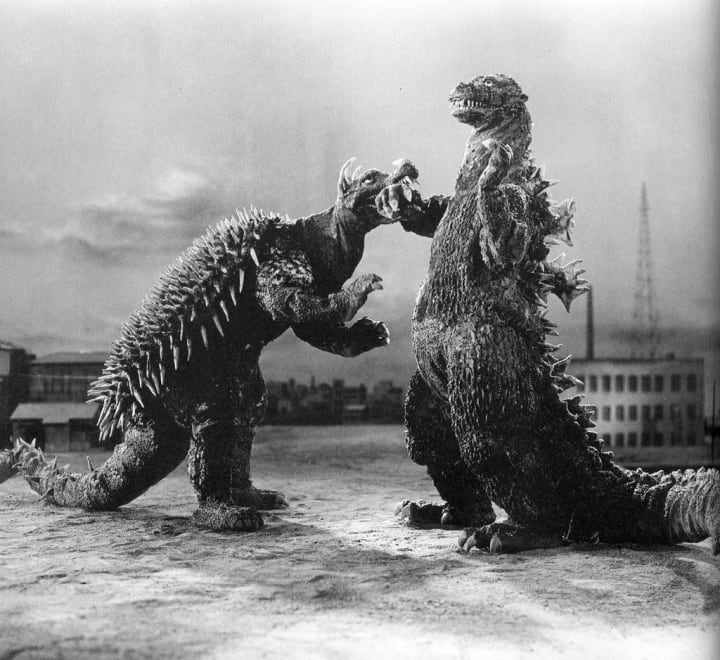
Also known as "Godzilla Returns," this is one of the most infrequently aired films in the franchise. It took me years to find it, though it's a bit easier to obtain and see now. It features Anguirus, an ankylosaurus, who appears in several of the later films in the series as one of Godzilla's allies, but in this film is a secondary antagonist who is reported to be an ancient adversary of Godzilla's species, which is a theme that has been repeated multiple times now, as recently as "Godzilla vs. Kong" (2021).
Overall the film is good, and two things are particularly noteworthy. First, it's established that Godzilla from the first film is still dead. This monster is a second member of Godzilla's species. Second, Godzilla, the original Godzilla, and now Anguirus are all ancient dinosaur species who had been in hibernation deep underground or in the sea who have been awakened by humanity's testing of hydrogen and atomic bombs, continuing the theme that testing and use of atomic weapons should be stopped before humanity destroys itself or nature strikes back.
Similar to Universal's monster movies from the 1930s and 40s, Toho seemed to realize that there was potential for an ongoing series of films, and so it ends not with Godzilla destroyed, but buried in ice, where he could be brought back for future films.
King Kong vs. Godzilla (1962)
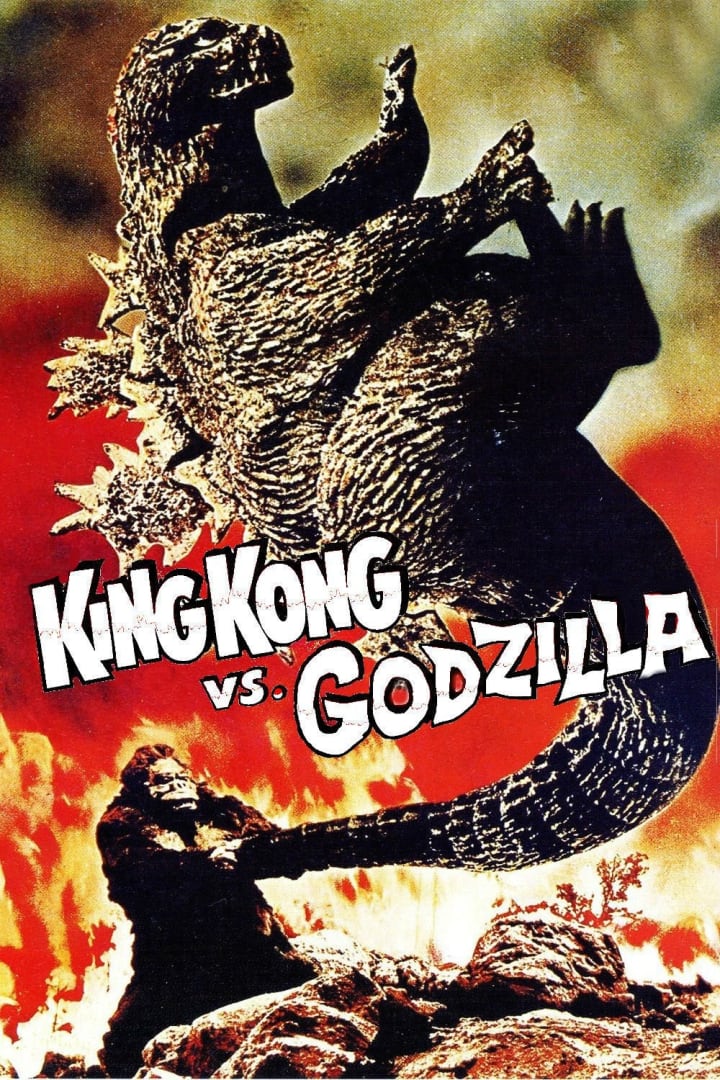
A landmark film in both the Kong and Godzilla franchises, marking the third film for each character, and the first time each was seen in both color and widescreen. It still holds the record for the most-attended Godzilla film in Japan, and is credited for reinvigorating the series.
Initially intended to be a Kong film in which Kong is captured by a pharmaceutical company (Kong is typically captured by business types with nefarious purposes), a later revision replaced Kong's original opponent, a giant Frankenstein monster, with Godzilla, who is reawakened by an American submarine.
Kong initially fights a giant octopus early in the film, when it attacks the island he has called home. Later, Kong and Godzilla encounter each other and Godzilla overpowers Kong. Before their rematch Kong powers himself up with lightning from a thunderstorm, an ability he had never demonstrated before.
As with the original Godzilla film, an American version of the film was released, heavily edited, with added American characters. Despite the common misconception, the ending of the American film does not differ from the original Japanese film. Kong is still in the victor of the final battle in both films. But the edits and additions in the American film do not increase quality.
Mothra vs. Godzilla (1964)

Thirty years after Universal created a shared universe for characters such as Dracula and the Wolf Man, Toho Productions created a shared world for Godzilla and other giant monsters, starting with Mothra, who had a solo debut with "Mothra" in 1961.
Once again, Godzilla is featured as the villain of the film, with Mothra representing a force for good. Godzilla is an atomic-powered nightmare threatening to destroy Japan, if not all humanity, while Mothra is a natural god-figure worshiped by a primitive Pacific culture, rising up at the request of humanity to stop Godzilla.
In the earliest Godzilla films, the parts of the films devoted to the human cast are a forgettable, even annoying distraction from the main action involving the monsters. However to keep the film together as a film, and to make the action relatable to people, the humans are needed, since Godzilla himself doesn't speak, and a movie featuring nothing but two monsters beating on each other would be difficult from a storytelling perspective. However, this film stands out as an exception, particularly among the early films in the series.
There is one scene in which the human antagonist is savagely beating one of the other characters in a high-rise building while Godzilla destroys the city. What makes this scene remarkable is first, it's rather graphic and bloody, particularly for 1964. At the time fight scenes tended to be brief, and even extended ones were bloodless. Someone might end up with a cut lip or a bloody nostril, but this character is shown with largely realistic damage. Second, as that happens, we can see Godzilla approaching through the window behind them, and then tension builds and builds until Godzilla fills the window and we're given the perspective that while all this horrid human drama is unfolding inside that room, it's nothing compared to the doom approaching that is Godzilla, who takes note of the men and lays waste to them in spectacular fashion.
Ghidorah, the Three-Headed Monster (1964)
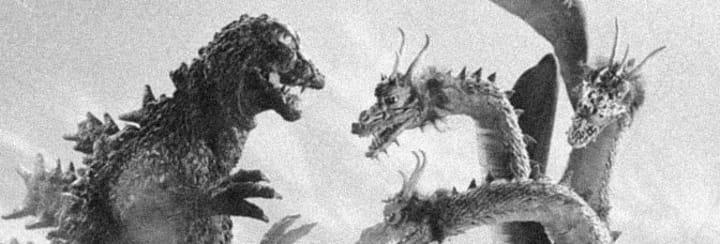
The second Godzilla film released in 1964, this one features Godzilla, Mothra, and a new ally, the flying pterosaur Rodan, joining forces to fight Ghidorah, a three-headed, lightning-spewing dragon from space. This marks the first appearance of Rodan in the Godzilla franchise after appearning in his own film "Rodan" in 1956. (Note: if you can find "Rodan," watch it. Like the original "Godzilla" film, it's more like a horror film and is fairly scary, with sequences of humans exploring a flooded mine while being picked off by hatchling pterosaurs).
This one has all the landmarks of what went on to make Godzilla films good. The tiny fairy women from Infant Island seen in Mothra's previous appearances show up to warn humanity of imminent danger, then summon Mothra to help. Those of us who thought Godzilla was the worst evil and danger one could imagine are forced to reconsider as Ghidorah arrives and proves to be more than Godzilla himself can handle. Three giant monsters face off against a new monster who is three monsters in one. Similar to Marvel launching "The Avengers" in 1963, this film takes great characters and puts them together as an unlikely, but powerful team of titans who may not always like each other, but work together well.
Invasion of Astro-Monster (aka Godzilla vs. Monster Zero) 1965
This film reteams Godzilla and Rodan vs. Ghidorah the three-headed monster, aka King Ghidorah, who has been threatening an alien world, now being explored by astronauts from Earth. The citizens of that world plead with the astronauts to help them bring Godzilla and Rodan to the planet to defend them from Ghidorah. This becomes a theme in the franchise, particularly in the films involving Ghidorah, in which aliens strike at Earth with the Earth's own monster, or with a new monster, and the monsters themselves have to choose sides, with humanity in the middle.
Overall this is a solid offering in the series, and it's fun to see Godzilla and Rodan teamed up without Mothra, since the inclusion of Mothra usually involves the little fairies and the overly long sequence of them singing the song to summon Mothra. Plus the bits with aliens and space travel are campy nostalgic fun.
Ebirah, Horror of the Deep (1966)

Also known as "Godzilla vs. the Sea Monster," this is one of my least favorite Godzilla films. It just feels...routine. Uninspired. In this one, Godzilla faces off against a giant lobster, who really seems more like a giant shrimp, as well as terrorists using military and chemical weapons. Ebirah, the new monster, is really unimpressive. He's not scary, he's just kind of silly, and Godzilla takes him out rather quickly. Mothra appears in this one, initially to help out, but later fighting Godzilla in some sort of grudge match, with Ebirah skittering off to the sea in defeat while Godzilla and Mothra shrug off the battle and await future appearances in the series. There is little reason to watch this film other than to say you've seen them all.
Son of Godzilla (1967)
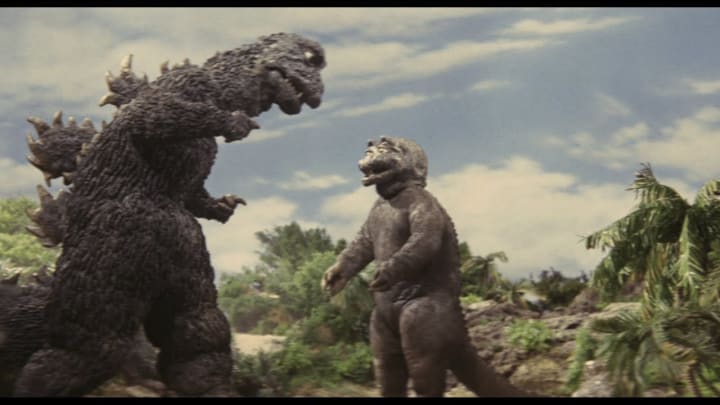
This is an odd entry in the series, in which Godzilla actually has character development, and the tone of the film is softer, with the intent of making it the kind of movie you could bring a date to, thus the inclusion of a cute baby Godzilla. The film begins as scientists conduct weather experiments on an island in the Pacific. When a radioactive baloon accidentally explodes, the radiation creates giant mantises, who dig into the island and reveal a monstrous egg. The egg hatches, releasing a baby version of Godzilla, who summons the adult Godzilla through a combination of crying and telepathy. Godzilla fights the mantises, who were threatening the baby, named "Minilla" by the human scientists. He then adopts the baby, who quickly grows to half Godzilla's size. There are additional fights involving giant spiders, before the weather control device is finally tested, bringing freezing temperatures to the tropical island, forcing Godzilla and Minilla to hibernate.
This has never been my one of my favorites in the series. I'm naturally averse to cute things presented to make me ooh and ahh, like Ewoks. However, if you do like cute things, and want to see Godzilla in the role of a doting but grumpy parent, this would be the film for you.
Destroy All Monsters (1968)

The film many fans consider the best of them all, "Destroy All Monsters" was originally intended to be the grand finale of the series, as the producers thought they had run out of ideas. The film was scripted to include all of the monsters from the previous films, as well as from other Toho films, including King Kong, but in the end it included just the major monsters: Godzilla, Rodan, Mothra, Anguirus, Minilla, and a few others who hadn't appeared in the series such as Baragon, facing off against frequent foe King Ghidorah.
The plot is simple: In the year 1999, the world is at peace and the giant monsters have been rounded up and kept confined on Monster Island, where they are continually watched by a special control center. Aliens release the monsters from the island and force them to attack Earth's major cities, threatening to destroy them all unless humanity surrenders. A defense is mounted, and the aliens summon King Ghidorah as the next wave of their assault. The monsters decide to unite against their common enemy, but the aliens aren't relying on Ghidorah alone.
If you're going to watch one film in the series, it should be this one. The plot is good, the action is good, the effects are good, it's the most bang for your buck.
All Monsters Attack aka Godzilla's Revenge (1969)
Like "Son of Godzilla," this is an odd entry in the series, and for similar reasons. This film is essentially a child's fantasy about life on Monster Island. The boy himself is bullied in real life, so he imagines that Godzilla's son, Minilla, might be bullied by monsters, and that Godzilla would protect Minilla. In his dreams, the boy becomes friends with Minilla, and as Minilla learns from Godzilla how to fight, the boy is inspired to fight back in real life.
The parts of the film involving the boy are new, but the parts involving the monsters are reused from previous films, making it a bit of a rip-off. There is a heartwarming aspect to the boy's story and the dreamy feel of the film, and if you were going to sit your young child down to watch a Godzilla film, this would be the best pick. But if you were watching as an adult, you could probably skip it.
Godzilla vs. Hedorah aka Godzilla vs. the Smog Monster (1971)
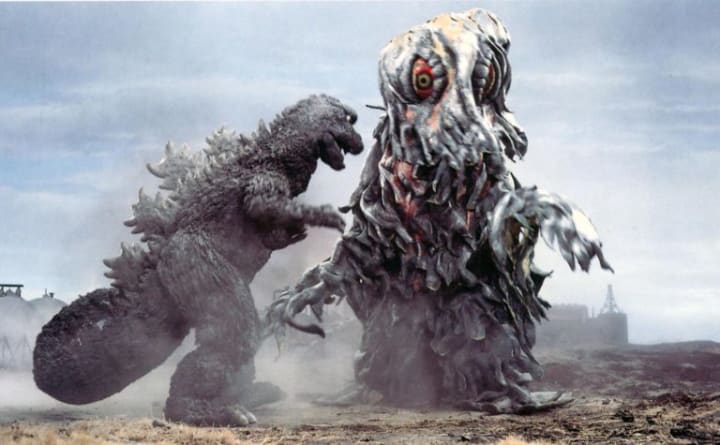
There is no other Godzilla film like this one. It's so weird and trippy the only way I can really describe it is if you mashed up a Godzilla film and an episode of the classic sit-com "Laugh-In." It has a linear plot and an ecological message, since the environment was just becoming a cause in the late 1960s and early 1970s, but at the same time it will cut to random scenes of Japanese go-go clubs or even animation. It's bizarre and goofy and I love it.
Not only is the film worth seeing because of the unique style, but because you'll see something that hasn't been seen in any Godzilla film since: Godzilla flies. He has fought flying monsters in many films, but this is the only time where he uses his breath weapon as a jet engine to launch himself backwards and fly. It's strange, it may be impossible, but it's fun to see.
Also, Hedorah, the Smog Monster is a serious opponent. Unlike most of Godzilla's foes, who have one form, Hedorah changes over time and is dangerous in all forms. There is significant concern about whether Godzilla can win, or even survive, which parallels the message of the film. In this one, Godzilla, rather than Mothra, is the champion of Earth, protecting himself and the world from Hedorah, who is a living product of the pollution mankind has released upon the world. And it's made clear: While industrial pollution is a horrible contributor to the problem, this is a problem all of us made, as objects from soda cans to stuffed animals float in the water around Japan.
Godzilla vs. Gigan (1972)
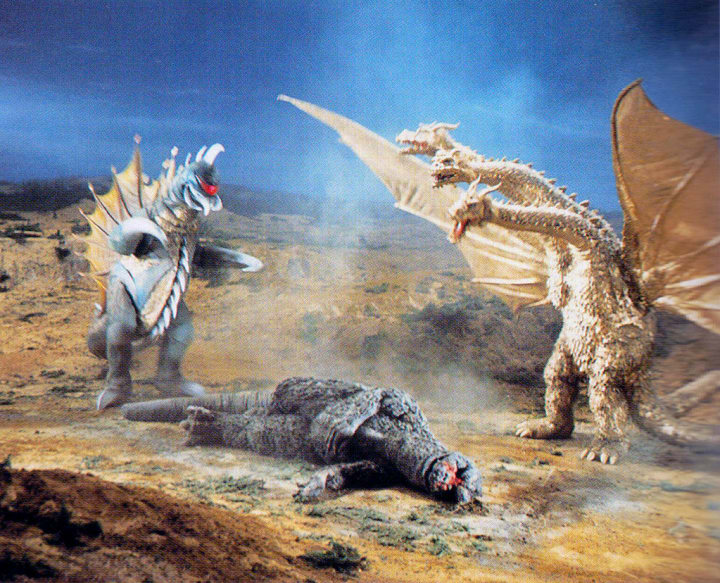
This film revisits a previous theme in the franchise, in which aliens seek to conquer Earth and use monsters, namely space dragon King Ghidorah and new foe Gigan, as weapons against humanity. This time the aliens are already on Earth, masquerading as humans. When humans learn of the plot and accidentally activate the devices that will be used to summon the monsters, the devices draw the attention of Godzilla on Monster Island, and he and Anguirus work with the humans to defend the Earth.
This is a pretty solid entry in the franchise. The films seem to hit their stride, with different teamings of monsters and different plots. Godzilla at this point frequently becomes a defender of Earth as a whole, or of the natural life on Earth, and it's interesting to see Ghidorah working with another opponent rather than being the lone villain.
The one oddball element is Gigan. In some ways he's really cool. The blades on his abdomen work like a buzzsaw, which is really scary, plus he has a 4 bladed beak and large hook like claws. These things make him a dangerous opponent, but at the same time he really just resembles a monstous chicken.
Godzilla vs. Megalon (1973)

And here's where things go off the rails a bit. If you've seen "Batman Forever" or "Batman and Robin" or "The Amazing Spider-Man 2" you know the rule of later sequels is, too much of a good thing is not better. In this case, we have a cool plot - nuclear testing sends shockwaves to Monster Island where Anguirus and Rodan are lost in a massive fissure, from which Godzilla narrowly escapes. The tests also disturb the once-peaceful and hidden Atlantis-like undersea city of Seatopia, which sends agents out across the globe to plan vengeance.
The Seatopians discover Jet Jaguar, a robot being built by a team of scientists. Jet Jaguar bears more than a passing resemblance to Japanese television and manga icon Ultraman, making this a sort-of encounter between the Japanese mega-characters. The Seatopians decide to use Jet Jaguar to guide their god-monster Megalon, who resembles an enormous beetle, across the world as their instrument of vengeance. Knowing Godzilla will get in the way, they send Megalon to Monster Island.
Eventually the Seatopians enlist their hidden allies, an alien race, who send returning foe Gigan to assist Megalon in fighting Godzilla, except Jet Jaguar starts acting independently and displaying abilities that he was not programmed for. He grows to enormous size and helps Godzilla fight Gigan and Megalon in one of the longest battles in franchise history.
That all sounds great, and having four characters worked in previous films, but in this one, you have one character, Gigan, who still resembles a big metal chicken, and another, Megalon, who seems to be a cockroach. Then you have Jet Jaguar, who is more than a little campy.
This is one of the most viewed and famous films in the series, and some people love it. It has a good plot and significant action, but if you like your Godzilla films with a bit more edge, this is not the one for you.
Godzilla vs. Mechagodzilla (1974)

This film addresses the change in Godzilla over the past few films, where he went from being humanity's worst adversary to our greatest defender. After a bit of foreshadowing involving omens and the discovery of alien metal in the ocean, Godzilla emerge from Mount Fuji on a destructive rampage similar to what he used to do in the old days, where nothing and no one in his path was safe.
People are confused. What made Godzilla go back to his old ways of trying to destroy humanity? Frequent Godzilla ally Anguirus appears and is sorely defeated before another Godzilla appears. The two Godzillas battle and it's revealed that the rampaging monster is an impostor, a robot covered in some sort of artificial flesh. The humans deduce that the artificial Godzilla must be an alien construct made of the same metal just discovered in the sea.
Godzilla is severely wounded during the battle and he retreats to Monster Island, where for the first time we see him absorbing lightning bolts to rejuvenate himself. This was a power we previously saw Kong use in "King Kong vs. Godzilla."
It's revealed that yes, aliens are trying to conquer Earth again, and Mechagodzilla is their weapon. The humans, responding to the legends and omens referred to earlier in the film, realize it's time to awaken the ancient god King Caesar, who arrives to help Godzilla defeat Mechagodzilla and save the day.
This film is one of the classics. Mechagodzilla is an outstanding villain, needed at a time when King Ghidorah no longer had the dramatic impact he once did, and other villains just weren't cutting it. The only part of the film that falls a bit flat is King Caesar, who overall seems silly and looks like some sort of giant Muppet or stuffed animal.
Terror of Mechagodzilla (1975)
While the films in the Godzilla series do follow a progression, with returning characters and locales, this film is unique in that it's a direct sequel to the previous film.
The search is on to retrieve the remains of Mechagodzilla so it may be repaired and the plan to conquer Earth continued. Meanwhile, a new monster, Titanosaurus, appears and attacks. Over the course of the film, Godzilla battles Titanosaurus, and then has a rematch with Mechagodzilla, sending the aliens packing once and for all.
In terms of box office, this has been the least successful Godzilla film to date, and as you could probably tell from the brief plot description, it's a far less complex film than the predecessor, though that's not necessarily a bad thing. There are aliens involved, and humans, and a beautiful cyborg, but essentially the film gets down to brining in a new, underwhelming monster before putting Godzilla back at it with one of his greatest foes. And there's no child dream sequences, no giant Muppets or pseudo-Ultra Man appearances. It's pretty much a back to the basics Godzilla film, which is a decent way to finish the original series.
Next: Part 2
About the Creator
Gene Lass
Gene Lass is a professional writer and editor, writing and editing numerous books of non-fiction, poetry, and fiction. Several have been Top 100 Amazon Best Sellers. His short story, “Fence Sitter” was nominated for Best of the Net 2020.
A Knight of the Seven Kingdoms Series Review (Season 1)
As one of the biggest properties in fantasy, A Song of Ice and Fire remains immensely popular with audiences. After reaching far into the past with House of the Dragon, a second spin-off was on the cards. A Knight of the Seven Kingdoms serves up a bite-sized slice of action and drama, but it still claims a spot among the best small-screen titles.
By Robert Cain7 days ago in Geeks
Rocky Power Rankings
The world of Rocky & Creed isn’t about fair fights or clean victories—it’s about grit, heart, and who can endure the most punishment while keeping their fists up. Some fighters look unstoppable until they crack, while others quietly dominate with technique, strategy, and unrelenting will.
By Top Ranked5 days ago in Geeks
Review of 'Man on the Run'
My wife and I saw Man on the Run, a nearly 2-hour documentary on Amazon Prime, about Wings, Paul McCartney's group that flew around the world from shortly after The Beatles broke up in early 1970 to shortly after John Lennon was murdered at the end of 1980, making a Beatles reunion forever impossible.
By Paul Levinson6 days ago in Beat



Comments (1)
Well deserved Top Story ♦️♦️♦️♦️✍️