

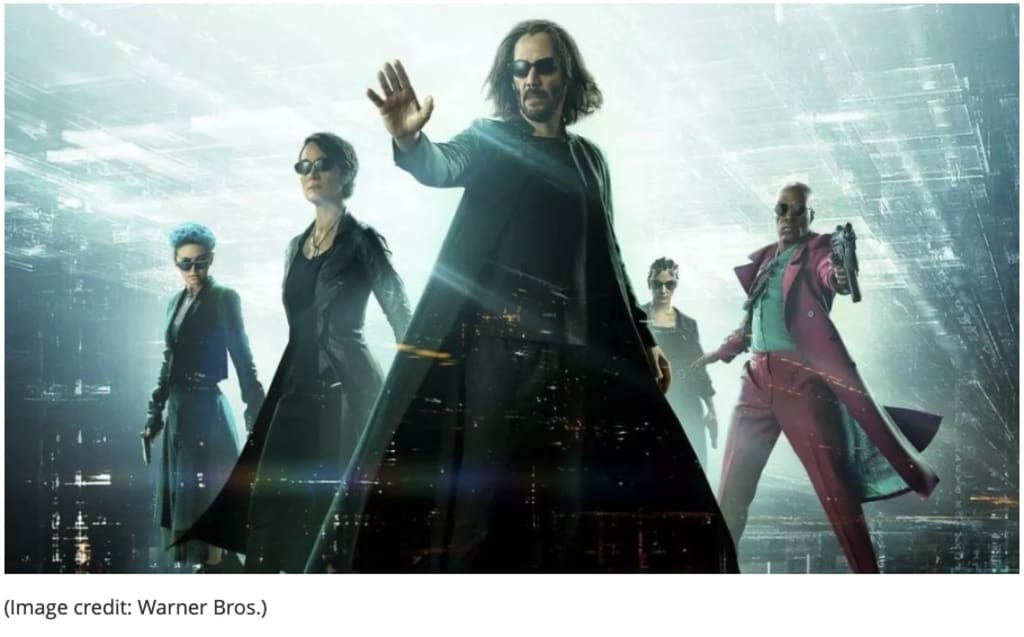
With today’s continual advancements in technology, including Mark Zuckerberg’s recent announcement of the ‘metaverse’, now seems an appropriate time to delve back into the exploration and questioning of simulated reality—both the possibilities and the philosophical dilemmas. And there’s no exploration of this topic more widely known or accessible as The Matrix.
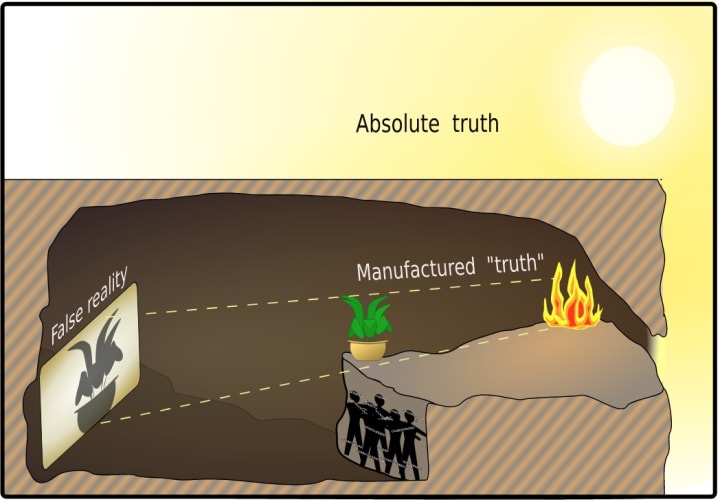
As a university student, we studied The Matrix through the lens of Plato’s Cave, an allegory that questions reality through the controlled nature of our knowledge and experiences. A man sitting in a cave whose whole reality was formed by the shadows he saw projected onto the cave walls, would at first be blinded by the world outside, but eventually would adapt to the vastness of absolute truth and never again accept the false reality of the dark cave.
In The Matrix, our titular hero Neo escapes the controlled reality of a computer simulation by taking the red pill and discovering the truth, unable to ever go back and unsee the harsh reality of the real world where machines had enslaved humanity. It begged a simple yet profound question of its audience, would you take the blue pill, choosing a reality where you are comfortable and safe, yet always knowing deep down you are being manipulated into conformity, or would you take the red pill and discover the uncomfortable yet freeing truth?
In a societal landscape dogged with ‘fake news’ and ‘alternative facts’, where the ‘known truth’ is questionable and the old reality seems to be unravelling by the day, a self-aware continuation of the Wachowski’s seminal science fiction think piece seems like a relevant idea, one that might be able to justify its existence beyond just another cash-grab sequel or exercise in nostalgia.
In many ways The Matrix Resurrections does feel like a retread—the same story with a few shiny new characters thrown in, and plenty of call-backs for fans of the original (“I still know kung fu” just one of many). Aged up actors from the trilogy make appearances, from Jada Pinkett Smith’s Niobe to Lambert Wilson’s now crazed and vengeful Merovingian. Fan favourites Morpheus and Agent Smith get a reimagining in Yahya Abdul-Mateen II and Jonathan Groff respectively, both actors doing a decent enough job of recapturing the feeling of those well-known characters, while conveying the new paradigm they inhabit.
The plot remains mostly the same, with a band of renegades working to free Neo from the Matrix so that he may embrace his calling as ‘the one’ and save humanity. In Resurrections, Neo must once again choose between the overall safety of the free human colony or saving his counterpart Trinity, battling a renegade Smith, and facing another architect figure along the way. The Matrix Resurrections is nothing we haven’t seen before, and the audience is constantly reminded of this with flashbacks and even in scene projections from the original movie. So many people may ask, what is the point of all this?
In the trivia section of Resurrections IMDb page, it states that Lana Wachowski was inspired to bring back Neo and Trinity as a sort of catharsis—that writing the script was a comfort after losing her parents and facing the realities of death. In this way it makes sense for Wachowski to want to go back to familiar ground, as nostalgia can often serve as a great comfort for all of us.
For me, Resurrections is a reminder, a cause to re-evaluate the first Matrix movie 20+ years on, what it stood for and what impact it had on the psyche of the general population. One scene from Resurrections caused me to stop and ponder this and it was enough for me to see the merit of this movie as a platform for discussion. You see Resurrections gets a bit meta, as Neo, now back to being regular old Thomas Anderson, is living life as a game developer, his big success being a trilogy of games called The Matrix. All of Neo’s memories of the original movies are now framed as games he created. He has forgotten reality and is once again subjugated to the simulation. In this reality Neo is being pressured by his business partner, Smith, to develop a fourth Matrix game, a decision spurred on by their ‘beloved parent company Warner Bros’. This leads to a scene where the marketing team brainstorm ideas for the Matrix 4, trying to pin down what the original series was about. Was it a philosophical deep dive into the nature of reality, or was it just all about the ‘bullet time’, flashy action, cool sounding lines and ‘guns, lots of guns’?
After its release in 1999, The Matrix cemented its place in popular culture, the movie itself being subject to parody and rip-offs, pulled apart and put back together, pieces of iconography taken from here and there, recreated and retrofitted into something else. The marketing scene in Resurrections reminded me that this sequel is indeed a product to be sold, a piece of entertainment to be consumed and reflected upon in numerous reviews and articles, decrying it as too much of a rehash or praising it for its action and special effects.
The mere presence of this meta commentary made me think long and hard about the message of this movie. Perhaps not what message the director intended but what was naturally inspired within me. The self-awareness in Resurrections only leads me to think that the repetition of ideas is deliberate. That the movie is directly speaking to the audience and saying: 'Hey, remember how pivotal and effectual The Matrix was in its time? Can we recreate that?'. History always seems to have a way of repeating itself, so perhaps, as an audience, we need another reminder of the dilemmas of simulated reality. Because nothing has truly changed. We are still on course to making this science fiction a reality with advancements in VR and the ever-looming metaverse. Maybe it’s time to put aside the distraction of ‘bullet time’, nostalgic call-backs and violent action spectacle, and get back to asking the important question: red pill or blue pill? Harsh truths or comforting lies? Real-life interactions with your fellow man, or computer simulated realities? The choice continues to be ours... for now.
About the Creator
Abbey Hunt
An aspiring author writing short stories/series in fantasy, speculative, romance, adventure, or slice of life, and the odd philosophical take on movies or TV series. Love to share the joy and light of creative expression.
Keep reading
More stories from Abbey Hunt and writers in Geeks and other communities.
Abandoned Places
“It’s a shame it didn’t work out.” A sheen of concern. A performative look of disappointment. No one wanted to acknowledge the truth of what had happened, because the truth was inconvenient—a pebble in your shoe you would rather ignore than fumble to fish out.
By Abbey Hunt4 years ago in Fiction
No Other Choice (2025)
It is only February, so other films may well surpass “No Other Choice”, but I think this is the best film I’ve seen so far this year. And that surprises me, because, it is a subtitled film and while I am pretentious enough to choose to watch foreign-language films, I was also very tired and that was an extra commitment from me. But more importantly, let me warn you, this film is gruesome and violent. There were times I had to turn away from the screen to avoid the worst of it (including some self-inflicted dentistry).
By Rachel Robbins23 days ago in Geeks
My Top 50 Favorite Sci-Fi/Thriller Movies of All Time
***Author's Note*** I realize there are several repeats from past lists included on this one. Sci-fi is my favorite genre, so when I started creating a list of my top 10 favorites, I realized I had to make the list much longer to be able to fit and talk about all the amazing sci-fi films I love.
By Madison "Maddy" Newtonabout 12 hours ago in Geeks



Comments
There are no comments for this story
Be the first to respond and start the conversation.