

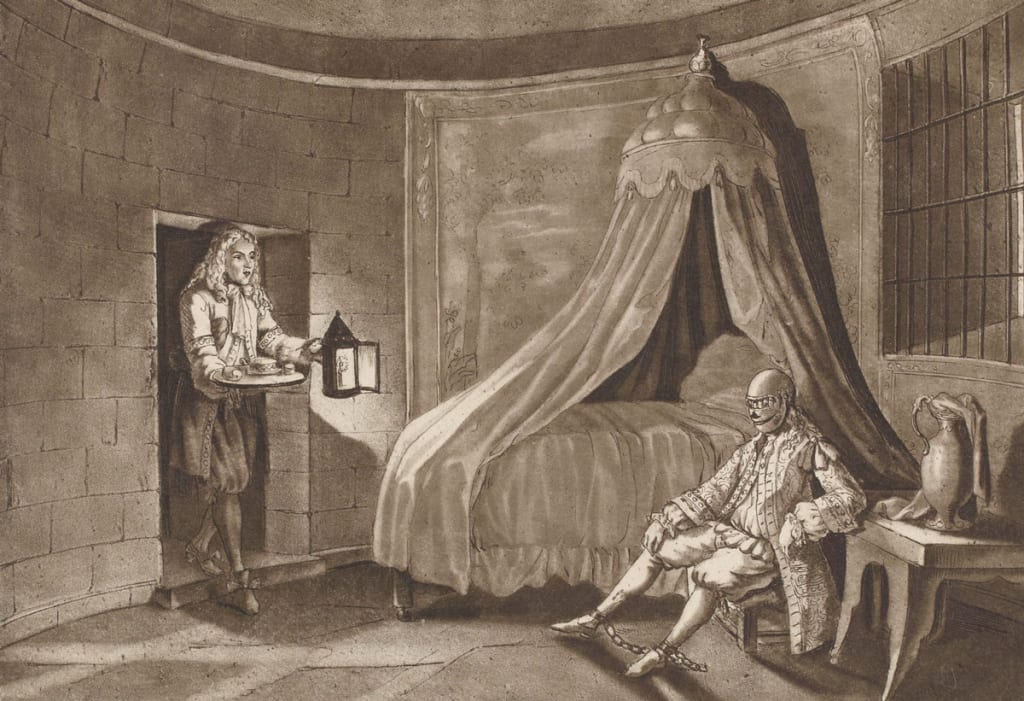
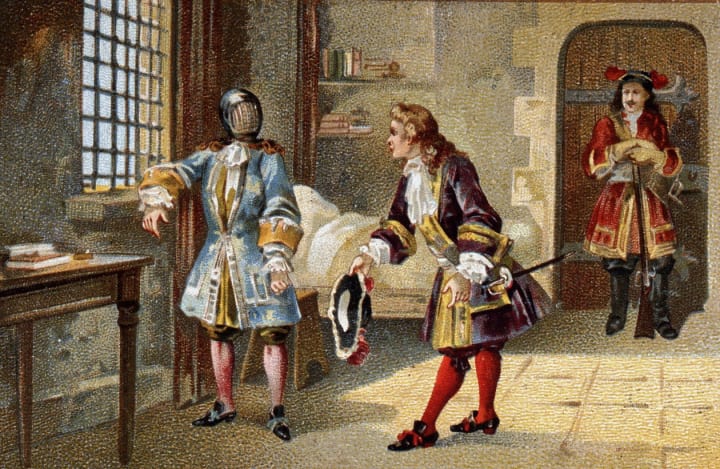
One of the most strange enigmas of French history is the identity of the Man in the Iron Mask, a prisoner who was held in various jails, including the Bastille, during the reign of Louis XIV. His incarceration, which lasted for several decades until his death in 1703, was shrouded in extreme secrecy. Most notably, his face was hidden behind a mask: sometimes reported as iron, though likely made of black velvet, sparking centuries of speculation about who he was and why his identity had to be concealed so completely.
Official records are scarce, and much of what is known comes from second-hand accounts, letters, and later historical speculation. The mystery of his identity has fascinated historians, novelists, and conspiracy theorists alike, with various theories proposing that he was a disgraced nobleman, a twin brother of the king, or even someone with knowledge too dangerous to be made public. So, who was he and will we ever know?
Plot
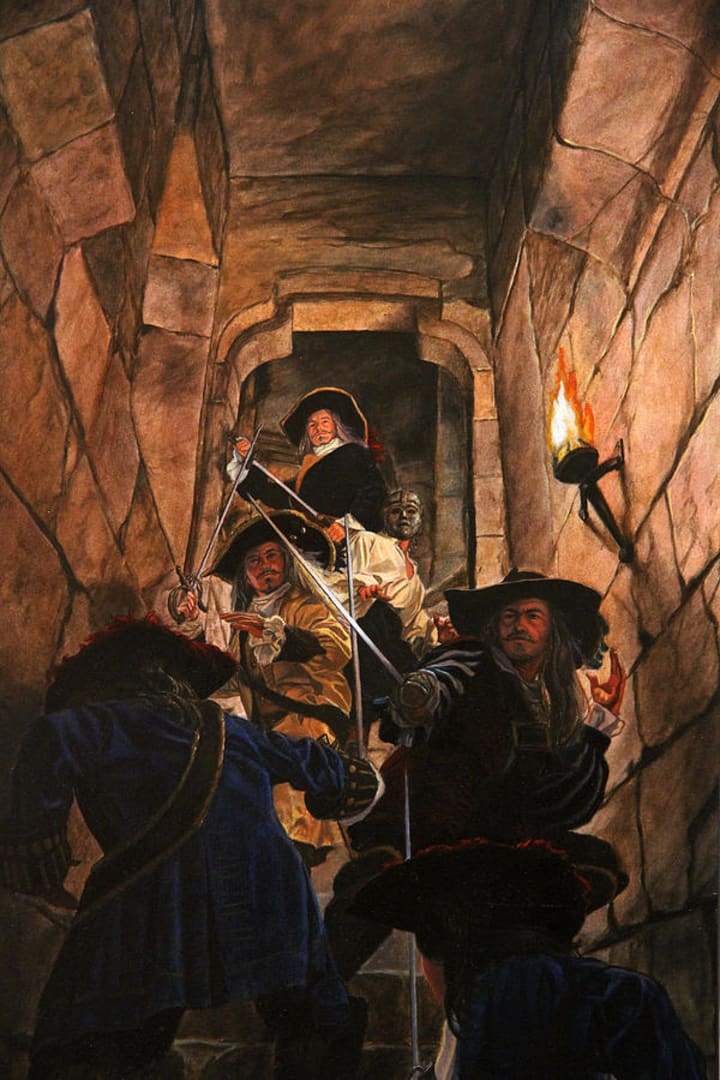
The first documented mention of the masked prisoner comes from records of his time in the prison of Pignerol in 1669, under the watch of the warden Bénigne Dauvergne de Saint-Mars. Pignerol was known to house political prisoners, and Saint-Mars was trusted with keeping these detainees under strict surveillance. Among the notable prisoners at Pignerol was Nicolas Fouquet, a disgraced finance minister whose knowledge of state secrets made him a liability. Some have suggested that the Man in the Iron Mask was a similarly sensitive figure.
The prisoner was moved along with Saint-Mars when he was transferred to different posts, eventually ending up in the Bastille in 1698. Throughout his long imprisonment, strict measures were taken to keep his identity concealed. He was placed in a private cell, received only limited visitors, and was forbidden from speaking to anyone apart from his jailers. His meals were delivered in a manner that ensured no unnecessary contact, and reports suggest that any fabric or notes he wrote on were immediately destroyed.
By the time of his death in 1703, official records stated that he was buried under the name "Marchioly." However, this name has no clear historical significance, leading many to believe it was a pseudonym to further obscure his identity. The absence of records regarding his crime or trial only deepened the mystery, giving rise to numerous theories about who he truly was. This is where we start to encounter strange and speculative theories about his identity...
Into the Theories
A Political Prisoner:
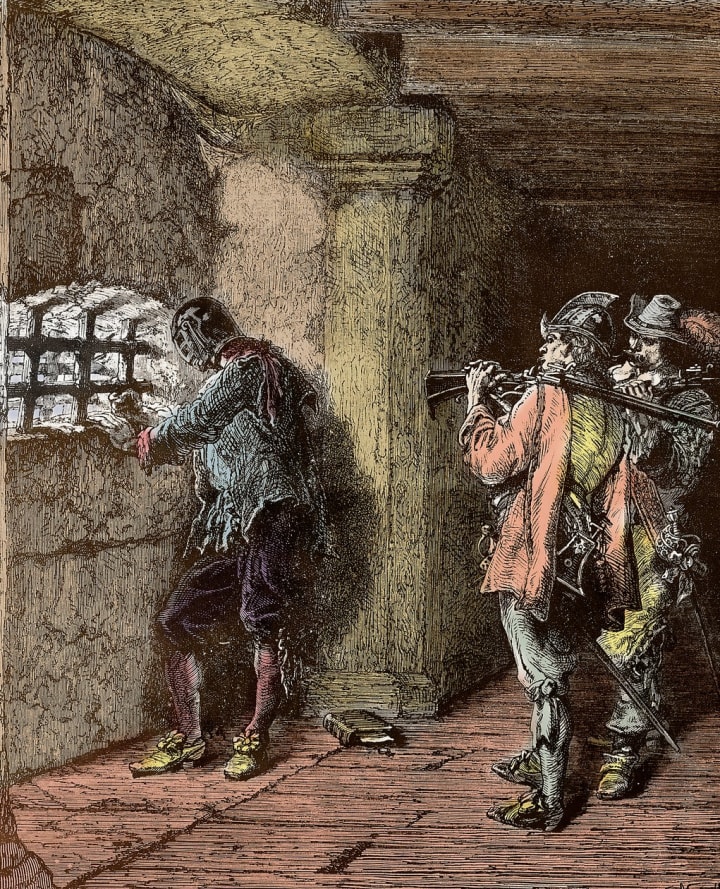
One of the most widely accepted theories is that the Man in the Iron Mask was a disgraced nobleman or a high-ranking individual who had fallen out of favour with the monarchy. Some suggest he was Eustache Dauger, a valet who may have been privy to state secrets, possibly involving espionage or financial corruption within the royal administration. The theory goes that he may have overheard damaging information about the king or his ministers, leading to his indefinite imprisonment to ensure his silence.
The King's Twin Brother:
Perhaps the most famous theory, popularised by Voltaire and later by Alexandre Dumas in The Vicomte de Bragelonne, is that the masked prisoner was the twin brother of King Louis XIV. According to this idea, he was hidden away at birth to prevent disputes over the French throne. If the monarchy feared that knowledge of his existence could lead to political upheaval, his lifelong imprisonment would have been a necessary precaution. While there is no concrete evidence of Louis XIV having a twin, the secrecy surrounding the prisoner makes this theory appealing to those who believe in hidden royal intrigues.
A Secret Spanish Diplomat:
A more obscure but intriguing theory suggests that the Man in the Iron Mask was a Spanish noble or diplomat, possibly an illegitimate son of the Spanish Habsburgs. This theory stems from speculation that his imprisonment was a matter of international diplomacy rather than internal French affairs. If he was a high-ranking Spanish figure whose true identity could have led to political conflicts between Spain and France, the French monarchy may have chosen to imprison him indefinitely rather than risk exposure. Supporters of this theory point to the extreme secrecy surrounding his case as evidence that his existence posed a threat not just to Louis XIV but to European stability as a whole.
Why It's Shifty
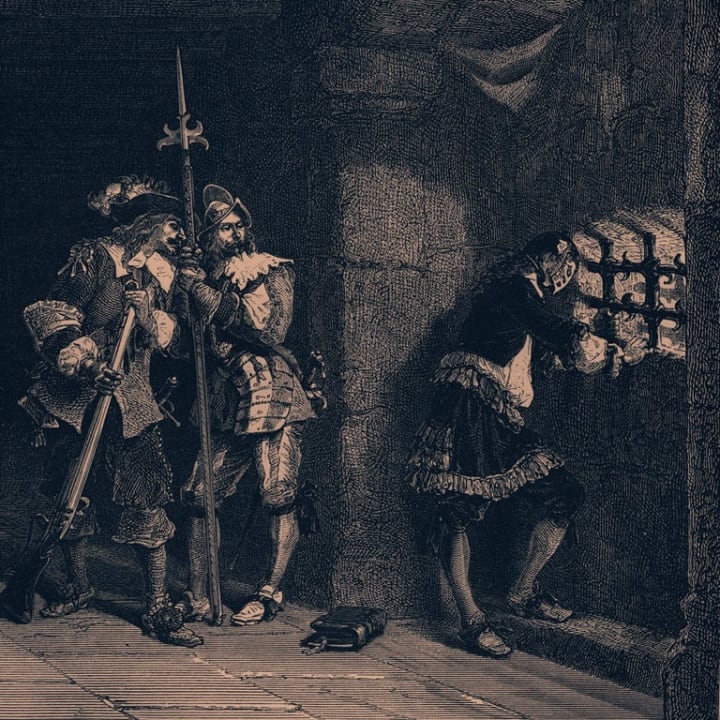
Although there has been centuries of investigation, the true identity of the Man in the Iron Mask remains elusive. No official documentation provides a definitive answer, and the lack of trial records suggests that his crime, if any, was never meant to be revealed to the public. Also, while accounts such as those of Voltaire and later historical writers have kept the mystery alive, much of their information was based on speculation rather than hard evidence. The deliberate efforts to erase traces of his true personhood only add to the puzzle, ensuring that the case remains one of history's strangest cases of unknown identity.
Conclusion
Among the various theories, the most plausible explanation is that the Man in the Iron Mask was a minor political prisoner, possibly someone with knowledge that the French crown deemed too dangerous to reveal. The theory that he was Eustache Dauger, a valet who might have stumbled upon a state secret, is supported by historical records indicating that a prisoner of this name was kept under similar conditions.
However, the complete secrecy surrounding his case suggests that even if he was not of royal blood, his imprisonment was of grave importance to Louis XIV’s government. While we may never know the full truth, the legend of the Man in the Iron Mask continues to capture the imagination of historians and storytellers alike with films and books being written and made about who he might have been.
Next Week: The Wisest Man on Earth?
About the Creator
Annie Kapur
I am:
🙋🏽♀️ Annie
📚 Avid Reader
📝 Reviewer and Commentator
🎓 Post-Grad Millennial (M.A)
***
I have:
📖 280K+ reads on Vocal
🫶🏼 Love for reading & research
🦋/X @AnnieWithBooks
***
🏡 UK
Keep reading
More stories from Annie Kapur and writers in Geeks and other communities.
Book Review: "Spores of Doom" ed. by Aaron Worth
Full Title: Spores of Doom: Dank Tales of the Fungal Weird edited by Aaron Worth There have been some British Library stuff I've been eyeing in this month of May. Hopefully, more and more keeps coming out because I quite enjoy the Crime Classics, but I love the Tales of the Weird even more. There's something about collecting the great horror stories together together under one lovely theme or motif that is quite delightful to read. I would have never thought about the stories in particular ways even though I'd read some of them before. Let us get on with it then, this anthology is entitled Spores of Doom.
By Annie Kapur8 months ago in Geeks
The Rachels - 2025
Much to my surprise, I have kept a list of the films I‘ve seen this year. I daresay it isn’t complete. There will be films that snuck in on a late night in front of the TV that I would’ve forgotten to note. Or others, that I went to watch at the cinema, but then had a red wine and promptly forgotten about. But it’s not a bad approximation of the films I’ve seen this year. In total, there are 53 films listed, so an average of one a week and one for good luck.
By Rachel Robbins25 days ago in Geeks
Game of Thrones: Knight of the Seven Kingdoms Review Episode 1 (The Hedge Knight)
Westeros is officially back in tournament mode. Episode 1 of A Knight of the Seven Kingdoms finally dropped, and yes, it’s absolutely packed with Easter eggs tying back to both the original Game of Thrones series and House of the Dragon. Because this story is wedged right between the major Targaryen eras, everything connects in some really clever ways, and we’re breaking all of it down step by step.
By Bella Andersona day ago in Geeks



Comments (1)
The mystery of the Man in the Iron Mask is really intriguing. It's crazy how little official info there is. I remember reading theories about him being a noble or twin. Wonder if we'll ever truly know who he was.