
The Legend of Aang: The Last Airbender
A Timeless Animated Epic About Balance, Destiny, and Compassion

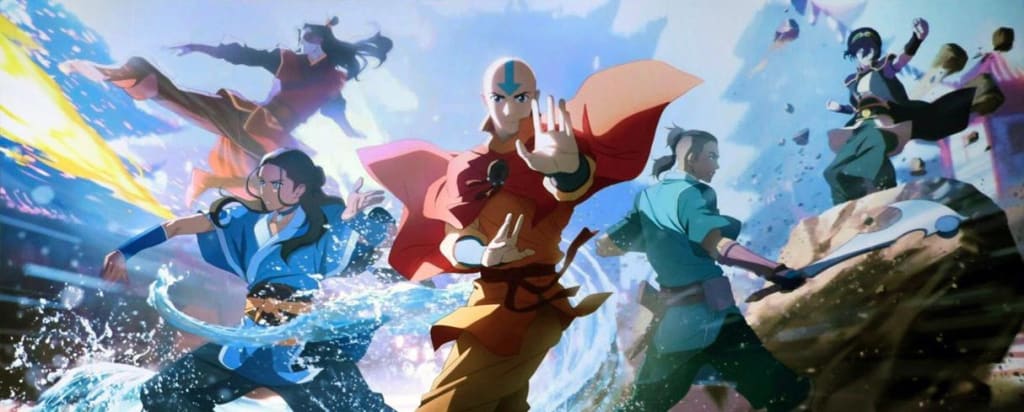
The Legend of Aang: The Last Airbender is more than an animated series; it is a cultural landmark that reshaped how audiences view storytelling in animation. Originally presented as Avatar: The Last Airbender, the story of Aang and his journey to restore balance to the world continues to resonate with viewers of all ages. Blending rich world-building, emotional depth, and philosophical themes, the series stands as one of the most influential animated narratives of modern times.
At its heart, The Legend of Aang is a coming-of-age story. It follows a young boy burdened with a responsibility far greater than himself, yet determined to face it with compassion rather than cruelty. Through Aang’s journey, the series explores identity, loss, duty, and the enduring power of hope.
A World Divided by the Elements
The world of The Last Airbender is structured around four nations, each aligned with a classical element: Water, Earth, Fire, and Air. Certain individuals can “bend” their native element, using martial-arts-inspired movements to control water, earth, fire, or air. This elemental system is not just a visual spectacle—it forms the backbone of the series’ cultural, political, and spiritual framework.
At the center of this world is the Avatar, the only person capable of mastering all four elements. The Avatar’s role is to maintain balance between the nations and harmony between the physical world and the Spirit World. Aang, the current Avatar, is also the last surviving Air Nomad, making him both a symbol of hope and a living reminder of devastating loss.
The Fire Nation’s imperial ambitions have plunged the world into a hundred-year war, setting the stage for Aang’s awakening and his reluctant acceptance of destiny.
Aang: A Hero Unlike Any Other
Aang is not a typical hero driven by vengeance or ambition. He is playful, kind-hearted, and deeply connected to the value of life. Raised by the peaceful Air Nomads, Aang’s instincts lean toward avoidance of violence, even when the world expects him to be a warrior.
This internal conflict defines his character. As the Avatar, Aang is expected to defeat Fire Lord Ozai and end the war, yet doing so challenges his core beliefs. The series does not simplify this struggle; instead, it treats Aang’s moral dilemma with respect and nuance. His journey is not about becoming stronger in battle alone, but about discovering how to stay true to himself while fulfilling his duty.
Aang’s emotional arc is marked by grief for his lost people, fear of responsibility, and gradual growth into leadership. His resilience lies not in domination, but in empathy—a quality that sets him apart from many traditional protagonists.
The Power of Companionship
While Aang is the central figure, The Legend of Aang thrives because of its ensemble cast. Katara, Sokka, Toph, Zuko, and others are not side characters; they are fully realized individuals with their own arcs, flaws, and growth.
Katara represents compassion and determination, often serving as the emotional anchor of the group. Sokka brings humor and strategic thinking, proving that heroism is not limited to bending abilities. Toph challenges expectations with her strength and independence, redefining what power looks like.
Perhaps the most complex arc belongs to Zuko, the exiled Fire Nation prince. His journey from antagonist to ally is one of the most celebrated redemption stories in animation. Through Zuko, the series explores themes of honor, identity, and the painful process of unlearning harmful beliefs.
Together, these characters form a found family, showing that balance is not achieved alone, but through trust, understanding, and shared struggle.
Themes That Transcend Age
What truly elevates The Legend of Aang is its thematic depth. Though accessible to younger audiences, the series tackles mature concepts with remarkable sensitivity.
Balance and Responsibility: The Avatar’s mission reflects the idea that power must be guided by wisdom. Aang’s struggle highlights the difficulty of making ethical choices in an imperfect world.
War and Its Consequences: The series does not glorify war. Instead, it shows its effects on civilians, families, and even the perpetrators. Trauma, displacement, and loss are recurring elements, giving the story emotional weight.
Identity and Choice: Many characters wrestle with who they are versus who they are expected to be. The series emphasizes that identity is shaped by choices, not by lineage or labels.
Compassion Over Hatred: Perhaps the most enduring message is that understanding and empathy can break cycles of violence. This philosophy is central to Aang’s ultimate decisions.
Visual Storytelling and Cultural Inspiration
The animation style of The Last Airbender blends Western animation with strong influences from East Asian art, philosophy, and martial arts. Each bending style is inspired by real-world disciplines, giving movement a sense of authenticity and purpose.
The series also draws from various cultures to build its world, resulting in a setting that feels expansive and lived-in. Architecture, clothing, music, and traditions vary meaningfully between nations, enhancing immersion and respect for cultural diversity.
This attention to detail elevates the storytelling, making the world feel as important as the characters who inhabit it.
A Lasting Legacy
Years after its original release, The Legend of Aang: The Last Airbender continues to find new audiences. Its relevance has not faded because its themes are universal and timeless. In a world still grappling with conflict, identity, and responsibility, Aang’s journey remains deeply relatable.
The series has inspired discussions, fan communities, academic analysis, and follow-up stories, proving its lasting impact. More importantly, it has shown that animated storytelling can be emotionally rich, philosophically thoughtful, and artistically ambitious.
Final Thoughts
The Legend of Aang: The Last Airbender is not just a story about mastering elements—it is a story about mastering oneself. Through Aang’s journey, the series reminds us that true strength lies in compassion, wisdom, and the courage to choose peace when violence seems easier.
For audiences seeking a narrative that balances adventure with heart, humor with depth, and fantasy with real-world meaning, the story of Aang stands as a timeless masterpiece.
About the Creator
Keep reading
More stories from James S Pope and writers in Geeks and other communities.
The Rip: A Gritty Exploration of Crime, Consequence, and Human Nature
In a cinematic landscape crowded with fast-paced thrillers and formulaic crime stories, The Rip stands out as a film that aims for something deeper. Rather than relying solely on spectacle, the movie leans into atmosphere, moral tension, and character-driven storytelling. It is a film that asks uncomfortable questions about loyalty, greed, and the thin line between survival and self-destruction.
By James S Pope3 months ago in Geeks
A Knight of the Seven Kingdoms Series Review (Season 1)
As one of the biggest properties in fantasy, A Song of Ice and Fire remains immensely popular with audiences. After reaching far into the past with House of the Dragon, a second spin-off was on the cards. A Knight of the Seven Kingdoms serves up a bite-sized slice of action and drama, but it still claims a spot among the best small-screen titles.
By Robert Cain15 days ago in Geeks
Psych: The running joke of Gus looking like Bud from The Cosby Show
Binge-watching Psych on Peacock, I realized how often Burton Guster (Dulé Hill) was asked if he were Bud/Kenny (Dion Richmond) from The Cosby Show. The fans noticed the resemblance from day one and often pointed out that Hill and Richmond looked alike.
By Cheryl E Preston5 days ago in Geeks



Comments (2)
Didn't really understand where the author was taking this article. Guy didn't do his research so he crashed and burned. He couldn't be bothered to Google The Legend of Aang: The Last Airbender, had he done that he would know ATLA and TLoA are two different entities altogether. We're not even talking about the poorly done movie, the poorly done live-action series, and TLoK. Just another guy trying to prove he's relevant.
Feels like author didn't watch ATLA and is fishing for attention by writing about something popular right now. The show was called Avatar: The Last Airbender. The Legend of Aang: The Last Airbender is a movie which hasn't come out yet. The photo at the top is from said film. Author continuously says The Legend of Aang when talking about the TV show. Overall, not very good writing.