
The Genius of 'Hamilton'
We may not live to see our glory, but that shouldn't stop us.


History is that one subject that most of us roll our eyes at. After all, how does what happened to men who lived hundreds of thousands of years before us affect us in the modern world? Why do we have to learn about how kings built their courts and how people lived their life back then? I think the primary question most people ask when they are asked to learn history in school is the question of relevancy to their lives in the present, and I agree — there isn’t much. However, if presented in the right way, I believe that history can be one of the best teachers of character and a brilliant opportunity to look back on humanity and see where even the best of us made mistakes. But with the way courses are structured in school, this is sadly traded away for mindlessly memorising facts and regurgitating them in examinations without internalising any of the intricacies and stories behind the material that is being learnt. I, too, play my role in the system by learning and writing pages and pages in order to get the best possible marks, but after seeing Lin-Manuel Miranda’s Hamilton, I’m afraid I might have to change my outlook on the subject.
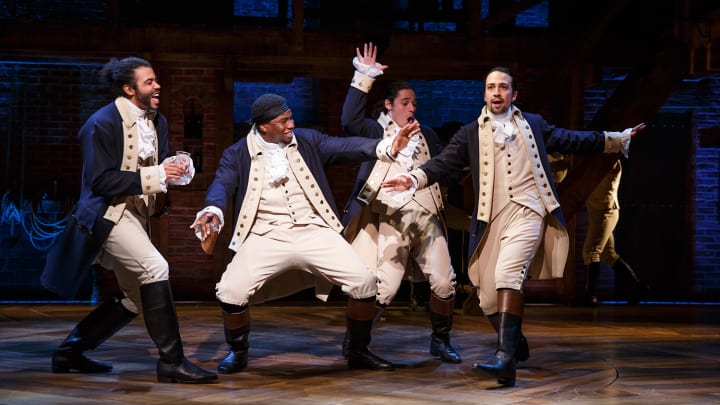
The Sons of Liberty (from left to right: Daveed Digs, Okieriete Onaodowan, Anthony Ramos and Lin- Manuel Miranda)
Hamilton is a musical that originated as an album that creator Lin Manuel Miranda wanted to make based on the biography of Alexander Hamilton written in 2004 by Ron Chernow. The play chronicles the life of Alexander Hamilton, one of the Founding Fathers of the United States, which it does in the form of various styles of music including hip hop, jazz, blues, and so many more. The play was initially Off-Broadway but was brought onto the big stage in 2015 and since then has become a national phenomenon. Never before had the people who made America received so much attention from more modern generations.
Now, I haven’t had the pleasure to see it (yet), but after listening to the entire album (which is available on iTunes, Spotify, Amazon Music, and most other music streaming devices) I have no doubt that the on stage production is enriching as it is enlightening. However, this article is not a review of the play; I want to focus more on the intricacies of the play itself and the themes present in it, which culminate in a powerful message.
As students of history, we have a tendency to place such important figures in a position of utmost reverence. When we think of the people who founded America like George Washington, Thomas Jefferson, Abraham Lincoln, we think of them as these paragons of human beings that we have to aspire to; as if they are the best of humanity. One thing that this play is insistent on showing us is that this way of thinking is blocking out the mistakes that these people made.

Well said, George
The entire play centres around the life of Alexander Hamilton from the time he was a soldier in the army under the command of George Washington to his position as Secretary of the Treasury. Now, Hamilton’s life was full of mishaps and mistakes. He was reckless as a young man, desperate to lead a group of men into the field of war, and was ecstatic with dying like a martyr for his country, thinking it would be a glorious way to go out. He often neglected his wife and his first born son in favour of his job of Secretary, and he even cheated on his wife when she was away. He didn’t even get to die normally, as he was fatally shot in a duel with the then Vice President Aaron Burr.
Needless to say, his life wasn’t smooth. It’s tales like this that remind us that even the best of us aren’t perfect, no matter how glamorous we seem on paper. It also ties into a major theme of the play: you cannot control how you will be viewed through the lens of history. This theme is best illustrated in two verses sung by George Washington in the first act. In the scene, Hamilton is finally being given soldiers to lead into battle. However, before he can take off with them, Washington offers him some advice, along with a warning in the form of what happened to him when he led for the first time.
I was younger than you are now,When I was given my first command.I led my men straight into a massacre,I witnessed their deaths firsthand.I made every mistake,And felt the shame rise in me,And even now I lie awake,Knowing history has its eyes on me.....Let me tell you what I wish I'd known,When I was young and dreamed of glory,You have no controlWho lives, who dies, who tells your story.
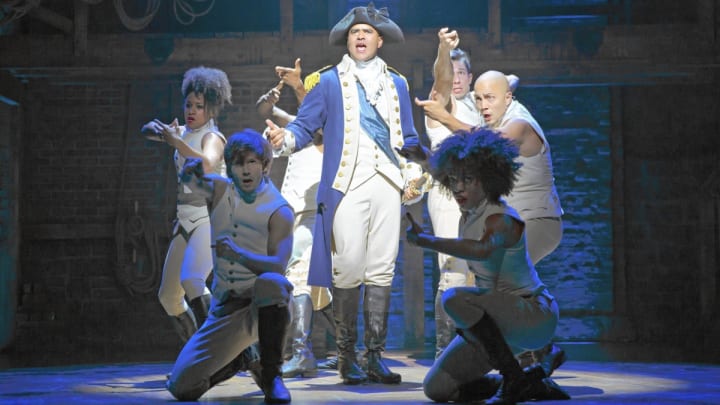
Washington as portrayed by Christopher Jackson
Something that we often forget as we are caught up in our lives is the fact that all of us — each and every single person on this planet — is part of a generation. We are a phase of the development of humanity, much like those who founded America or any other country, for that matter. I’m studying so much about what has happened before, we forget that we too, have a story to tell. Maybe not one of such epic proportions as our forefathers or those who came before us, but a story nonetheless. We are a part of history, and someone, someday, will tell our story. Like the play says, we have no control how our story will be presented in the future. We can only hope that our actions in the present define who we are and embody our values and principles.
In the play, Aaron Burr shoots Hamilton in a fit of rage, fueled by his desire to not let Hamilton kill him, even though he never intended to, instead opting to throw away his shot. History now remembers him not as a war veteran of the American Independence Movement, not as one of the first Senators of America, but as the person who shot and killed Hamilton. He is painted as the villain in the story of America gaining its autonomy. Alexander Hamilton is also victim to this; he published an account of his affair, hoping to clear his name admits rumours, and was never given a chance for redemption as his wife, Elizabeth Hamilton, burnt all his letters of his love for her. She even says as much in the song, titled "Burn":
I’m erasing myself from the narrativeLet future historians wonder how ElizaReacted when you broke her heart

Eliza as portrayed by Phillipa Soo
The play’s primary theme is this: that our actions define how we’re remembered, and that no matter what we do, history always watches us, waiting to tell our story. And we, as individuals, have no control how that story is told. We have no say in it, because our actions tell it for us. And this is why Hamilton is a work of art because it reminds us of this fact. We are so caught up in the horror show that today’s world seems to have become that we forget that we are not all that matters. There are generations of people to follow us and generations after them as well. How do we want history to remember this time period? Is our story meant to be one where freedom of speech is non existent, guns are put into the hands of people to slaughter innocents, where war is seeming more and more like an inevitable conclusion instead of a last resort? A time where tolerance is all but gone, the most miniscule things offend people, and one where corruption and injustice is the norm?
Hamilton shows us that there is so much more to the world around us than simply us. It attempts to tell us that there is a much bigger picture that we all have to pay heed to and take due care to address. That is why this play is a success, and that is why I have so much respect for Lin Manuel Miranda for crafting such a masterpiece. Just think about it: if you were to die, right now, how would people remember you?
Are you satisfied?
About the Creator
Arvind Pennathur
I'm a graduate law student with a love for the quieter things in life. I write on a variety of topics, along with the occasional short story or poem. My perfect evening? Give me a rainy day, a cup of coffee, and a place to sit and write.
Keep reading
More stories from Arvind Pennathur and writers in Geeks and other communities.
Avengers: Infinity War Review (Spoiler Edition)
For the past 10 years, Marvel has come to dominate cinema and completely transform superhero movies as we know them. They have managed to build an entire universe within a set of 19 movies. When you consider that each of these movies tie into each other with the most intricate of details in a way that combines for one cohesive narrative, only then will you realise the scale that Marvel's movies have reached, and no movie emphasizes that more than their latest blockbuster, Infinity War.
By Arvind Pennathur8 years ago in Geeks
A Knight of the Seven Kingdoms Series Review (Season 1)
As one of the biggest properties in fantasy, A Song of Ice and Fire remains immensely popular with audiences. After reaching far into the past with House of the Dragon, a second spin-off was on the cards. A Knight of the Seven Kingdoms serves up a bite-sized slice of action and drama, but it still claims a spot among the best small-screen titles.
By Robert Cain5 days ago in Geeks
SpongeBob Review
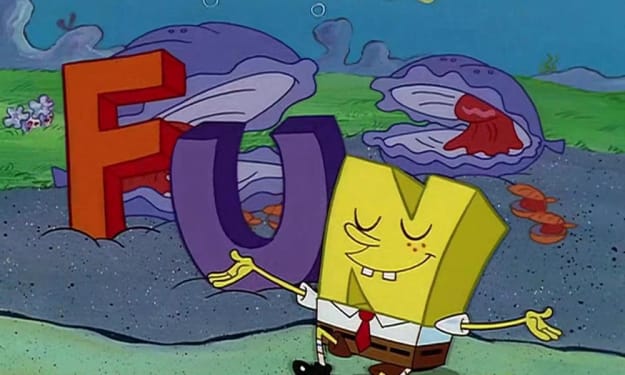
The episode "F.U.N." unfolds as a masterclass in character-driven comedy and narrative irony, centering on Plankton’s most hilariously transparent scheme to date. From the opening moments, the Chum Bucket’s oppressive gloom is a stark, almost visceral contrast to the sun-drenched, vibrant chaos of the Krusty Krab, a visual metaphor for the fundamental conflict between cynical ambition and joyful innocence. Plankton, tiny and vibrating with a fury that seems to distort the very air around him, constructs his "Friendship, U & Me, and Anywhere and Anytime" acronym not as a genuine olive branch but as a convoluted trap, his every syllable dripping with insincerity. The scene is a tightly wound spring of tension, as we, the audience, are complicit in the joke, watching SpongeBob—radiating pure, unadulterated optimism—plunge headfirst into the obvious snare with a trusting eagerness that is both exasperating and profoundly endearing.
By Forest Green7 days ago in Geeks
I was in a Toxic Relationship, with my Workplace
“You got that?” My ex yelled. His hands were balled into fists at his side. At six foot three, he towered over me. A normal person would have been afraid, but I looked up a video of George Lopez repeatedly saying, “I got this,” and showed it to him. I had grown used to this treatment, so much so that I didn’t blink when he ripped the phone from my hand and threw it across the room.
By Jade M.6 days ago in Confessions



Comments
There are no comments for this story
Be the first to respond and start the conversation.