
The Future is Audible: How AI is Rewriting the Rules of Music Creation
A New Chapter for Artists, Producers, and the Entire Industry

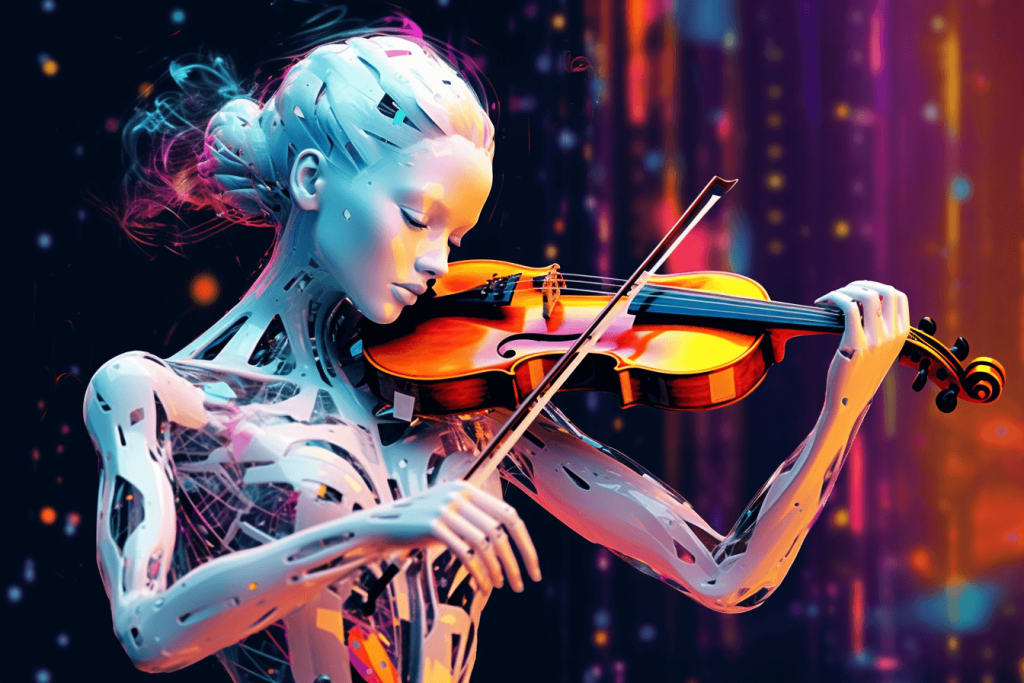
Artificial Intelligence is no longer a futuristic concept in music; it is a reality transforming the studio, the stage, and even how we perceive a melody. Far from being a mere gimmick, AI is poised to become the essential co-pilot for creators, raising fascinating questions about originality, copyright, and the very evolution of the industry. This is not a threat—it is a creative revolution. The artists and producers who embrace these tools now will be the ones defining the soundscape of tomorrow.
1. Augmented Creation: When AI Composes
The ability of AI to generate original compositions is stunning. Platforms like AIVA or Amper Music, often used for background or film scoring, can analyze millions of tracks, understand complex harmonic structures, and produce entire songs in seconds, based on a specified style, tempo, and mood. The musician's role is fundamentally evolving: AI handles "writer's block" by providing foundational ideas, unexpected chord progressions, or melodic lines to spark the artist's inspiration. Consequently, the human shifts from being the sole composer to becoming the musical curator, selecting, refining, and injecting the necessary soul and emotional intent into the machine-generated structures.
2. From Studio to Stream: Automated Mixing and Mastering
The production phases, traditionally lengthy and expensive, are being significantly streamlined by AI. Through intelligent mixing, AI tools can analyze a track and automatically adjust equalization, compression, and spatialization to achieve a balanced sound, often by learning from the techniques used by top-tier audio engineers. Similarly, services like Landr utilize machine learning to provide professional-grade instant mastering online. This drastically reduces the time between final mix and distribution, effectively democratizing high-quality production for independent musicians worldwide.
3. The Voice Revolution and Audio Deepfake Phenomenon
This is perhaps the most controversial aspect of AI in music: its capability to clone human voices or generate new, ultra-realistic synthetic vocals, a process often facilitated by tools like Kits.AI. Advanced systems can create synthetic voices for use in songs or narration, a trend known as vocal personalization that opens the door to permanent vocal avatars for artists, allowing them to monetize their voice even without performing. However, this raises a significant ethical challenge: the risk of musical "deepfakes," where an AI sings new songs in a famous artist's voice without their consent. This rapidly evolving area is forcing the entire industry to urgently re-evaluate copyright law and intellectual property rights.
4. Personalization and Discovery: AI-Driven Recommendation
AI isn't just creating music; it's profoundly changing how we consume it. Recommendation algorithms on platforms like Spotify or YouTube are moving beyond simply listing similar artists. They now employ AI to analyze mood, time of day, type of activity, and even weather data to suggest a hyper-personalized playlist. For artists, this means AI is becoming the most powerful tool for targeted marketing, ensuring their music reaches the ears most likely to engage and become loyal fans, substantially reducing guesswork in campaign planning.
5. The Crucial Debate: Soul vs. Algorithm
The lingering question persists: Can AI truly create art? Can the emotion, lived experience, and intent that define human music be reproduced by lines of code? The answer likely lies in collaboration. AI is essentially a productivity tool, capable of handling complex, repetitive tasks, leaving the human with the essential role of artistic decision-maker and emotion injector. The true future is not music by AI, but music with AI. For creators, the time to master this new instrument and push the boundaries of what is audible is now.
About the Creator
Wellbek
https://wellbek.com
The Rachels - 2025
Much to my surprise, I have kept a list of the films I‘ve seen this year. I daresay it isn’t complete. There will be films that snuck in on a late night in front of the TV that I would’ve forgotten to note. Or others, that I went to watch at the cinema, but then had a red wine and promptly forgotten about. But it’s not a bad approximation of the films I’ve seen this year. In total, there are 53 films listed, so an average of one a week and one for good luck.
By Rachel Robbins16 days ago in Geeks
Tales from Outer Suburbia
At first glance, Tales from Outer Suburbia doesn’t look like a television series. There’s no opening theme song, no streaming platform logo, and no weekly episode schedule. Instead, it exists as a beautifully illustrated anthology book by Shaun Tan. Yet the more time you spend with it, the more it feels like a TV show that somehow slipped past the cameras—an episodic, surreal exploration of suburban life that plays out vividly in the reader’s mind.
By David Cook4 days ago in Geeks


Comments
There are no comments for this story
Be the first to respond and start the conversation.