
The depressingly realistic representations in Netflix's "Devil May Cry."
The problems within and outside the "unholy trinity."


It's a tough few days for demon hunter Dante as his limits are tested both physically and emotionally, drawing him into a battle against the demon invasion of Earth, armed with two vital pieces that only he can provide or partially provide. A spoiler warning and sensitive topics (including religion, mental health, mass murder, etc.) warning are in effect! Dante (Johnny Yong Bosch) makes his comeback in a new revival of Devil May Cry, succeeding the 2007 12-episode anime inspired by the Japanese video game series created by Hideki Kamiya. This 2025 installment by Adi Shankar invites the franchise's dedicated fans to explore its revisions and consistencies as Dante is urged by the White Rabbit (Hoon Lee) and members of the government organization Dark Realm Command (DARKCOM) to awaken his dormant abilities and give up his family heirloom.
Following the murder of his mother (Erica Lindbeck) and brother, and an absent father, Dante discovers more about his family's history and his father's sacrifice to the demon realm. He learns how this sacrifice impacted the Makians after his father's betrayal of the tyrant leader Mundus, forcing them to "live with the fallout of his betrayal" while keeping the gates secure to protect humans. Sparda, a fellow demon, betrayed his own people and left for the human realm. Dante grapples with the conflicting perceptions of his father as he confronts his identity, navigating the information from his late mother while dealing with feelings of guilt for not saving her or his brother, Vergil (Robbie Daymond).
His somewhat immortal attributes of extraordinary strength, speed, and rapid healing are explained by his half-demon heritage as he learns to access his demonic form, similar to his father's, and utilize his Devil trigger. Dante's blood and amulet are crucial to the White Rabbit's plot to unite the worlds and liberate the Makians from the toxic wasteland they have been trapped in. Dante faces the constantly swearing DARKCOM leader, Lieutenant Mary (Scout Taylor-Compton), the Christian-oriented Vice President William Baines (Kevin Conroy), and the clever villain known as the White Rabbit as he seeks to navigate the situation and prevent world domination, especially since he has no alternatives.

In another instance of an incompetent president, the United States of America is being catered to by the vice president, a power he knows he possesses as he calls himself the real power leading covert operations, having formed the DARKCOM organization and crew that Mary leads. William Baines exhibits a strong faith, as seen throughout the series. Initially, his strength may inspire admiration, but it quickly morphs into a troubling and adaptable belief he manipulates for his own ends. He prayed while plummeting from a shattered airplane, remaining calm amid chaos, firmly convinced he wouldn't perish until he fulfilled his purpose on Earth, which is indeed commendable. Interestingly, he views Dante as a divine gift meant to safeguard humanity, believing that goodness can arise from any source, asserting that "even the Devil can do God's work."
However, the first undeniable evidence of his filthy conduct and powerful privilege is when he orders the soldiers to kill the demon refugees and their families, following Mary's efforts to assure their safety despite having no plan for them. Many fled from the demon realm due to the hazardous air and oppression, particularly for their children, and lived under the White Rabbit's control to survive. They are promised sanctuary, but Baines orders their death, and the soldiers execute the order, killing them all. It was appalling to watch as the realization of another betrayal dawned on them, especially the family that sheltered Mary to avoid her death.
Baines is deeply disappointing and repugnant as he manipulates Christianity to suit his needs, even claiming that Mary's team is disposable because they served their purpose after dying in battle. Mary was the only survivor of an attack that felt wrong from the start, as King (Sunkrish Bala) noted. He used common sense and posed the crucial questions before Mary steered them all to their demise while managing to survive herself. Mary's passion for conquering demons overwhelmed her, causing her to ignore the vice president's caution and making her oblivious to any unusual happenings, even when asked about them.

Mary and Dante's shared passion originates from their families being attacked by demons, both physically and mentally, especially due to Mary's father's deadly fixation. Mary is quick-witted and intelligent, having trained since childhood. I found her brief redemption arc engaging, but her fear and loathing of demons obstructed her ability to recognize Baines's evil intentions. Everyone was eager to use Dante, who was struggling with intense emotions while attempting to disguise his pain and turmoil with humour. Yet, Dante never had genuine support or friendship. Even his friend and job connection, Enzo (Chris Coppola), betrayed him twice - but at least he recognized this as part of Enzo's nature, unlike Mary, who was more underhanded in her betrayal.
At the conclusion, Mary betrays Dante after they join forces, and he plans to search for Vergil, who he's told is alive. This aligns with the recurring theme of inherent evil and cruelty within humanity: even when a half-demon attempts to save the world, there's enough fear to provoke his capture, reminiscent of Baines' earlier attempt to arrest him in the episode. Such dynamics echo numerous historical moments where ignorance breeds fear, resulting in efforts for forced assimilation or even extermination. I was reminded of Magneto's views from the X-Men series, contrasting with those of Charles Xavier; although optimism is often portrayed as the more desirable stance, it isn't always realistic based on their lived experiences. This realization was profoundly disheartening, a feeling intensified when Baines decided to open the demon realm to assert control over it.
Following the killing and capture of numerous Makians, the soldiers go on to raise the U.S. flag, taking selfies in the midst of the ongoing conflict, as if no one else were present. This action exemplifies the behaviour of colonizers who take what isn't rightfully theirs, frequently without justification. It epitomizes selfish greed at its worst. This selfish attitude is evident in Mary's character, as she dismisses everyone's hardships as mere sob stories. Despite grappling with her own challenges, her hostile demeanour and hatred of demons can be more irritating than her constant swearing, so much so that I was taken aback by her lack of harm towards the family that took her in. However, her true nature is revealed through the story of the main antagonist, the White Rabbit.
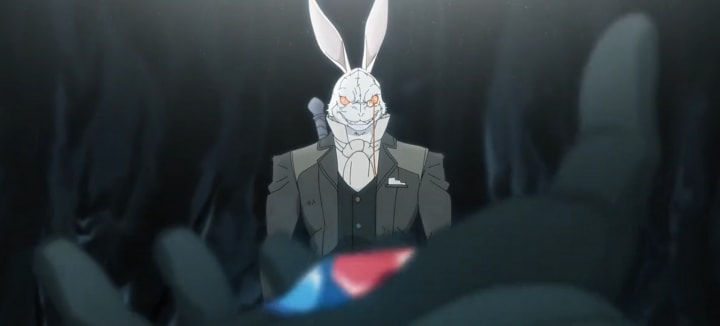
Hoon Lee delivers an outstanding performance as the White Rabbit. He portrays a character rich in complexity. He is intelligent, capable of intensity, exuding gravitas, and burdened by a heartbreakingly tragic backstory that makes him a relatable villain. Having endured a challenging upbringing as a foster child, he escapes through a portal to the demon realm, liberating himself from the mental and physical abuse inflicted by his family and finding refuge among the Makians. He is motivated by a desire to protect them from the toxic air that threatens many lives. He creates a plan to transport some Makians to the human realm, but Mary and her DARKCOM team uncover his refuge. In the end, the only individuals he has ever cared for are brutally killed, either by Mary or the monster, which continues to threaten them from the portal.
Mary's team fired at the demons, despite their claims of innocence and the danger they were in, as they witnessed the giant monster behind them devouring their comrades. They abandoned them to die. This situation reflects the justification of simply following orders, reminiscent of the incident where the Makians were slain at the vice president's command. This phenomenon resonates with the sentiment of disdain towards law enforcement officers, who act on directives as they did without regard for the lives of innocent and unarmed individuals they killed. The White Rabbit's aim to dismantle DARKCOM in retaliation is successful despite Mary's escape. As a human frequenting both realms, he learned to survive on regular demon blood transfusions while donning the rabbit head to strategize his actions.
The White Rabbit presents a morally gray character, having committed questionable acts such as holding and surveilling the oppressed. While this was their only path to safety and acceptance, it forced them to yield to him, yet it still served as a means of escape for them. Additionally, he used some demons without their knowledge to seek revenge for those who had previously died. Nonetheless, he often holds accurate views on the human and demon realms, a few of which Dante agrees with. He refers to himself, Dante, and Mary as the "unholy trinity," a group of orphans fully committed to their mission prior to disclosing Vergil's existence. The White Rabbit's internal conflict becomes clear when he reflects on their similarities, lamenting that they might remain unlovable orphans like himself, which is a saddening sight to witness. I realize he required more time to fulfill the final part of his life's mission, but I hated his return. He was a clever and reliable villain, only to return as a rage-driven monster after devouring demon parts. He lost his way and was fueled by anger, which Dante mentioned stems from being a demon but could also be from his contempt for various aspects of humanity.

Devil May Cry encompasses multiple themes alongside a notable body count, all wrapped within a well-woven narrative, an engaging soundtrack, and stunning animation. This combination fosters a bloody and melancholic atmosphere supported by an upbeat intro that quickly led to a series renewal. I am intrigued about the identity of Mary's childhood friend and whether he will have a significant role, but my curiosity peaks regarding Dante's backstory following the attack on his family. Both he and Vergil exhibited abilities even in their childhood, in contrast to their human mother, suggesting that Vergil could have survived the attack, especially after his claim Mundus freed him, which could be physical but more psychological to embrace his demon side more. I wonder whether Mundus was behind the attack in an attempt to capture their father, Sparda, who was not present and thought to recruit Vergil as a form of revenge.
Furthermore, I strongly believe that Sparda is still alive, despite conflicting with the original material, much like Mary's character, but since everyone else often spoke of him as either missing or a deadbeat and Dante even likened him to the boogeyman, asserting he's not real; thus, he might very well be. I wasn't shocked that Vergil was alive, given his demon form's resemblance to Sparda's, marked by the same blue colour that contrasts with the red in Dante's look. I also pondered how the White Rabbit obtained the blue side of the amulet before securing the other vial of blood. Eventually, it occurred to me that, as Plasma (Roger Jackson) mentioned, he can only manifest as someone who is alive; thus, his initial appearance as Vergil was an unmistakable sign, despite Dante considering it a poor representation.
I believe Vergil's frustration over Dante's departure is somewhat understandable. Despite being children, he witnessed the attack unfold. Although he may not have been capable of much, he would likely have valued Dante's effort to help, much like Mary's attempts for her mother, especially given their earlier tendency to argue. While I wish he weren't upset, he is aware that Dante survived and took no action, contrasting with Dante's instinct to search for him once he realized Vergil was alive. This could reflect Dante's desire to alleviate his guilt or a genuine wish to reconnect with his brother. I'm curious about how their backstory will be explored. Additionally, I wonder how Vergil will navigate his challenges and what Mary will experience before truly understanding Baines' nature, especially considering he feels she sometimes needs to be sidelined. I thoroughly enjoyed this eight-episode series, including some of the original English audio, and the Japanese audio is available for those who prefer it. Given everything, it's not surprising that a second season has been approved, and I'm looking forward to the character interactions, battles, revelations, and more in Netflix's Devil May Cry.
If you enjoyed this and would like more of my articles, you can:
- Check through the Geeks category on my profile
- Subscribe to my account and/or subscribe to my mailing list
- Visit my Linktree and/or my X (Twitter) account
About the Creator
'Vive Akugha
I write on various things: social issues, well-being, cinema and out of curiosity. More!
Keep reading
More stories from 'Vive Akugha and writers in Geeks and other communities.
Another Black woman runs the White House in Shonda Rhimes' new Netflix series, "The Residence."
Hit series veteran Shonda Rhimes returns to Netflix and The White House with The Residence, an eight-episode exploration into the death of White House Chief Usher, A.B. Wynter (Giancarlo Esposito). A spoiler warning is in effect! Cordelia Cupp (Uzo Aduba) acts in favour of Police Chief Dokes (Isiah Whitlock Jr.) by becoming the out-sourced detective tasked with uncovering A.B.'s cause of death in an effort to mitigate the damage to the new presidency's already poor reputation. President Perry Morgan (Paul Fitzgerald) and his husband, Elliot (Barrett Foa), are the first gay couple in the White House I've encountered, and they appear incompetent as well. I found myself questioning whether this reflects poorly on representation or if it's a positive step towards normalcy, suggesting that they and Black women can be less than perfect, as many believe. Nonetheless, they demonstrate no clear strengths throughout the series; there is a noticeable lack of respect towards this president, with people making disrespectful remarks only to add "respectfully' afterward. This is further highlighted by Elliot's mother, Ms. Cox (Jane Curtin), who visibly reacts with disgust every time they discuss her son's husband. I enjoyed Cordelia's connection with Ms. Cox, grounded in shared views and compatible personalities.
By 'Vive Akugha10 months ago in Geeks
A Knight of the Seven Kingdoms Series Review (Season 1)
As one of the biggest properties in fantasy, A Song of Ice and Fire remains immensely popular with audiences. After reaching far into the past with House of the Dragon, a second spin-off was on the cards. A Knight of the Seven Kingdoms serves up a bite-sized slice of action and drama, but it still claims a spot among the best small-screen titles.
By Robert Cain6 days ago in Geeks
Bengali actress Subhashree Ganguly and son Yuvaan stranded in Dubai hotel amid Middle East airspace closure – Reports
Bengali film actress Subhashree Ganguly and her young son Yuvaan have reportedly been stranded at a hotel in Dubai following the sudden closure of airspace across parts of the Middle East, according to media reports circulating in India and the Gulf region. The situation arose after several airlines suspended or delayed flights due to escalating regional security concerns, leaving thousands of travelers unable to return home as planned. Sources close to the actress said she had traveled to Dubai for a short personal trip with her son when flight operations were disrupted. Their return journey to India was reportedly canceled at short notice, forcing them to remain in their hotel while awaiting further instructions from airline authorities. Though no official statement has yet been released by the actress herself, reports suggest she and her child are safe and being looked after by hotel staff. The disruption is part of a broader aviation crisis affecting travelers across the Middle East and South Asia. In recent days, several international carriers announced the suspension of flights or rerouting of aircraft after airspace restrictions were imposed in response to rising geopolitical tensions in the region. Airports in the United Arab Emirates and neighboring countries have experienced delays, long queues, and confusion as passengers seek alternative routes. According to aviation officials, airspace closures are a precautionary measure to ensure passenger safety when regional conditions become unpredictable. While authorities have not disclosed how long the restrictions will remain in place, airlines have warned travelers to expect further cancellations and delays until the situation stabilizes. For Subhashree Ganguly, who is one of the most popular faces in contemporary Bengali cinema, the unexpected delay has drawn public attention. Fans on social media expressed concern for her well-being and that of her young son, sending messages of support and urging authorities and airlines to assist stranded passengers. Several fan pages shared updates, claiming that the actress was calm but anxious to return home as soon as flights resume. Industry observers noted that celebrities are not immune to the impact of travel disruptions caused by geopolitical events. “This situation highlights how even well-known personalities can be affected by sudden closures of airspace,” said a senior travel consultant in Mumbai. “The priority for airlines right now is safety, but they also need to provide timely communication and accommodation support to stranded passengers.” Hotels in Dubai and other major transit hubs have reported an increase in extended stays as travelers wait for flight schedules to normalize. Many airlines are offering passengers options such as full refunds, rescheduling without penalty, or travel credits for future journeys. However, the volume of affected passengers has made customer service responses slower than usual. The Middle East is a crucial corridor for international aviation, connecting Europe, Asia, and Africa. Any disruption in this region quickly sends ripple effects across global travel networks. Flights between India and the Gulf, in particular, are among the busiest routes in the world, used by millions of workers, tourists, and business travelers every month. Officials in India’s civil aviation sector have advised citizens stranded abroad to remain in contact with their airlines and local embassies for assistance. Indian missions in Gulf countries have also reportedly set up help desks and emergency contact lines for nationals facing prolonged delays. As of now, there is no confirmed timeline for when Subhashree Ganguly and her son will be able to return to India. Reports indicate that they are waiting for a clear update from their airline regarding the reopening of airspace and the availability of safe flight paths. The episode underscores the fragile nature of global travel in times of regional instability. While airspace closures are essential for safety, they leave thousands of passengers in limbo, dealing with uncertainty, added expenses, and emotional stress. For public figures like Ganguly, the situation becomes even more visible, but it reflects a shared experience faced by many ordinary travelers caught in the same circumstances. Until flights resume, stranded passengers in Dubai and across the region continue to wait, hoping for swift resolution and a return to normal operations.
By Fiaz Ahmed 4 days ago in Geeks


Comments
There are no comments for this story
Be the first to respond and start the conversation.