
The Biggest Mistake Writers Make
Focus on what your characters want, not the audience


So often, stories trip themselves up when they focus too much on what's running through the mind of their audience. A perfect example of this is the structurally unsound Star Wars sequel trilogy. Regardless of which one was your favourite, if you liked any of them, the lack of a clear outline is obvious even to a more casual viewer. While the trilogy's conclusion, The Rise of Skywalker, loses stakes to fanservice, and so can The Force Awakens, the heart of the issue is unfortunately at The Last Jedi.
Let me explain.
While I have many issues with The Last Jedi (largely around how most of the characters are sidelined to retread ground for Kylo Ren) one of the most annoying ones is the sudden swerve of the movie's main plot line. Rey, finding a lacklustre teacher in Luke Skywalker, tries to figure out the identity of her parents. It doesn't sound bad on the surface, as that's the question the majority of the audience had on their minds walking out of The Force Awakens a couple years prior, so why is it such a big issue here? Why would focusing on it derail the sequel film so completely from the roots of the original?
Well, there's a few reasons for it.
The biggest problem is that this was never a priority of Rey in the first film. She never cared about the identity of her parents, only fixated on the concept that they could come back for it. But TLJ acts like the former was her main obsession. In the first film, Rey is still clinging to the hope of her family returning for her some day after leaving her alone on Jakku for a good fourteen years. She desperately seeks a family, a home, and someone who won't leave her behind. Over the course of The Force Awakens, she learns to grow beyond a solitary existence in Jakku, finding a friend in Finn and a cause worth fighting for. Finn comes back for her, Rey leaves Jakku, and moves on to chart her course as a Jedi-in-training.
So not only does it feel regressive to have her fixating on her parents in a fashion in The Last Jedi, it also makes her fixate on the wrong aspect of her parental abandonment. Previously, Rey was focused on having her parents come back for her. She wanted to know why they left her and why they hadn't come back yet, but she never cared or wondered who they were.
So why would that be one of her main plot points in the following film?
Well, because even though she didn't care who her parents were, the audience did. By prioritizing the audience's demands over Rey's pre-established desires and characterizations, her character is shafted and the narrative is put off-kilter. She's no longer allowed to pursue her own self actualization, or even focus wholeheartedly on her own mentor or Jedi training. Instead, she's regulated to a pawn in the story of two men, believing in Kylo's goodness for basically no reason at the expense of ever developing a proper bond with her own teacher, when she's not hunting down answers to something she has no pre-established reason to be concerned over. It's a perfect example of why sacrificing character for plot or mystery will only ever be a bad thing.
That being said, it is also, of course, not a bad thing to prioritize your audience. Sometimes, what the characters and audience fixate on can be perfectly aligned, such us a detective figuring out a mystery wherein the answer to that mystery is the story's main conceit. It is important to figure out what you want to say and to whom, particularly when it comes to an age demographic, narrowing down said audience, subsequent word choice or thematic handlings, etc etc.
However, it is equally crucial to ensure you are maintaining a consistent interiority for your characters rather than pandering to an audience, and that you are not breaking your set up with middling payoff. If Rey had been interested in her family's identity in the first film, or had a conscious reason to care in the second film (perhaps wondering about where her Force sensitivity had come from), The Last Jedi having her focus on the identity of her parents could've worked. As it is, neither film did either of those things, leaving the trilogy with a muddied middle and Rey with a discombobulated character arc.
It is critical, as a writer, to be aware of when your character's goals are aligned with your audience's primary concerns, and when they're not or shouldn't be. The trick of a great writer, after all, is getting your audience to care about the things your character cares about, even if it's not your viewership's primary concern.
About the Creator
TC13
Aspiring author and mythology enthusiast with a deep love for fantasy. Writes from a queer nb (they/them) perspective. You can also find me on Substack under TC Humes.
A Knight of the Seven Kingdoms Series Review (Season 1)
As one of the biggest properties in fantasy, A Song of Ice and Fire remains immensely popular with audiences. After reaching far into the past with House of the Dragon, a second spin-off was on the cards. A Knight of the Seven Kingdoms serves up a bite-sized slice of action and drama, but it still claims a spot among the best small-screen titles.
By Robert Cain4 days ago in Geeks
SpongeBob Review
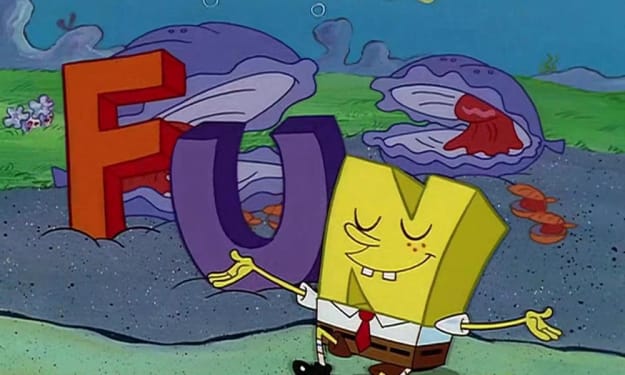
The episode "F.U.N." unfolds as a masterclass in character-driven comedy and narrative irony, centering on Plankton’s most hilariously transparent scheme to date. From the opening moments, the Chum Bucket’s oppressive gloom is a stark, almost visceral contrast to the sun-drenched, vibrant chaos of the Krusty Krab, a visual metaphor for the fundamental conflict between cynical ambition and joyful innocence. Plankton, tiny and vibrating with a fury that seems to distort the very air around him, constructs his "Friendship, U & Me, and Anywhere and Anytime" acronym not as a genuine olive branch but as a convoluted trap, his every syllable dripping with insincerity. The scene is a tightly wound spring of tension, as we, the audience, are complicit in the joke, watching SpongeBob—radiating pure, unadulterated optimism—plunge headfirst into the obvious snare with a trusting eagerness that is both exasperating and profoundly endearing.
By Forest Green6 days ago in Geeks
Flower Bloom 369
FLOWER Bloom 2/25/26 Wednesday By Mariann Carroll Karen had been with Tony for 7 years. Tony started acting strangely after her surgery. He would mow the lawn in the rain and be on his cellphone. He started pushing Karen away. Tony came clean about seeing someone. Karen moved out two months later. Karen moved in with a friend. She felt betrayed.
By Mariann Carroll5 days ago in Fiction


Comments
There are no comments for this story
Be the first to respond and start the conversation.