
Superman: The First Great Leap
The Legendary Birth of an American Icon (1938)


Like Luke Skywalker or the Lone Ranger, he is an indelible piece of heroic Americana. He is every bit the equal of Popeye or Mickey Mouse in sheer recognition. But he’s bigger than all of that.
He represents the best, most noble attributes of the human spirit—of the American spirit. But, like America itself, he has flaws. He wrestles eternally with the morality of violence and force, with the dividing line between "good" and "evil." But let me explain.
Action Comics #1
When I was a kid, I ordered the first issue of Superman (technically Action Comics #1) from the Science Fiction Book Club. I think. Maybe I ordered it from somewhere else. How the hell could you expect me to remember after all these years?
It was a thin thing, with a newsprint cover, rough to the touch. It outlined the origins of Superman, who, as previously noted, was a freaking alien—which should be creepy enough, right? A scientist (presumably Jor-El) placed him in the sci-fi equivalent of a "basket in the bulrushes" and sent him hurtling through galactic space. He crashed on Earth, was seized by DHS (or the 1938 equivalent), and ended up in an orphanage. There, the titanic tot could lift the furniture with one baby arm while doctors and orphanage personnel looked on in a single-panel scene of shocked outrage.
We're told Clark can outrun a locomotive, exhibit massive strength, and hurdle skyscrapers. As noted, in Siegel and Shuster's first incarnation of the Man of Steel, Superman could not yet fly. He does, however, wear the requisite red-and-blue tights and, of course, the cape.

A phony-baloney "scientific demonstration" compares Superman to grasshoppers and ants—creatures that can leap great distances and carry many times their weight. Then, Superman races through the night with a bound and gagged woman beneath his arm, heading for the governor’s mansion because he has a signed confession that could save Evelyn Curry, set to be executed for a murder she didn’t commit. Superman breaks into the mansion, pulling a door off its hinges, after carrying the governor’s servant up the stairs by balancing him on his fist.
The governor looks at the confession while a clock ticks in the panel. He makes a call. In the next scene, we see the back of Evelyn Curry on her knees, thanking God—the governor has stopped her execution at the last moment. This was possibly partly inspired by the Snyder-Gray murder case of 1927.
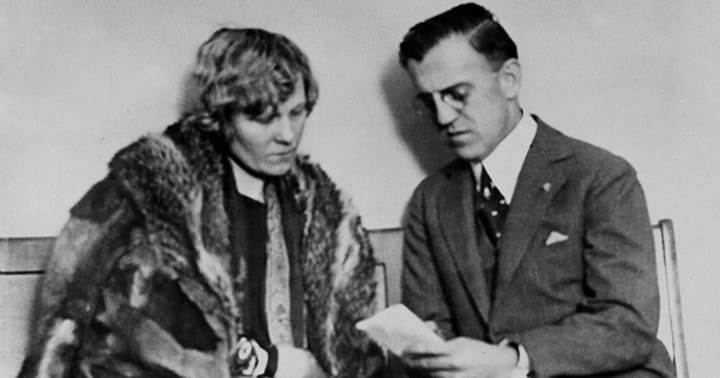
(In 1927, the infamous “Double Indemnity” murder, in which Ruth Ann Snyder and her lover Judd Gray killed her husband for insurance money, captivated the public. An enterprising young reporter snapped a photograph of Snyder at the exact moment of her execution in the electric chair, using a camera hidden in his shoe. The next day, the grisly image hit the front pages and remains widely circulated online. Snyder and Gray, like later "Lonely Hearts Killers" Raymond Fernandez and Martha Beck, were executed just minutes apart. Their case inspired James M. Cain’s classic Double Indemnity (1943), which later became the iconic film starring Fred MacMurray, Edward G. Robinson, and Barbara Stanwyck.)

Returning to Action Comics #1, Superman then proceeds to beat up a wife-beater—right after we get a glimpse of his life as "Clark." (I don’t think Siegel and Shuster had given him the Kent surname at this point. After all, there is no mention of George, Martha, or Smallville in this first story.) Clark is a reporter with the Daily Star (not yet the Daily Planet), and his editor is a great fat man who is not yet Perry White. Lois is still there, though, and she’s a classic 1938 spitfire—a tough, beautiful American woman frustrated by her wimpish boyfriend, Clark, who she doesn’t realize juggles wife-beaters and assorted scum in his spare time.
("You're not fighting a woman now!" Superman exclaims before demonstrating just what a violent mother he was in 1938.)
Enter Butch Matson
In the next sequence, Clark and Lois go to a dance (or nightclub—it's vague), where they encounter a group of “crook-noses.” One of them, Butch Matson, gets fresh with Lois. Bad move.
Clark plays the cowardly act, and Lois, disgusted, leaves. The crooks then kidnap her, ensuring that this becomes a “job for Superman.” He stands in the middle of the road as their car barrels toward him, then leaps over it. He flips the car onto its side, shaking everyone out (including, presumably, Lois!) as if emptying a can of peanuts.

Superman Takes on Politics
Superman then gets wind of a corrupt Senator Barrows (perhaps inspired by outlaw Clyde Barrow of Bonnie and Clyde fame) taking bribes from a shadowy "foreign agent" to get America involved in European affairs—something that, in reality, would soon happen.
Superman hunts down the agent and gives him a terrifying "ride," pole-vaulting to great heights while dangling the man from his hand. Previously, he had left Butch Matson hanging from a telephone pole, offering kindly to “cut him loose”—to which Butch, realizing he’d fall to his death, screamed, “Don’t!”
The issue ends abruptly, but the story continues in the next installment. The final panel proclaims:
“A physical marvel! A mental wonder! Superman is destined to reshape the destiny of the world!”
And you know what? IT WAS TRUE.
Two Hale and Well Goodfellas and the Birth of a Legend
The artwork is primitive—Chester Gould, Perry Mason-level stuff. The illustrations are stiff and scratchy, with each scene conveyed in a single panel. There is no Smallville, no Perry White, no mention of Krypton or Kryptonite, no Fortress of Solitude, and certainly no Lex Luthor (who wouldn’t appear until later as simply “Luthor”). Batman did not yet exist—he wouldn’t flap into Detective Comics until a year later.
This early Superman has few moral qualms about violence. He was, in fact, the second Superman. The first was a supervillain—a psychic dictator bent on world domination. Siegel and Shuster, two nice Jewish boys looking to break into comics, experimented with various genres—Westerns, detective stories, sci-fi—before finally hitting on the formula that would make them immortal.

(It’s possible they worried that their original villainous Superman bore too close a resemblance to a certain German dictator with a weird Charlie Chaplin mustache who was gearing up to invade Poland.)
For years, people have said, “Superman is dead.”
No. Wrong.
Superman is not dead. Never was. He is legendary Americana. He exists as long as the ideals of America exist. He is pure, inviolable—often morally conflicted, but never brooding and melancholic like Batman.
Superman will save us. Superman will fly once more, in the hearts and minds of young and old.
Faster than a speeding bullet?
You better believe it, pilgrim.
Superman lives.
Excelsior!
Facebook group:
About the Creator
Tom Baker
Author of Haunted Indianapolis, Indiana Ghost Folklore, Midwest Maniacs, Midwest UFOs and Beyond, Scary Urban Legends, 50 Famous Fables and Folk Tales, and Notorious Crimes of the Upper Midwest.: http://tombakerbooks.weebly.com
A Knight of the Seven Kingdoms Series Review (Season 1)
As one of the biggest properties in fantasy, A Song of Ice and Fire remains immensely popular with audiences. After reaching far into the past with House of the Dragon, a second spin-off was on the cards. A Knight of the Seven Kingdoms serves up a bite-sized slice of action and drama, but it still claims a spot among the best small-screen titles.
By Robert Cain5 days ago in Geeks
The Shifting Landscape of the United States Luxury Car Industry at CAGR of 1.2%
A sales consultant reviews overnight inquiries. A returning customer compares trim levels on a tablet. Outside, a silent electric luxury sedan glides past traffic. Inside, leather, brushed aluminum, and ambient lighting signal something more than transportation.
By Ashutosh Srivastava7 days ago in Geeks




Comments (4)
I hate how they have tried to make Superman Batman. Or that people don’t like that he is the blue Boy Scout. I love the hero who chooses to do good because it’s the right thing to do. But people doubters as always say no one can be that good. Even though we know good people like Superman even though they seem fewer and fewer in this darker turning world.
My son just loved Superman. A fun stroll down memory lane!
Look, in the sky! It's a bird! It's a plane! It's a dog! A dog? Underdog! Superman never was the underdog, but he was for them, constantly rushing to their defense from the nearest phone booth where he changed his clothes. (Wait! Weren't those basically glass on all four sides? And yet, nobody ever noticed? I guess he was just too fast. But then why did he need to find a phone booth? For a place to leave his Clark Kent clothes, silly!) Enjoyed the article fully, Tom.
This was a stroll down memory lane for me: thanks for a wonderful read!