
Shot of the Movie: Gladiator (2000)
A little shadow for a lot of foreshadowing...
This article is one of a series - Shot of the Movie - and may contain spoilers.
He'll bring them death - and they will love him for it. - Gracchus
With Gladiator II's trailer dropping this week, I felt it appropriate to go back 24 years and look at the original for it's Shot of the Movie.
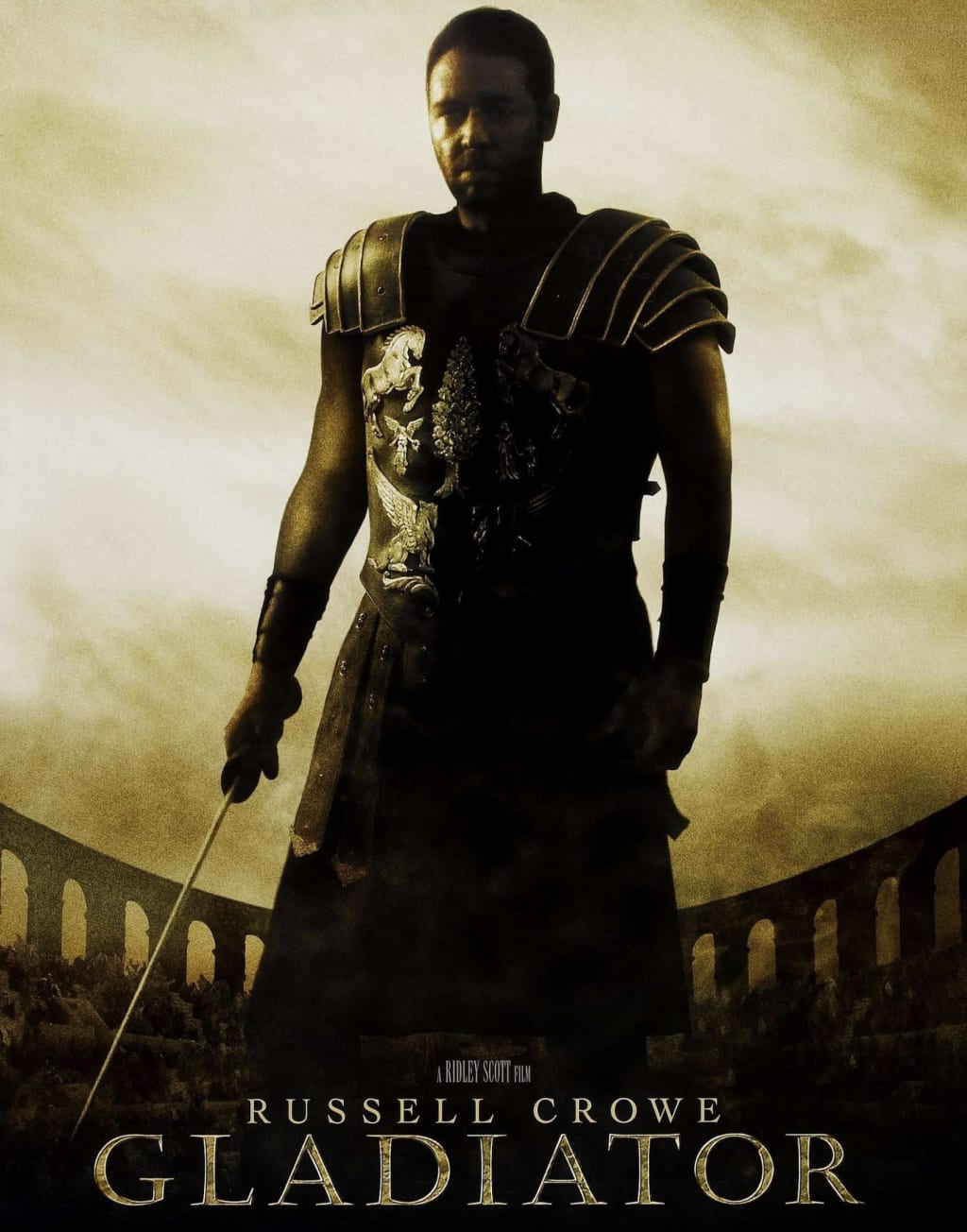
Helmed by director Ridley Scott, Gladiator (2000), with writers David Franzoni (story), John Logan, William Nicholson, and actors Russell Crowe, Joaquin Phoenix, Connie Nielsen, Djimon Hounsou, Oliver Reed, and Richard Harris, earned five academy awards including best picture, best actor, best visual effects, best sound, and best costume design.
Film Overview
Gladiator (2000) follows General Maximus Decimus Meridius (Crowe) as he takes on the mantle of "the Spaniard," a crowd-pleasing gladiator, with tactical training and an aura of reluctant leadership that surrounds him no matter what role he's obligated to serve. Betrayed by the Roman empire following the assassination of the emperor to whom he'd sworn allegiance, Maximus finds his way into the gladiatorial arena following his own attempted assassination and subsequent fall into slavery. His skill in the death arena brings him to Rome and face-to-face with the man who signed his death warrant, Commodus (Phoenix), the new emperor of Rome. Now fueled by revenge, Maximus makes it his mission to kill Commodus and avenge the deaths of his family, the former emperor, and the destiny of Rome.
Context Scene
Leading up to the Shot of the Movie, Commodus has returned to Rome as the new emperor. Here, he meets with the Senate, using his skill as an orator to banter against the Senate, and outline his vision for the empire. Countering the senators, he describes a society where he is the father and the people of Rome are his children. He will love them, making a not-so-subtle nod to the fact that he never felt loved by his own father. He will win this affection by bringing the people what he believes they want. This is important to explain the Shot of the Movie, where we get to see not only the designs Commodus has for the people of Rome, but also the role he believes he plays in this future.
This is the Shot of the Movie.
The Shot of the Movie
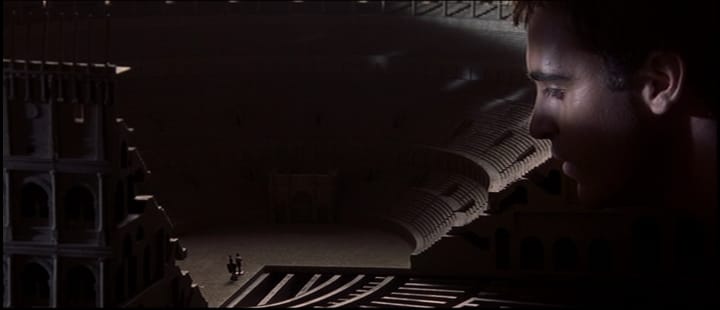
The Shot of the Movie shows us Commodus looking at a scale model of the colosseum where his gladiator games will be held. The shot is framed by the colosseum and Commodus's face.
So, what makes this the Shot of the Movie?
- It fulfills a promise from act one. In the first act of the film, Commodus tearfully expresses to his father that he never felt truly (or perhaps, fully) loved by him. Commodus regales a letter from his father, where the emperor outlines virtues, of which Commodus recognizes he has none. He goes on to explain to his father that he has other virtues, notably, ambition. Commodus's ambition is represented in this scale model of the colosseum, a clearly and articulately designed plan, which will set him up to retain the power that he has, up to this point, taken forcefully.
- The light focuses on Commodus's eyes. The majority of this scene is draped in shadow. So, the placement of light is a deliberate choice. Notably, two areas of the shot are highlighted: (1) the two, small gladiator figures at the center of the shot, (2) and most importantly, Commodus's eyes. This shot is a visual metaphor showing us that this is Commodus's vision for Rome.
- Intentional shadowing allows for foreshadowing. Building off of point two, the shadowing of the shot illustrates that nothing else matters to Commodus. This vision is the only thing in his focus, both literally and figuratively, and therefore should be the only thing that matters to the empire. As the movie progresses, this laser focus becomes a reality, specifically, that two opposing forces (he and Maximus) will come face-to-face (and corps-a-corps) with Commodus's decisions.
- To Commodus, he is God, and the people of Rome are his playthings. In looking at his scale model of the colosseum, Commodus is literally above everything. He is separate from Rome, lording over it. This is true metaphorically as well; Commodus views himself above everyone else (senators and citizens, alike). To him, everyone and everything are just his playthings, there for his own amusement, and nothing more. He may say he loves these toys, and this may be true, but it is clear Commodus uses everyone as objects with little regard to their own capacity to understand, feel, and want in return.
Winning for both best picture and best visual effects, it would be easy to say that there are certainly other beautiful (and perhaps even more memorable) shots to chose from Gladiator (2000). A gliding hand over the Elysian fields, or a handful of dirt to show how "grounded" our "down-to-earth" protagonist is, are two that come readily to mind. However, our Shot of the Movie, this almost blink-and-you'll-miss-it moment, is still one of the strongest for the film. In my opinion, it not only meets the criteria outlined above, but it also outlines a promise of premise for the movie. This movie will bring us death (and, fittingly, justice), and bringing the death [of injustice], as Gracchus astutely noted, we will love [it] for it.
About the Creator
Bethany Yoder
Fascinated with the art and science of story-telling, particularly through the lens of film and the magic of subtext.
Keep reading
More stories from Bethany Yoder and writers in Geeks and other communities.
Shot of the Movie: The Poseidon Adventure (1972) and Poseidon (2006)
This article is one of a series - Shot of the Movie - and may contain spoilers. Today, I'm going to be presenting a double feature on The Poseidon Adventure (1972), and it's reimagining, Poseidon (2006). Before we jump in, I want to give a quick shout-out to whoever was responsible for this:
By Bethany Yoder2 years ago in Geeks
A Knight of the Seven Kingdoms Series Review (Season 1)
As one of the biggest properties in fantasy, A Song of Ice and Fire remains immensely popular with audiences. After reaching far into the past with House of the Dragon, a second spin-off was on the cards. A Knight of the Seven Kingdoms serves up a bite-sized slice of action and drama, but it still claims a spot among the best small-screen titles.
By Robert Cain15 days ago in Geeks



Comments