
Short Film Review: Juice
A Look into How We Practice Patriarchy at Home


‘Juice’ is a short film by LargeShortFilms available on YouTube. Set in India in a small city flat of our main character Manju Singh (Shefali Shah) and her husband, who is having a family gathering. The film attempts to illustrate patriarchy manifesting through gender roles and gender inequality in a South Asian household.
The film opens in a living room, populated by male guests relaxing, eating, and chatting, and the only woman there, Manju Singh, is clearing up dirty dishes on the table left by the men. Immediately, we see gender roles being assigned. The men are talking about topics they have no knowledge of and casually expressing sexist opinions, and Manju plays the role of the domestic maid. We even see this through the setup, the men are sat on chairs and sofas, Manju is kneeling at the table as she cleans. Throughout the film, we see these gender roles and gender inequality at play through characters, dialogues, and mise-en-scene.
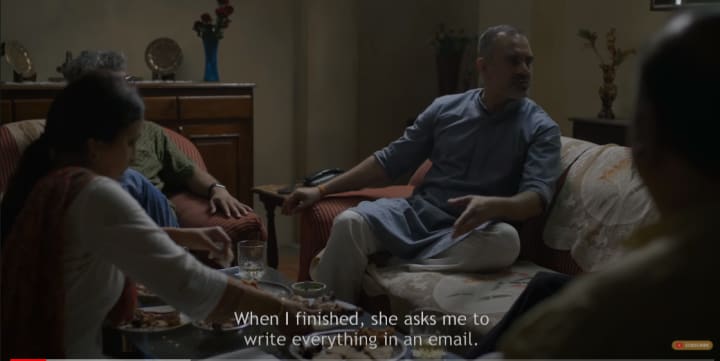
We watch as Manju’s husband and their male guests complain about a woman being assigned as the new manager at their workplace. One of them argues biological differences for why she’s not fit for the job — (It’s a physically exhausting job — the heat, dust, and crazy shifts — can she handle it?). All the while Manju is working around the men in the heat, sweating, as she feeds the air cooler with water to keep the room cool for the men. This is the irony of gender roles in the 21st century. More and more women are excelling in their careers, and at the same time working tirelessly to run their homes and take care of their families. But the “biology” argument rendering them as the weaker gender will never leave them. Even if you don’t have a career outside of the home and you’re a housewife, you are still working full-time with zero days off and little free time. But of course, you are the weaker gender, you should stay home because the men have to go out hunting for meat and water in the supermarkets of modern society.
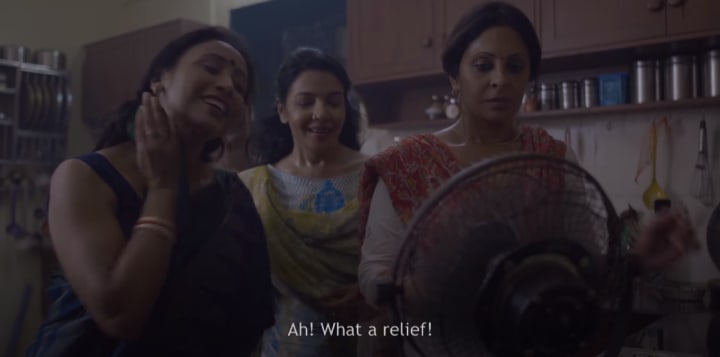
We see another contrast between the female space and the male space, as we follow Manju and a new guest just arriving through the hallway towards the kitchen. As Manju opens the door, we are introduced to the wives of the men in the living room. In the suffocating heat, women are cooking as they wipe away sweat with their saris and dupattas. There is no cooler or even a fan to keep them cool, there is no food being served for them. This is not a fun weekend gathering for all of the women as they work away in the kitchen. As I said before, housewives never get days off. This is also the difference between female leisure time and male leisure time. Women can relax but only for a certain time and only in certain places. Men however can have free time in living rooms, in mosques and temples, in deras (a place where men meet and socialise), outside on the streets, in public — anywhere and anytime.
How do we learn gender roles you ask? How do we uphold them? Well, the film answers these questions for us. We are taken to a room where kids are playing videogames, one of the women’s daughter is the only girl there among three boys. Now, this scene absolutely infuriates me because this has happened to me and I still see this happening all the time. The girl’s mother comes and asks her to serve food for her brothers (“Food is ready, come and serve your brothers.”). And I completely understand the girl’s reluctance to stop playing videogames but once again her mother asks her with a stern voice (“Enough playing, come right away!”). Just as adult women, the little girl is not allowed unlimited leisure time. There is always a limit. The women can only chit chat while they continue to work and the little girl can only play videogames for a certain time before she has to go and be conditioned to learn her role in the house and in society — to serve the men in her life at the expense of her comfort and freedom.
The film doesn’t just highlight obvious, surface-level gender roles. But it layers different aspects of patriarchy and misogyny, and how it manifests in a home. We see the unequal distribution of labour at home, the unequal leisure time afforded to women compared to men, socialising young children to learn gender roles, and the age-old argument of ‘career or motherhood’ for women.
The film almost seems familiar, like I’ve seen it multiple times, and I have — in our own homes at weekend gatherings or on Eid or Diwali. We’ve all seen ‘Juice’ before in our real life. The film doesn’t try too hard by exaggerating everyday instances nor is it too understated that you have to squint to see what the film is trying to show us. It’s perfectly balanced and it hits home multiple times with its realistic portrayal of gender inequality at home. This is a testament to Director Neeraj Ghaywan’s poised approach to show how patriarchy, which is so deeply entrenched in our society that it’s invisible sometimes, exists in our homes.
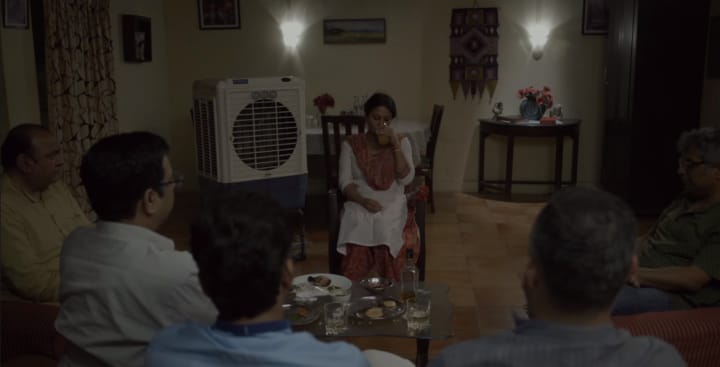
We are all given roles to play according to our genders in society and we act in the Patriarchy Show every day. There comes a time though when we can’t act anymore, both women and men. The role is not a fit for you anymore, it seems fake and unnecessary, in fact, it is suffocating you now. It's not at all true to your larger-than-life character unbound by gender, society, and biology. In Truman Show fashion, the stage of patriarchy is crumbling under your feet as you realise there is a whole world to experience out there, and these expectations and roles assigned to you are not real. We watch Manju, our main character, coming to this realisation, through every sexist comment and every instance of unequal treatment, and suddenly she’s done acting. She doesn't want to act like the perfect wife, the perfect mother, the perfect housewife, or the perfect host anymore. She wants to do what her soul wants in that very moment — to have a cool glass of orange juice in front of the air cooler in the summer heat. And she does.
About the Creator
Keep reading
More stories from writers in Geeks and other communities.
Book Review: "The Haunted Library" ed. by Tanya Kirk
Full Title = The Haunted Library: Tales of Cursed Books and Forbidden Shelves edited by Tanya Kirk To be too impressionable is as much a source of weakness as to be hypersensitive: so many messages come flooding in upon one another that confusion is the result; the mind chokes, imagination grows congested. - The Whisperers by Algernon Blackwood
By Annie Kapur6 days ago in Geeks




Comments
There are no comments for this story
Be the first to respond and start the conversation.