

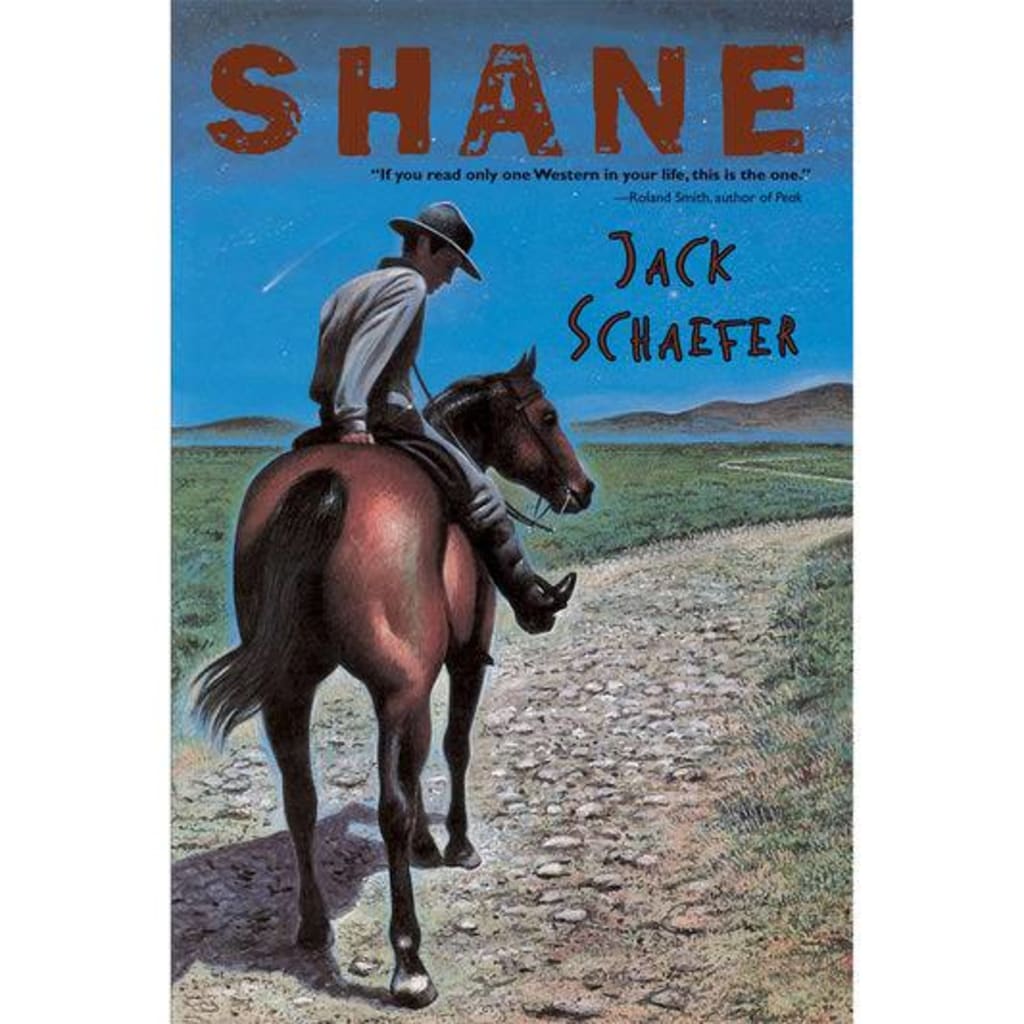
The 1949 book Shane is probably the most influential Western book of all time, with its 1954 film elevating the story into pop culture status. The image of a mysterious rider appearing one day in a violent town, scaring its inhabitants, before eventually protecting and fighting for those who couldn't defend themselves, became the undying image of a gunslinging Western hero; influencing other mysterious but altruistic heroes in other stories and genres. Yet, the origins and creation of Shane is equally as inspiring.
Jack Schaefer wrote Shane during the Golden Age of Westerns, a time when heroic cowboys reigned supreme in books, comics, movies, and television shows. Initially titled Rider from Nowhere and serialized in Argosy, the story was soon published in novel form, before becoming popular enough to be made into a feature film. Not all Western stories, though, were written as purely fiction. Some were inspired by real-life events that happened in the previous century. Schaefer was inspired by the historical range war, the Johnson County War, which happened in Wyoming between 1889-1893. It was fought between a corporation of rich ranchers against smaller independent settlers, which soon involved the United States Cavalry. The war claimed the lives of at least 20 people, possibly more.
Shaefer, though a popular novelist in his time, seldom talked about himself or his books. However, as seen in his works and a few interviews, he was a man who wrote about the courage of the common folk. As such, Shane was written with a focus on the struggles and triumphs of the independent settlers. There is information circulating in the web that Schaefer supposedly rescinded the idea, stating that the "settlers destroyed America." But there has been no documentation or primary source to support this. Even though other of his books became beloved and adapted, Shane was undoubtedly his most famous work.
Many literarians suggest that Schaefer wrote the book as an antithesis to the 1902 novel The Virginian, written by Owen Wister, which also tackled the Johnson County War. Wister lived in that era, but as a wealthy man himself, sided with the rich ranchers. The Virginian espoused the notion that it was justifiable, and even honorable, to use vigilante justice and murder to protect property. The protagonist, the titular Virginian, was loud, rugged, and an ideological cowboy. In contrast, Schaefer sided with the smaller settlers, and wrote the protagonist, Shane, as a quiet, stoic, and humble gunfighter.
It is also unknown who was the inspiration behind the character of Shane, although historians have a couple of candidates, namely Jim Roberts and Clay Allison. Both lived violent lives as gunfighters of the Old West. Both arrived in towns ravaged by range wars, namely the Pleasant Valley War and the Colfax County War. And both ended up helping the poor underdogs of these conflicts, with Allison even killing one of the hired guns of the rich ranchers, similar to Shane. These, however, still remain assumptions. Nonetheless, the hardships these people faced back then still resonate in Schaefer's time and even today.
Of all Western books in history, Shane by far is the one that stood the test of time. It inspired many from Clint Eastwood's Pale Rider to Nobuhiro Watsuki's Rurouni Kenshin.
About the Creator
Carl Hannigan
Self-acclaimed connoisseur of the literary arts. Famed warlord in the wars against typos. Lover of the sweet books and magnificent prints. TL;DR I'm a book nerd and editor :D
Keep reading
More stories from Carl Hannigan and writers in Geeks and other communities.
Otaku Girl (Book Review): Where Memes and Literature Mix
Last year, I was lucky to stumble upon the book Escapist Dream by Louis Bulaong. It’s a story about this virtual reality world where people can visit and transform themselves into real comic book, anime, and video game characters. It’s basically this pop culture gamelit book for geeks which, as a fellow geek myself, instantly loved. While it’s gotten mixed reviews as expected from a book of its genre, it has gotten recognition for being the quintessential book for geeks.
By Carl Hanniganabout a year ago in Geeks
The Rachels - 2025
Much to my surprise, I have kept a list of the films I‘ve seen this year. I daresay it isn’t complete. There will be films that snuck in on a late night in front of the TV that I would’ve forgotten to note. Or others, that I went to watch at the cinema, but then had a red wine and promptly forgotten about. But it’s not a bad approximation of the films I’ve seen this year. In total, there are 53 films listed, so an average of one a week and one for good luck.
By Rachel Robbins28 days ago in Geeks
PTA Wrote to X Three Times Seeking Closure of Imran Khan’s X Account Over the Past 3.5 Years
Pakistan’s digital governance has once again come into the spotlight following revelations that the Pakistan Telecommunication Authority (PTA) contacted X (formerly Twitter) multiple times over the past three and a half years, seeking the closure of former Prime Minister Imran Khan’s X account. The disclosure has sparked renewed debate about freedom of expression, political speech, and the regulation of social media platforms in Pakistan. As social media continues to shape political narratives, the issue highlights the growing tension between state regulation and digital rights. Background of the Requests According to official sources, the PTA wrote to X three separate times over the last 3.5 years, requesting action against Imran Khan’s verified account. The communications reportedly cited concerns related to content guidelines, misinformation, and public order. Imran Khan, leader of the Pakistan Tehreek-e-Insaf (PTI), has remained one of the most influential political voices on social media, even during periods of political uncertainty and legal challenges. His X account has been used to: Share political statements and policy positions Address supporters directly Comment on national and international developments This influence has made his digital presence a highly sensitive issue for regulators and authorities. PTA’s Role in Digital Regulation The Pakistan Telecommunication Authority is responsible for monitoring and regulating telecommunications and internet services in the country. Over the years, PTA has taken action against: Content deemed unlawful Accounts accused of spreading misinformation Platforms that allegedly violate Pakistan’s digital laws Officials argue that their requests to X were made under existing legal frameworks, emphasizing the need to maintain public order and prevent the spread of harmful or misleading content. However, critics say the repeated requests raise concerns about selective enforcement and political pressure. X’s Response and Platform Policy X, like other global social media platforms, operates under its own content moderation policies, which are applied worldwide. While the company may comply with local laws in some cases, it also balances: Free speech principles User rights International standards on expression There has been no public confirmation that X agreed to permanently suspend or close Imran Khan’s account following PTA’s requests. In fact, his account has remained active for most of the period in question, suggesting that X either rejected or limited compliance with the requests. This reflects the broader challenge faced by governments when dealing with international tech platforms that are not fully subject to domestic control. Political and Public Reactions News of the PTA’s repeated letters has drawn strong reactions from various quarters. Supporters of Imran Khan PTI supporters view the requests as an attempt to silence political opposition. They argue that: Social media remains one of the few platforms for uncensored political expression Restricting accounts undermines democratic discourse Digital spaces should remain open for debate and dissent Government and Regulatory Perspective On the other hand, supporters of regulation stress that: No individual should be above the law Social media content can influence public order Authorities have a responsibility to act when content crosses legal limits This divide reflects Pakistan’s deeply polarized political environment, where digital platforms play a central role. Freedom of Expression vs. Regulation The case has reignited a broader conversation about freedom of expression in the digital age. Social media has become a powerful political tool, but it also raises concerns about: Fake news and misinformation Incitement and hate speech National security implications Human rights advocates argue that account closures should be a last resort, used only in extreme cases and through transparent legal processes. They warn that repeated requests without clear public justification could lead to self-censorship and erosion of democratic values. The Global Context Pakistan is not alone in facing these challenges. Governments around the world have struggled to regulate social media platforms while respecting free speech. Similar disputes have emerged in: India Turkey Brazil Several European countries These cases highlight a global trend where states seek greater control over digital narratives, while tech companies resist blanket censorship. What This Means for Pakistan’s Digital Future The disclosure that PTA contacted X three times over several years points to an ongoing struggle over digital authority. Key implications include: Increased scrutiny of political speech online Pressure on social media companies to comply with local demands Growing public awareness of digital rights Possible legal reforms related to online regulation As Pakistan’s population becomes increasingly connected, the outcome of such disputes may shape how politics, activism, and expression function online. Conclusion The revelation that the PTA sought the closure of Imran Khan’s X account three times over 3.5 years underscores the evolving battle between state authority and digital freedom. While regulators insist they are acting within the law, critics warn that repeated attempts to restrict a major political voice risk undermining democratic principles. As social media continues to influence public opinion and political engagement, Pakistan faces a critical question: How can it balance regulation with the right to free expression in an increasingly digital society? The answer will likely define the country’s online landscape for years to come.
By Fiaz Ahmed 2 days ago in Geeks
📢 Raise Your Voice Thread: 01/22/2026
Our “Raise Your Voice Threads” are hosted most alternating Thursdays at 12PM ET to offer creators more avenues to uncover exceptional stories on Vocal. As we are continuously searching for fresh creators and inspiring stories, this thread provides an opportunity to exchange and discuss the stories that have moved and motivated us on Vocal.
By Raise Your Voice by Vocal2 days ago in Resources




Comments
There are no comments for this story
Be the first to respond and start the conversation.