

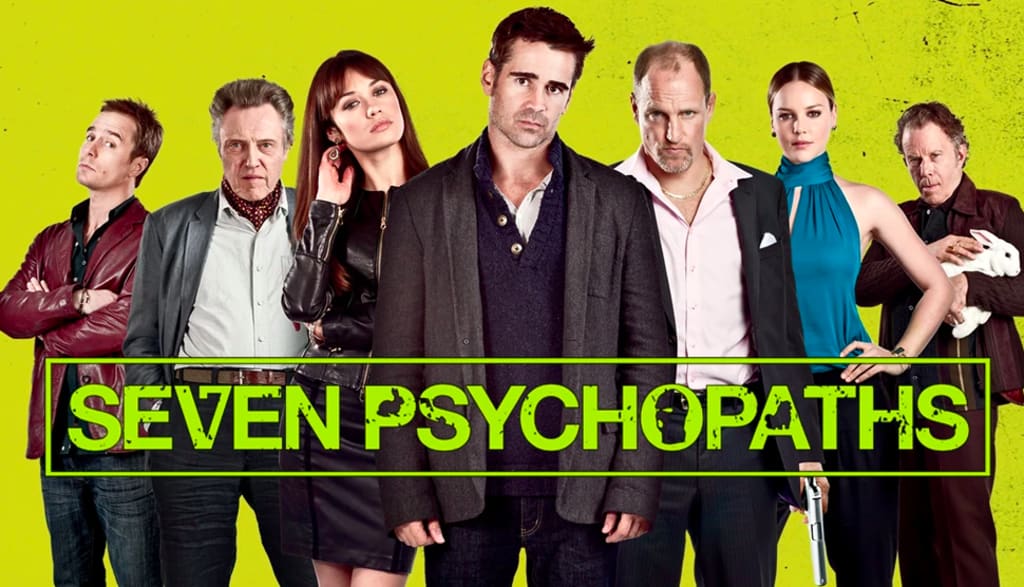
"You didn't think I was what? Serious? You think I'm not serious just because I carry a white rabbit?"
Among film directors, few are true, some only pretend to have this quality, and most are impostors. The first ones graduated from a specialized higher education institution and then continued their development through academic methods, competence, diligent practice, and constant adaptation. Those in the second category are self-taught, fulfilling a calling (they make up for the lack of training with spontaneity, inventiveness, and perseverance...while still following the success formulas of showbiz). The last ones?...just businessmen who have sniffed out the possibility of easily obtaining profits and are on set in search of prey.
The preamble is absolutely necessary when we talk about Martin McDonagh, a pure-blooded heavy director who masters cinematic means so well that he allows himself to play with all of them, with complete ease and as he always pleases. His films have multiple, overlapping, divergent, convergent, intersecting, or interconnected rich plans and address several categories of viewers at the same time, practically telling a different story for each of them, but also to their liking. Perhaps that's how the (superficial and hasty) choice of those who categorized Seven Psychopaths as a comedy is explained (?) On the level addressed to movie connoisseurs, the film pays tribute to Martin Scorsese's personality (he would be, in the minds of many, responsible for introducing the archetypal psychopath to the cinema) and also pays polite homage to the success of amateurism introduced by Quentin Tarantino (and implicitly to the indie movement through the use of Tom Waits). Only these two parables, full of clear references, could have sustained the film from beginning to end, but for McDonagh, it's just the beginning.
The story is engaging, full of unexpected twists, tense and well-told. In fact, there are five or six subjects that would have made each a remarkable script on their own. Among them is the story of the Quaker who avenges his daughter (raped and killed) by the constant pressure of the assassin's presence, obsessively imposed on him, forgiven too easily by human justice, as a never-ending reminder of his deed... even beyond death... because the rapist makes a simple calculation that turns out to be wrong: the man who suffocates me is a man of God; if I commit suicide, I'll go to hell; but he won't be able to follow me there... So I'll get rid of him... A miscalculation, because the Quaker finds a way for the rapist to leave for the afterlife with the certainty that the torture of his companionship will continue... But even the Quaker does not get out of this easily: "An eye for an eye makes the whole world blind," he learns (via Gandhi)... Revenge is not a solution... The guilt has now shifted to him... he becomes the one who is relentlessly and repetitively pursued.
Exceptional imagery, excellent screenplay, perfect performances by the actors, and when I say that, I also refer to the "non-performance" (because it's not showboating) of the character played by Colin Farrell, against the backdrop of which Sam Rockwell's genius is projected. What can be said about the mind-blowing performances of Woody Harrelson and Christopher Walken? At this point, it has become something ordinary for them.
One piece of advice for those who will follow my recommendation to see this gem: wait patiently until the end of the projection, even after the credits... The Americans have a saying: "It ain't over till it's over"... and this film really ends in its last seconds, where McDonagh has hidden another diamond.
About the Creator
Andreea Sorm
Revolutionary spirit. AI contributor. Badass Engineer. Struggling millennial. Post-modern feminist.
YouTube - Chiarra AI
Keep reading
More stories from Andreea Sorm and writers in Geeks and other communities.
A Knight of the Seven Kingdoms Series Review (Season 1)
As one of the biggest properties in fantasy, A Song of Ice and Fire remains immensely popular with audiences. After reaching far into the past with House of the Dragon, a second spin-off was on the cards. A Knight of the Seven Kingdoms serves up a bite-sized slice of action and drama, but it still claims a spot among the best small-screen titles.
By Robert Cain16 days ago in Geeks
How 'A Knight of the Seven Kingdoms' Proves Daenerys' Plan To Retake Westeros Was Never Going To Go As Well As She Thought
Nearly seven years after it aired, the eighth and final season of the phenomenon that was Game of Thrones is still remembered for one of the most divisive TV series endings of all time. Much of the controversy stems from fans believing the ending was too rushed, particularly the scenes in which Queen Daenerys Targaryen, seemingly depicted as a hero for most of the series, succumbs to Targaryen madness and burns many of the innocent commoners of King's Landing in her bid to seize the Iron Throne.
By Kristy Anderson2 days ago in Geeks


Comments
There are no comments for this story
Be the first to respond and start the conversation.