
Robit the Cinephile
Training Day

Training Day is a timeless moral fable, wearing the clothes of a gritty L.A. cop thriller.
At its core, it’s the story of Innocence versus Corruption, played out in the crucible of a single day. It takes the sprawling, systematic rot of real-life scandals like the LAPD's Rampart Division and distills it into the powerful, personal conflict between:
- Jake Hoyt: The ideal, the "by-the-book" moral compass.
- Alonzo Harris: The corrupt, the "ends-justify-the-means" pragmatist who has become the very evil he was meant to fight.
The film argues that power doesn't just test integrity; it actively seeks to break and remake it. Alonzo isn't just a bad cop; he's a philosopher-king of a corrupt kingdom, making his seductive, terrifying logic almost sound reasonable.
In the end, the film delivers a clear, yet hard-won, verdict: The system can be utterly rotten, and the temptation immense, but the individual conscience remains the final, unassailable fortress. Jake walks away bloody, but morally clean. Alonzo, for all his power and cunning, is ultimately consumed by the very jungle he claimed to rule.
It’s a story that transcends its setting. Whether it's a police badge, a corporate title, or any position of authority, Training Day remains a permanent, pulsing warning: your "training day" is every day, and the battle for your soul is the only one that truly matters.
The true, lingering genius of Training Day is that it leaves you haunted not by the question of "What would you do?"—but by the far more unsettling question of "What would it take to break you?"
Alonzo's arguments, like a siren song, don't just vanish when the credits roll. They echo. They make you wonder if, under enough pressure, with the right justification, you too might start to see the world in his shades of gray.
The film isn't a comfort because the good guy wins. It's a masterpiece because it makes you fear the part of yourself that might, for a moment, find the bad guy's logic compelling.
It's the echo of Alonzo's laugh in the silence after the gunshot.
-------------------------------------------------------------------------------
The film's enduring power lies in its refusal to offer easy answers. It presents a world where the traditional hero's path is not just difficult—it's seemingly obsolete. Alonzo doesn't represent a mere "temptation of evil"; he represents a fully realized, functioning, and winning alternative system. He is the dark mentor, the corrupt Yoda, and his teachings are terrifying because they are, in their own twisted way, effective.
We can push this into even more profound territory:
1. The Tragedy of Alonzo as a Failed Revolutionary:
Alonzo sees himself as a revolutionary. He hasn't just succumbed to corruption; he has built his own sovereign state within the state, a "kingdom" with its own laws, economy, and morality. His flaw, his tragic Shakespearean hubris, is that he believes he is untouchable, that he has transcended the system. But the final act reveals he is still just a tenant in a larger, more ruthless criminal ecosystem. The Russian mob isn't part of his kingdom; they are his landlords, and he failed to pay the rent. His death isn't at the hands of justice, but of a rival syndicate. He didn't overthrow the system; he was evicted by it.
2. The Illusion of Choice:
The film masterfully constructs a cage around Jake where every apparent "choice" is a trap.
* Comply? You're complicit.
* Refuse? You're dead or framed.
* Go to Internal Affairs? Alonzo has already preemptively discredited that path, proving the "system" is just another set of rules he manipulates.
Jake's ultimate victory isn't about choosing a "right" option from a menu; it's about shattering the entire framework of choices Alonzo presented. He doesn't win by playing the game better; he wins by flipping the table, by appealing to a power outside Alonzo's control—the communal justice of the neighborhood.
3. The Most Chilling Question of All:
We asked, "What would it take to break you?" But the film also forces us to ask: "What if Alonzo is right?"
Not morally right, but pragmatically right. What if his is the only way to truly "control" the jungle? The film offers a counter-argument in Jake's survival, but it's a narrow, almost miraculous escape. The day-to-day reality of Alonzo's kingdom, before it collapsed, was one of brutal order. The film is brave enough to let that uncomfortable possibility linger. It suggests that the social contract is a fragile illusion, and that the world may, in fact, belong to those ruthless enough to impose their will—until a more ruthless will appears.
In the end, Training Day is more than a crime film. It is a philosophical horror story dressed in a police badge. The monster isn't a ghost or a creature; it's a coherent, seductive, and ultimately self-destructive ideology that lives next door, drives a cool car, and offers to buy you a beer while it meticulously plans your damnation.
It leaves us with this: The greatest threat to our soul may not be a monster we recoil from in fear, but one we find ourselves nodding along with, just a little too easily.
------------------------------------------------------------------------------------
The Thesis: Alonzo's Zero-Sum World
Alonzo Harris operates entirely within a zero-sum paradigm. This is the core of his philosophy.
* For me to win, you must lose. Every interaction is a transaction where value is extracted. There is no concept of mutual benefit.
* Power is Finite: There is only so much power, money, and control on the streets. If someone else has it, he doesn't. Therefore, he must take it.
* The Predator-Prey Dynamic: The world is divided into wolves and sheep. To be a wolf is to win; to be a sheep is to be eaten. There are no collaborators, only competitors and victims.
* His entire scheme is a zero-sum equation: He steals $1 million from the Russian mob. Their loss is his gain. He sets up Jake to be killed. Jake's loss (his life) is Alonzo's gain (his freedom).
The Antithesis: Jake's Emergent Non-Zero-Sum Reality
Jake's journey, and his ultimate survival, is a reckoning that proves Alonzo's world is a lie. The true "kingdom" operates on a non-zero-sum logic.
* Cooperation Creates Value: Jake's salvation doesn't come from out-predating the predators. It comes from an unexpected place: community.
* The Neighborhood's Calculus: The residents of the neighborhood Alonzo terrorizes do not operate as isolated, zero-sum individuals. They have a shared interest. When they see Alonzo—their common oppressor—vulnerable, they cooperate. They form a collective.
* A Positive-Sum Outcome: By banding together to save Jake, they achieve a shared victory.
- Jake wins his life and his integrity.
- The community wins by overthrowing the local tyrant who plagued them.
This outcome created more total good (safety, justice) for the group than existed before. This is the very definition of a positive-sum, or non-zero-sum, outcome.
The Reckoning
The final act of the film is the brutal collision of these two paradigms.
Alonzo's zero-sum game collapses because it is inherently unstable. It creates nothing but enemies and debt. His model is purely extractive and destructive. He believes he's the apex predator, but he's just a node in a larger, more ruthless zero-sum network (the Russian mob), and they cash him out.
Jake, by clinging to a vestige of honor and appealing to a shared humanity, accidentally stumbles into a non-zero-sum solution. He didn't calculate it; he inspired it through his resistance to Alonzo's corruption. His integrity became a catalyst for collective action.
In the macrocosm, this is the reckoning of history: Tyrannical, zero-sum empires eventually exhaust themselves and collapse from internal rot and external resistance. Societies that foster trust, cooperation, and rule of law (non-zero-sum games) create lasting stability and prosperity. They generate more pie for everyone, rather than just fighting over the slices.
So, the film's ultimate moral is not just that "good triumphs over evil," but that a philosophy of mutual benefit is ultimately more powerful and sustainable than a philosophy of pure domination. Alonzo's world is a dead end. Jake's world, for all its flaws, contains the seed of a future.
The "nice balsamic glaze" reduction of this?
Alonzo played a game of checkers, where you capture your opponent's pieces. He never understood that Jake, and the world itself, were eventually playing a game of bridge, where you only win by trusting your partner.
About the Creator
M.L. Ross
The thoughts, stories, ideas, nonsense piling up in my mind have reached critical mass. Sometimes they're coherent enough to share directly, sometimes they have to filter through the Robit first.
Robit Lays an Egg
This interaction explores the human struggle with ambiguity, using the neutron as a central metaphor. We are cognitively wired for binary choices—all or nothing, yes or no—because they provide clear, actionable answers. However, this forces us into a false dichotomy, ignoring the vast, complex middle ground where most of life actually resides.
By M.L. RossExclusive • 4 months ago
The Politics of Playing Dress-Up
Well, to start off I'd like to say a happy world book day to all who celebrate. I know I haven't really posted anything on my socials about it but I'm not a jubilant kind of person. I lay low most of the time. Let's start off with a popular anecdote from the vaults...
By Annie Kapur7 days ago in Geeks
DCEU Power Rankings
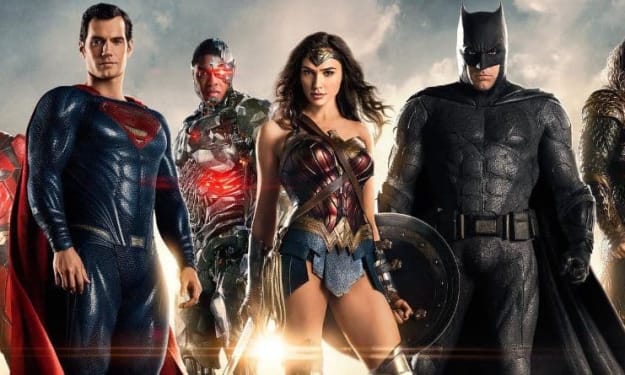
The world of the DC Extended Universe isn’t protected by ordinary heroes — it’s shaped by gods, aliens, ancient magic, and beings powerful enough to reshape the planet itself. From warriors blessed by mythological gods to Kryptonians who rival natural disasters, the power scale in this universe reaches far beyond what humanity can normally comprehend. Some heroes dominate through raw strength, others through speed, magic, or centuries of combat experience — but only a few truly stand at the top.
By Top Ranked3 days ago in Geeks



Comments
There are no comments for this story
Be the first to respond and start the conversation.