
Pulp Fiction - Quentin Tarantino (1994)
Movie Review

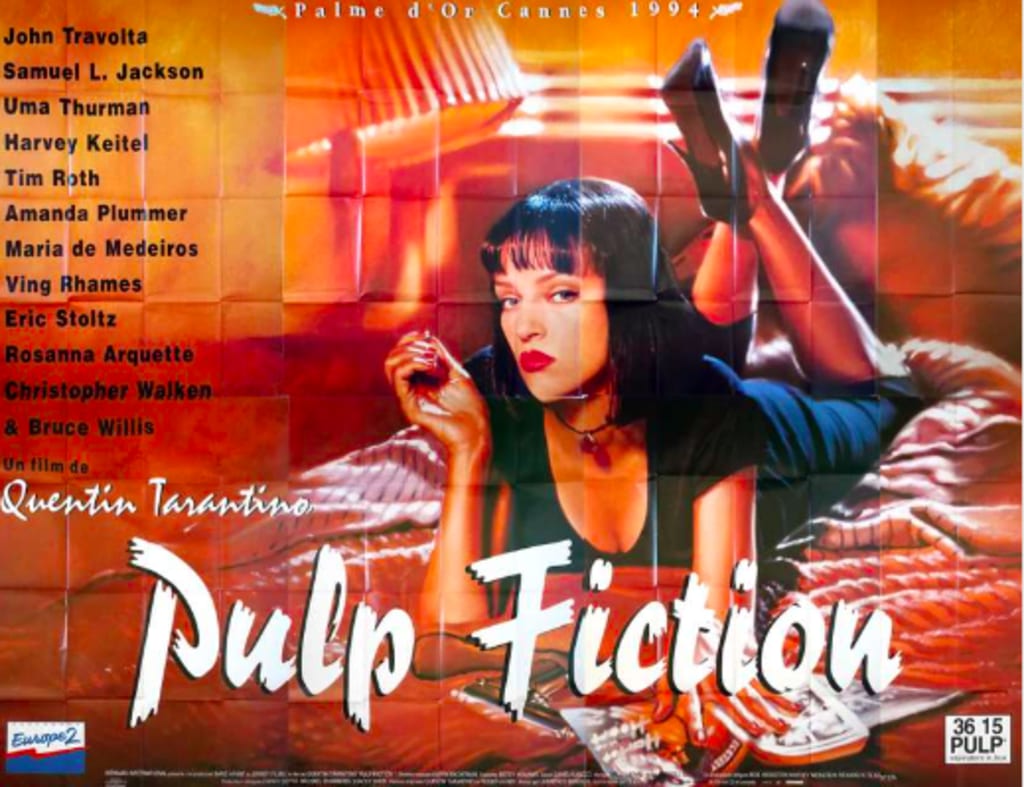
Speaking seriously about imposture and opportunism in film directing, we inevitably and every time come to the controversial case of Quentin Jerome Tarantino. A person without specialized studies (academic certificates), and even more than that: one who couldn't even finish high school, but who nevertheless provided an important and significant contribution to the seventh art. Coming from a disorganized family, with few inherited components of an artistic nature (an obscure theatrical parent and an amateur musician), Quentin had his first contact with the projection room in his early childhood when his mother's occasional friends bought tickets for B or C category films to take him away from home. Otherwise a fairly determined person, at only 15 years old he took life into his own hands, abandoning college for a theater school, which he would leave just as suddenly and nonchalantly.
His ambitions initially channeled towards acting, were to be redirected and amplified in the direction of cinema only with his employment at the video rental shop called "Video Archives" in Manhattan Beach, California. Owned and impeccably managed by Lance Lawson and Dennis Humbert, the store was a huge success in the 80s (the heyday of VHS-Betamax video systems); and for more than a year, it was even the most important center for renting video cassettes in the world, statistically confirmed.
We can only imagine the impact of such an environment on the young, bewildered, and unknowledgeable teenager, suddenly assaulted by the free, unlimited, and tempting offer of shelves full of productions from all genres, as well as the need to maintain a level of participation in discussions corresponding to the debates around him.
For it is the complex confrontation of ideas among group members (which pathologically accelerated the archivists' interest in watching as many and as diverse films as possible) that imposes on Tarantino an intensive regime and an exhausting rhythm, culminating (according to his own statements) in being stuck in front of the screen for over ten hours a day for uninterrupted months.
We owe the heroic period and these extreme experiences to the film Pulp Fiction, as well as Quentin's entire career.
Without education and a predetermined path, there were no other possibilities, and the brilliant idea of composing a screenplay that would mix key scenes from randomly selected productions (mostly of secondary importance) no longer seems so unnatural, but rather a normal consequence of a fortunate conjunction.
Based on the structure of a cinematic triptych, inspired by the anthology film Black Sabbath - Mario Bava (1963), Pulp Fiction (without a name at that time) was supposed to contain three short films based on separate stories written by Tarantino, Roger Avery, and Adam Rifkin. However, things did not go as planned. After several convulsions and setbacks, the project finally took shape, two years after its start, to become something close to what we know today. That is, Tarantino abandoned the three different scripts, as well as Rifkin's part, and merged them with scenes taken from other planned or ongoing productions, separately for Quentin and Avery. The script had a vague and confusing character that relied heavily on shocking violent outbursts, alternating with somewhat more domestic scenes. Only at this point is the connection between the disjointed narrative elements and the pulp phenomenon (active in journalism between 1900-1950), which represents that adventure literature delivered on morning stalls, in series, and printed on cheap paper (wood pulp support, opposite to that of quality "glossies" or "slicks") noticed, and this realization redirects the artistic endeavor towards a complete meaning and form... but also suggests the most suitable title.
In Pulp Fiction, the main roles were written specifically for each actor in the cast, with the exception of the character Vincent Vega (played by John Travolta), which was originally intended for Michael Madsen. The dance between Travolta and Thurman was a direct copy of the one between Barbara Steele and Mario Pisu in Federico Fellini's film "8½", and was meant to be allegorical.
Presented in a circular narrative and a planned disorder, some chapters are overlapped, and two include alternative points of view. Each of the seven parts of the film metamorphoses references scenes from selected productions based on subjective criteria, regardless of their ratings or positions in specialized rankings. The main influences are attributed to filmmakers: John Badham, Jean-Luc Godard, Brian De Palma, Anna Karina, John Boorman, Dennis Donnelly, Sheriff Buford Pusser, Sam Raimi, Tobe Hooper, Akira Kurosawa, Sydney Pollack, Robert Houston, David Weisman, Don Siegel, Robert Aldrich. Pulp Fiction's greatest achievement lies precisely in the way this bizarre selection functions.
No, Quentin Jerome Tarantino is not a film director born overnight out of talent, ardor, work, and inspiration. No, Quentin Jerome Tarantino is a trickster, an orchestrator who has brilliantly harmonized and exploited all the opportunities that have come his way. He is a prestidigitator with impressive dexterity, to whom the beauty of the illusions offered allows you to forgive anything, because in the end, from one end or another, everything on the set is just spectacle and magic.
About the Creator
Andreea Sorm
Revolutionary spirit. AI contributor. Badass Engineer. Struggling millennial. Post-modern feminist.
YouTube - Chiarra AI
Keep reading
More stories from Andreea Sorm and writers in Geeks and other communities.
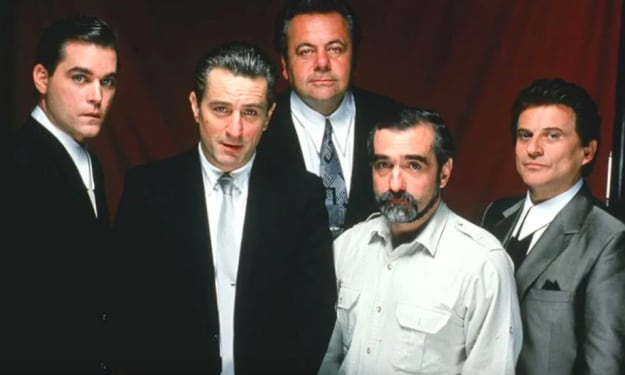
Goodfellas-Martin Scorsese (1990)
It was initially called "Wiseguy," just like the investigative journalist Nicholas Pileggi's novel (which served as inspiration for the screenplay), and proposed a fictionalized autobiographical account of a real character, thus providing an analytical incursion into the inner workings of the mafia. The idea of such a portrayal was different from previous approaches, which, although they exceeded the boundaries of impartial observations or went as far as suggesting organizational relationships, never reached the intimate mechanisms of the phenomenon or the fascination it exerted on others, where only opulence was correctly received.
By Andreea Sorm3 years ago in Geeks
A Knight of the Seven Kingdoms Series Review (Season 1)
As one of the biggest properties in fantasy, A Song of Ice and Fire remains immensely popular with audiences. After reaching far into the past with House of the Dragon, a second spin-off was on the cards. A Knight of the Seven Kingdoms serves up a bite-sized slice of action and drama, but it still claims a spot among the best small-screen titles.
By Robert Cain16 days ago in Geeks
Where Is The Cast Of 'Orange Is The New Black' Now?
While Netflix was still in the early days of blockbuster shows, the streaming service hit the jackpot when it launched the prison-dramedy series, Orange is the New Black, in 2013. The show followed a white collar criminal, Piper Chapman, as she faced consequences for a past mistake, and was based off the memoir of the same name by Piper Kerman. In fact, OITNB was just the second Netflix original series after House of Cards.
By Jenika Enoch6 days ago in Geeks



Comments
There are no comments for this story
Be the first to respond and start the conversation.