

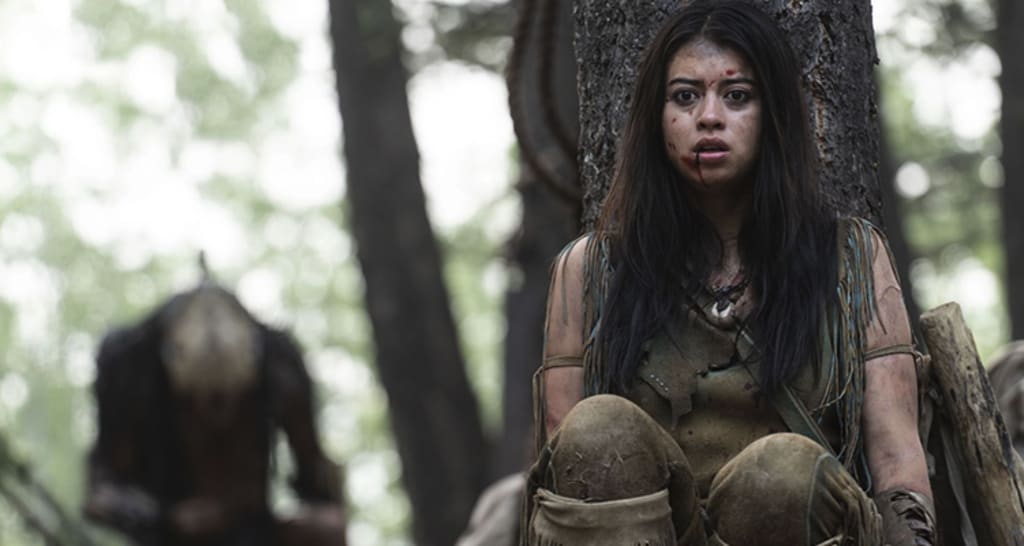
If you're a fan of the Predator franchise, then you'll be happy to know that a new installment has been released on Hulu. While some may wonder why it wasn't released in theaters, "Prey" is a great movie that's worth watching on the biggest screen possible. The movie is set in 1719, making it a period piece, and stars Amber Midthunder as Naru, a young Comanche woman who must confront the first Predator alien to appear on Earth.
One of the best things about "Prey" is its portrayal of Naru as a strong and capable warrior who can hold her own against both the Predator and the French fur trappers who threaten her tribe. Naru wants to hunt like the men in her tribe, but they think hunting is only for men. Despite their doubts, Naru proves herself to be twice as tough and three times more observant than the others. When she notices a skinned snake and strange prints that don't belong to any known animal, she knows that something is out there, something that might be a monster from the childhood stories her mother used to tell her.
Naru's brother, Taabe (Dakota Beavers), is on a hunt to find a lion that's been prowling about, and Naru tags along despite his objections. They have an easygoing sibling relationship that's established early in the movie and adds to our worries once the real danger appears. Naru is the first to see the Predator, but Taabe doesn't believe her when she tells him that it's a monster from their childhood stories. Meanwhile, the Predator is making its way up the animal chain, teaching a pugnacious wolf a lesson about selling woof tickets by pulling out its spine. When it ruthlessly guts the bear that was chasing Naru and her faithful mutt, she finally gets to see it and runs like Hell.
The scene with the bear is one of the movie's best, cleverly staged to make us wish we hadn't seen the Predator beforehand. As it yanks the bear from its pursuit, lifting it up for the kill, the invisible Predator is painted into view by an outpouring of blood. Naru sees this and runs like Hell. So begins a series of expertly crafted chase scenes, with the Predator employing familiar and new ways to eviscerate its victims. There's also a callback to one of the original film's best lines: "if it bleeds, we can kill it." Bleed it does, with a neon green blood that Naru uses as war paint at one point.
Adding another element of danger to the movie are the uncouth French fur trappers who are also on the hunt for the Predator. When Naru stumbles upon a field of skinned buffalo, she prays over them, thinking that this is the monster's handiwork. Soon she realizes it's man, that other evil predator, who is responsible. Even though they agree with Naru that something otherworldly is out there, the trappers are even more villainous than the Predator. So we're not sorry when they start getting splattered.
"Prey" is a great addition to the Predator franchise, even though there are no "choppas" for anyone to get to in 1719. The movie does an excellent job of portraying Naru's Comanche nation without othering them. They are the heroes of the story, and their village teems with a sense of camaraderie. Although the movie is mostly in English, a full Comanche language version was apparently also shot in tandem. This does not endanger our suspension of disbelief, however, and the movie is still very enjoyable.
One of the strengths of “Prey” is its attention to detail in recreating the world of 1719 Alberta. From the costumes and sets to the dialogue and customs of the Comanche tribe, everything feels authentic and immersive. Director Dan Trachtenberg and his team clearly did their research and took great care in bringing this world to life on screen.
The film also benefits from a strong cast of actors who bring depth and nuance to their roles. Amber Midthunder is a standout as Naru, the film’s protagonist, imbuing her with a quiet strength and determination that makes her a compelling hero to root for. Dakota Beavers is also excellent as Taabe, Naru’s protective older brother who learns to appreciate her skills as a hunter over the course of the film. And while the Predator itself is, of course, a CGI creation, the filmmakers do a great job of giving it a sense of weight and physicality, making it feel like a real threat to the characters.
Perhaps the most refreshing thing about “Prey,” however, is its willingness to take risks and subvert expectations. The fact that the protagonist is a Native American woman, for example, is a bold choice for a series that has traditionally centered on male, often white, protagonists. And the film doesn’t shy away from addressing the historical injustices faced by Native American communities, even as it celebrates their strength and resilience. It’s a timely reminder that representation matters, both on and off screen.
That said, “Prey” is still very much a sci-fi action movie at its core, and it delivers on that front in spades. The Predator is as menacing as ever, and the film’s various action set pieces are expertly choreographed and thrilling to watch. Fans of the series will find plenty to enjoy here, while newcomers will likely be impressed by the film’s technical prowess and strong storytelling.
In the end, it’s a shame that “Prey” isn’t getting a theatrical release, as it truly deserves to be seen on the biggest screen possible. But even on a small screen, it’s a thrilling and engaging ride that showcases the best of what the “Predator” franchise has to offer. And with any luck, it will help pave the way for more diverse and inclusive stories in the genre moving forward.
About the Creator
Keep reading
More stories from Diresh Sherid and writers in Geeks and other communities.
A Man Called Otto (2023) Movie Review
Marc Forster’s latest movie, “A Man Called Otto,” is a heartwarming, albeit unremarkable dramedy that tells the story of a man who finds it challenging to pick his daily battles. Living in an ordinary suburban neighborhood in the Midwest, Otto gets easily annoyed by the missteps of strangers, and his protests are so pronounced that they rival those of Larry David in an average episode of “Curb Your Enthusiasm.” Tom Hanks plays Otto in an indistinct performance that strikes a balance between quirky and grounded. Although he is often right about his grievances, Otto could perhaps afford to have some manners himself, especially when a new, pregnant neighbour drops by with a bowl of home-cooked meal as a courtesy.
By Diresh Sherid3 years ago in Geeks
National Shutdown
Across the United States, organizers have called for a national shutdown January 30, urging people to pause daily routines and participate in a coordinated day of economic and civic protest. The movement, often described as a jan 30 general strike, reflects rising public tension around immigration enforcement policies and the role of federal agencies in local communities.
By Saboor Brohi about 9 hours ago in Geeks




Comments
There are no comments for this story
Be the first to respond and start the conversation.