
Pop Culture: How the Whims of the West Dictate the Indain Subconscious
West Dictate the Indian Subconscious


Pop Culture: How the Whims of the West Dictate the Indian Subconscious
By definition, pop culture is supposed to represent what everybody is loving. It is supposed to pervade continents and populations and be the accepted norm in most open or sufficiently open societies. With the Internet allowing people to connect and share en masse, there is no longer any monopoly on popular cultural practices. It is powerful enough to bring a wave and wash over the generalities of a society. A product of globalisation and radicalisation, mass culture literally drives the economy nowadays.
One of the biases we attach to pop culture is that it is inclusive of anyone that will partake in it. However, in an imperfect society as ours, it can also be an instrument employed by the prejudiced to abuse and propagate hatred. We will deal with both the positive and negative aspects of pop culture, but first, we will discuss a few of the properties of pop culture.
What Defines Pop Culture
If asked to describe how to decide if something is pop culture or not, people, in general, will see that it fulfils three criteria. First, it should cross boundaries and be in demand in multiple geographically separated places. Second, the rise in popularity of the object of attraction should be meteoric and exponential. And last, it should be widely accepted by people of multiple and diverse societies and cultures and devoured eagerly.
Pop culture is not restricted by genre. Fashion, food, literature, motion media, social media, social narratives, economy, communication, etiquettes - every aspect of your life can be invaded by pop culture. Even countercultures, when they gain sufficient momentum, can ironically become mainstream enough to gain pop culture status. It is hard to argue if individualism is lost or conserved in pop culture when individualism itself has, nowadays, become a pop-culture element of sorts.
Impact of Western Culture on the Indian Masses
Westernization has long been held as an open-secret taboo among Indians of the boomer and Gen X generations. For the former, it is a matter of fierce nostalgia that leads them to possessively hold on to the elements that defined them. For the latter, it is more about comfort in the past and resistance to change. Now, while none of these are accusatory generalisations, they are undeniably the prevailing temper. It is quite funny how objects with veritable shock value ones become commonplace with time. The uncertain response that bare midriffs a la crop tops get nowadays was how jeans were looked at once.
Fashion, due to its visibility, is definitely one of the most starkly westernised areas in India. Suits have become more “formal” than saris and kurtas. Western clothing has become more common than Indian attire even in suburban and rural societies. Media is another. At one point of time, web series, short films and on-demand streaming platforms were foreign notions; the bourgeois revolutions changed that. Kids now watch Hollywood movies with their families in theatres instead of smuggling them in pen drives from friends. Supermarkets and malls have overrun households. Alcohol and clubbing are pleasures that are becoming less and less guilty. McDonald’s, KFC, Domino’s, Starbucks and even organic food is the craze nowadays. It is no longer entirely weird if you compliment a stranger in India today or ask for someone’s number. Even Indian literature has seen a shift in the style of writing. From tiptoeing around uncomfortable topics using euphemism and tangible tension to being unapologetic in their approach and from an almost lyrical storytelling method to a blunt one, westernisation of literature happened with an oxymoronically loud subtlety.
Is the Impact Good or Bad
It is both. Talking about issues like sex, menstruation, mental health, LGBTQ+, personal independence and privacy were considered anything from taboo topics to be hush-hushed, to awkward conversations whose necessity would be questioned. That stance has been reformed to a large extent today. But there have been detrimental effects too. Colourism in Asia, in general, and India, in particular, was reinforced by the conventional beauty standards of the West. But that is not all.
Indians have lost the ability to appreciate their own culture alongside Western pop culture. Even when people in the West appropriated Indian culture and started fetishizing it, we failed to regain any sense of pride in it. Instead, we accepted the mutated, watered-down Western version as an “improved” form of our culture. Examples? The maang tikka, matha patti and bindi were reborn as chic accessories for Coachella, jadau jewellery was “adopted” in the Alexander McQueen 2008 Fall Collection, saris were revamped as wraparound gowns for prom, and suddenly, every Indian wanted to show their collection off on social media.
Responsible Pop Culture
In the age where digitisation has turned the world into a global village, it is impossible and unthinkable for any trend or fad to not become popular. And this is why we should be reviving that old favourite sermon of our parents, “If your friends jump off a cliff, will you follow them?” There is no shame in not jumping a bandwagon if you think it is problematic. You can discuss your issue with the object with others. At the end of the way, the onus is on you to judge and be responsible about taking part in pop culture.
About the Creator
Shaggy C
Authorpreneur with a proven track record of editorial innovation across the platform, I have worked with Brands to build audiences and drive profitability. Recognized for my Creative Vision, Talent of Storytelling, Expertise in Technology.
History of The Three Stooges (Part I: The Beginnings and Columbia Pictures - 1920s-1936)
I have been itching to write about The Three Stooges on Vocal for close to two years, but I couldn't figure out how to do it. I wanted to do it by third Stooge, but that's a bit complicated. I know this much. I was about eight or nine years old when I first saw The Three Stooges. I remember one of my local channels had the Stooges on for hours, and I tried my damnedest to be up for those shorts. I remember that the Family Channel actually had an hour of the Stooges on from 11PM to midnight, and it was the entire library on during that time.
By Clyde E. Dawkins4 days ago in Geeks
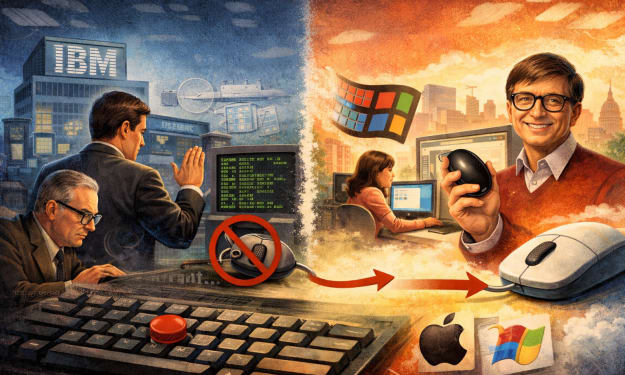
Cursor in Limbo – How IBM Almost Slept Through the "Click" Revolution 🖱️
In the history of technology, few moments are as ironic as when an industry giant ignores an invention that eventually changes the world. The story of IBM (International Business Machines) and their cool reception of the computer mouse is a classic case study of how the "curse of knowledge" and engineering hubris can blind even the most powerful players. 🏢
By Piotr Nowak4 days ago in Geeks
A Transparent Look at Vocal Challenges and Top Stories
Almost three years ago, we shared a resource article that served as a place for people to suggest new challenge prompts. We thought it would be a good idea to refresh that thread, and take the opportunity to answer a few common questions about top stories, how challenges are judged and how submissions are reviewed.
By Vocal Curation Team4 days ago in Resources

Comments
There are no comments for this story
Be the first to respond and start the conversation.