
Plain as the Alphabet
According to Thomas Paine


"It is my design to make those who can scarcely read understand." - Thomas Paine
As I continued to read Thomas Paine's reflection on his own writing style, contained in The Norton Anthology of American Literature, I couldn't help but recall a similar comment made by William Wordsworth a quarter of a century later when he wrote the Preface to Lyrical Ballads (published 1801). When studying British Literature, I came across an article written by Tom Thompson, "The State of the Preface Address: on Wordsworth and Common Speech." According to Thompson:
[P]oetry in English was most prominently composed in the highest diction -- issuing either from divine circles (the Muse or God) or from urbane ones (first "at Court," then more generally among London intellectuals.
William Wordsworth, with his friend Samuel Taylor Coleridge, invented a new style of poetry, replacing this high diction with language that could be understood by the common man. Much of American Literature is influenced by the English of Great Britain. In this instance, an American writer has introduced the concept that everyone should be able to understand the written word.
To further understand Paine's style, he clarified that language should be
as plain as the alphabet (and that it should) fit the powers of thinking and the turn of language to the subject, so as to bring out a clear conclusion that shall hit the point in questions and nothing else (Levine 338).
Common Sense and the subsequent pamphlets, The Crisis, were written to inspire and stir the souls of men to rise up and stand for what is right. In order for every man to understand, Paine knew that he needed to speak plainly. When Wordsworth and Coleridge presented the Lyrical Ballads in this new style, it was to stir the human heart in a different way. Wordsworth's life influenced his style and theme of poetry and when discussing poetry in his Preface to Lyrical Ballads he states:
Poetry is the spontaneous overflow of powerful feelings: it takes its origins from emotion recollected in tranquility.
In many of his poems, including "I Wandered Lonely as a Cloud" (aka "Daffodils"), there is a reference to this tranquility brought about by our connection with nature.
I Wandered Lonely as a Cloud
BY WILLIAM WORDSWORTH
I wandered lonely as a cloud
That floats on high o'er vales and hills,
When all at once I saw a crowd,
A host, of golden daffodils;
Beside the lake, beneath the trees,
Fluttering and dancing in the breeze.
Continuous as the stars that shine
And twinkle on the milky way,
They stretched in never-ending line
Along the margin of a bay:
Ten thousand saw I at a glance,
Tossing their heads in sprightly dance.
The waves beside them danced; but they
Out-did the sparkling waves in glee:
A poet could not but be gay,
In such a jocund company:
I gazed—and gazed—but little thought
What wealth the show to me had brought:
For oft, when on my couch I lie
In vacant or in pensive mood,
They flash upon that inward eye
Which is the bliss of solitude;
And then my heart with pleasure fills,
And dances with the daffodils.
Paine was not interested in tranquility or peace and even stated that:
Not a man lives on the continent but fully believes that a separation must some time or other finally take place, and a generous parent should have said, "If there must be trouble, let it be in my day, that my child may have peace" (Levine 349).
The powerful feelings that stirred Wordsworth to write poetry are the same feelings that stirred Paine to inspire a nation. Paine also knew that inspiration ebbs and flows when he said: "for though the flame of liberty may sometimes cease to shine, the coal can never expire" (Levine 349).
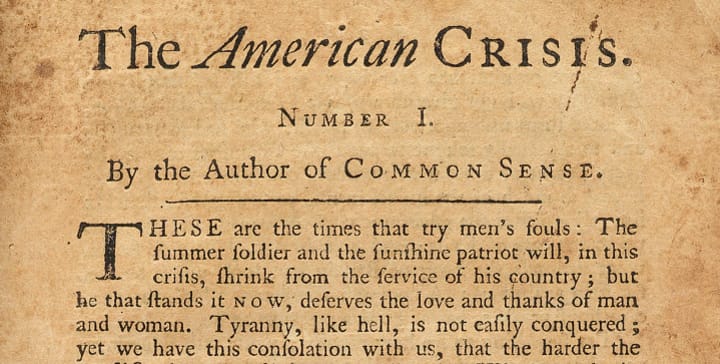
In The Crisis, No. 1, Paine speaks clearly by speaking plainly: "I bring reason to your ears, and in language as plain as A, B, C hold up truth to your eyes" (Levine 351). What is the truth Paine spoke of? Paine started his prose with a phrase that has been quoted many times: "These are the times that try men's souls" (Levine 346) and ends with
By perseverance and fortitude we have the prospect of a glorious issue; by cowardice and submission, the sad choice of a variety of evils... (Levine 351).
The truth is simply the consequences of our actions or inactions. From time to time the American citizen has been stirred to stand with others. Some of the events in our present past have stirred our souls. I can recall the explosion of the Challenger and the Twin Towers crumbling to the ground. These moments have stirred our souls and have caused us to fight for liberty and to avoid "a ravaged country - a depopulated city - habitations without safety, and slavery without hope..." (Levine 351).
So we stand.
References:
Levine, Robert S., et al. The Norton Anthology of American Literature. 1820-1865. 9th ed., vol. 1 2, W.W. Norton & Company, 2017.
Thompson, Tom. “Celebrating English Poets & Poetry.” Poets.org.Academy of American Poets, 4 Oct. 2016, www.poets.org/poetsorg/text/state-preface-address-wordsworth-and-common-speech
Wordsworth, William, and W.J.B. Owen. Preface to Lyrical Ballads. Rosenkilde and Bagger 1957.
About the Creator
Rebecca A Hyde Gonzales
I love to write. I have a deep love for words and language; a budding philologist (a late bloomer according to my father). I have been fascinated with the construction of sentences and how meaning is derived from the order of words.
Keep reading
More stories from Rebecca A Hyde Gonzales and writers in Geeks and other communities.
The Moral Compass
Queen Victoria’s reign (1837-1901), defines the historical and literary period of the Victorian Age. The historical Industrial Revolution and the literary Romance period preceded the Victorian age, each laying the groundwork for the advances and growth experienced in England. The Romantic Period was a response to the Industrial Revolution that catapulted Europe forward economically. The Romantics sensed a loss of humanity due to the separation from the simplicity of life and connection to nature. It was a plea to return to the Golden Age. Poems and prose expressed the feelings of many writers who felt that England’s leadership in “commerce and industry exacted a terrible price in human happiness.” And that “progress had been gained by abandoning traditional rhythms of life and traditional patterns of human relationships.” The rapid and unregulated growth of industrialization came with many social and economic issues. The Victorian Era appeared to address more of the social order of things. What is acceptable. Right and wrong were clearly defined. Women were expected to conduct themselves in a way that represented high moral standards and conduct befitting a lady. The sexual appetites of the sexes were not considered appropriate topics of conversation. A young woman would be ruined if found in a compromising situation. Repeated themes of the Victorian era include the roles of women, morality, and principles of good versus evil.
By Rebecca A Hyde Gonzales4 years ago in Geeks
A Knight of the Seven Kingdoms Series Review (Season 1)
As one of the biggest properties in fantasy, A Song of Ice and Fire remains immensely popular with audiences. After reaching far into the past with House of the Dragon, a second spin-off was on the cards. A Knight of the Seven Kingdoms serves up a bite-sized slice of action and drama, but it still claims a spot among the best small-screen titles.
By Robert Cain13 days ago in Geeks
Lycan Lore
As the students of my 10am mythology class take their seats, I decide to steer the day's curriculum away from Greek and dive into a Western European discourse on the misaligned beliefs of the Werewolf. A tale of truth or fiction. No one really knows.
By Lamar Wigginsabout 9 hours ago in Fiction


Comments
There are no comments for this story
Be the first to respond and start the conversation.