
My Beautiful Laundrette (1985)
Does it Stand the Test of Time?

Director: Stephen Frears
Writer: Hanif Kureshi
Starring: Gordon Warnecke and Daniel Day Lewis
**Contains Spoilers**
I’d never seen My Beautiful Laundrette. An oversight on my part. I was just old enough to see it on its cinematic release, and I could’ve caught it when it appeared on the Friday night film spot on Channel Four (a channel that probably saved the British Film Industry by allowing new and different voices to the epic space of the cinema screen). But I didn’t. I tell people that this was because of my Catholic mother’s disapproval – a real thing and a good comic throwaway line. But it was also probably a symptom of my own teenage prudishness.
Anyway, I didn’t really need to see the film because I knew all about it from the discussions in newspapers, late night TV and viewing clips on film review shows. I knew it was groundbreaking and a comment on the divisive entrepreneurial politics of Thatcher’s Britain. I also knew it was about an inter-racial homosexual relationship between two photogenic, handsome young men.
I had read clever stuff about the film, about its lyricism, amidst the bleakness of a dour, down-trodden London. It was trailblazing in subject matter, a key part of the 1980s artistic renaissance borne out of struggle across class, gender and racial lines. I assumed I would love it. It’s a masterpiece.
I went to see it for the first time yesterday – a forty year anniversary showing of the film. I expected to be blown away. This is not a good frame of mind to examine a movie, because of course, I was disappointed. This morning, then, I need to reflect and give an honest, fairer appraisal.

The film started life for Kureshi as an epic of immigration – a back story of ships entering ports, flashbacks of Omar and Johnny as children, large-scale fascist violence on London streets. However, as budget and time restraints came into play, Kureshi states:
“It was shot in six weeks, in February and March 1985 on a low budget and 16 mm film.”
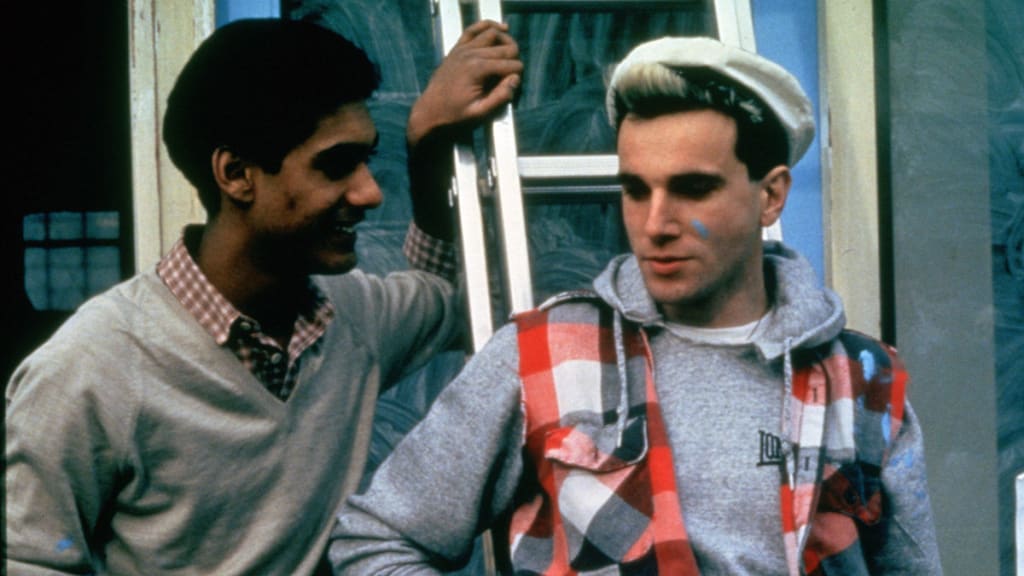
The film is about Omar and Johnny. Two young men struggling with the economics of a city that has lost its safety nets and is quick to brand the unemployed as wasters. Omar’s father has amibition for his son, having been an educated, respected journalist in Pakistan. Johnny’s family is a small "Greek chorus" of thugs who threaten and loom. We find out that Johnny and Omar have a history of friendship, maybe more. And that Omar’s father had to help Johnny only to spot him on a fascist march sporting right-wing regalia and fervour.
Omar is given a job in his paternal uncle’s garage, washing cars, before being promoted to laundrette manager. Omar gives Johnny a job to help with the renovations and running of the laundrette, which Johnny takes as a chance to stop being a “bad boy” The two rekindle a sexual relationship.
There are a number of subplots, mainly involving Omar’s family: his uncle’s mistress, a potential arranged marriage, drug-dealing, violent landlords, subterfuge. The film has a lot to say and is action-packed. I suspect modern editing techniques would have chopped the action faster.
Kureshi says:
We decided the film was going to have gangster and thriller elements, since the gangster film is the form that corresponds most closely to the city, with its gangs and violence. And the film was to be an amusement, despite its references to racism, unemployment and Thatcherism. Irony is the modern mode, a way of commenting on bleakness and cruelty without falling into dourness and didacticism

I wish that amongst all the intense praise of the movie, someone had let me know that it is also stylised and choreographed. Whilst the setting is gritty and grim the acting is theatrical. (Day-Lewis's more naturalistic approach, with slight facial movements and intensity, sticks out amongst the other performances). I wish I’d been told because I was a little taken aback and it formed a boundary between me and the film. I was never fully-immersed. My emotional pull was diverted.
The film has plenty of memorable scenes: Nasser and Rachel dancing in front of the laundrette as Omar and Johnny narrowly miss being caught out having sex in the back, Tania baring her breasts in a show of female defiance, a car being shaken by thugs, Tania disappearing from view from a train platform, two young men cleaning wounds whilst giggling playfully, an old drunk man dying. But all these scenes are set up as metaphorical rather than emotional.
For example, when Omar’s father dies, it becomes symbolic of the loss of an older order that believed in education and compassionate socialism that was drowned out by materialism. Grief is slightly robbed of its full vocabulary.
Does it stand the test of time? Would I watch it again? To both of those a tentative yes. But a second viewing would be looking for meaning rather than connection. It would be an examination of symbolism over emotional pull.
In the end, this isn't a film about plot. The audience isn't expected to invest in whether or not the lovers will stay together, or the laundrette will be a success. It is more about the introduction of a new set of characters to the cinematic universe, the outsiders, the grifters, the drifters and the grafters of the 1980s forced into a space that is claustrophobic and neglected, forcing enemyhood on those who have more in common than they realise.

If you've enjoyed what you have read, consider subscribing to my writing on Vocal. If you'd like to support my writing, you can do so by leaving a one-time tip or a regular pledge. Thank you.
About the Creator
Rachel Robbins
Writer-Performer based in the North of England. A joyous, flawed mess.
Please read my stories and enjoy. And if you can, please leave a tip. Money raised will be used towards funding a one-woman story-telling, comedy show.
Keep reading
More stories from Rachel Robbins and writers in Geeks and other communities.
Amadeus
Screenplay: Peter Schaffer Director: Milos Forman Starring: F Murray Abraham, Tom Hulce Going to rewatch Amadeus on the big screen, I was worried. Do you recognise that fear that something you once loved might not meet expectations on revisiting? That the memory might be better than the reality?
By Rachel Robbins7 months ago in Geeks
A Knight of the Seven Kingdoms Series Review (Season 1)
As one of the biggest properties in fantasy, A Song of Ice and Fire remains immensely popular with audiences. After reaching far into the past with House of the Dragon, a second spin-off was on the cards. A Knight of the Seven Kingdoms serves up a bite-sized slice of action and drama, but it still claims a spot among the best small-screen titles.
By Robert Cain5 days ago in Geeks
SpongeBob Review
The episode “I Was a Teenage Gary” delivers a surprisingly layered narrative that satirizes classic horror movie tropes while staying true to the absurdist humor that defines SpongeBob SquarePants. From the opening scene, where the titular snail’s sudden transformation into a teenage version of himself is accompanied by a deliberate, melodramatic music cue reminiscent of 1980s horror films, the show signals its intent to blend parody with genuine character development. The script deftly balances slap‑stick moments—such as Gary’s over‑the‑top teenage angst manifesting in the form of an inexplicable craving for water—with more nuanced commentary on identity crises, highlighting how even a simple pet can embody the adolescent struggle between conformity and rebellion.
By Forest Green6 days ago in Geeks



Comments (8)
An awesome review, Rachel! It sounds like an interesting flick!
I saw this when it was first shown on C4 and, yes, their support for such films helped to get them off the ground. Very much a film of its chaotic time. I may rewatch at some point and thanks for the memory.
Great review mate! I love this film, I've seen it about three or four times and every time I watch it, I uncover more about its social commentary.
Alas, I remember the hubbub but not the actual movie! I was surrounded with babies and toddlers at the time (ok, 1 baby, 1 toddler). Love your coherent thoughts on the film and now want to check it out. Thanks, Rachel!
Brilliant breakdown of a subversive masterpiece—race, queerness, ambition washed clean with Thatcher-era grit.
I think you've gotten to the problem I also had with the movie. And it also seemed to need a better editor.
Another excellent review. I was 25 in 1985 so the last two films you review (Amadeus and this one) were released at the peak of my interest in film and certainly during a creatively interesting era where special effects became more elaborate and topics more revealing and risqué. Oddly I do not watch either of the last two films you reviewed. However I do very much remember seeing the title My Favorite Launderette and for some reason it did not really pique my interest. I’m not quite sure why that is so, maybe it was not so popular here in the United States. I’m not quite sure but it’s one that just passed right by me. however, this review now makes me want to see this. over the past 10 to 12 years I have grown an interest in watching as many films as I can from the 1980s. The 80s was a magical decade for me as that was the decade of my 20s. I was 20 in 1980 and 29 and 1989. I turned 30 on December 29, 1989 so as you can see the entire 80s except for a matter of a few days spent in my 20s. What I get from these films of the 1980s is being able to relive that youth when I see the styles of the clothing, the music, the overall quality of the films that were made during that time, and remembering what was going on in my life at the time when these films were released. Thank you again for such a wonderful review.
Interesting, I'll have to check it out.