
Movies of the 80s: 'Steel' and the Death of A.J Bakunas
The forgotten 1980 movie Steel is a bizarre and tragic rabbit hole.


The movie Steel was released two times in 1980. The first release came in August 1980 with ads that touted dramatically, "They reached for an impossible dream and built a miracle." This refers to the premise of the movie which is about a ragtag group of construction workers who, under the leadership of Lee Majors, put the finishing touches on a Kentucky high rise before it defaults back to a greedy magnate.
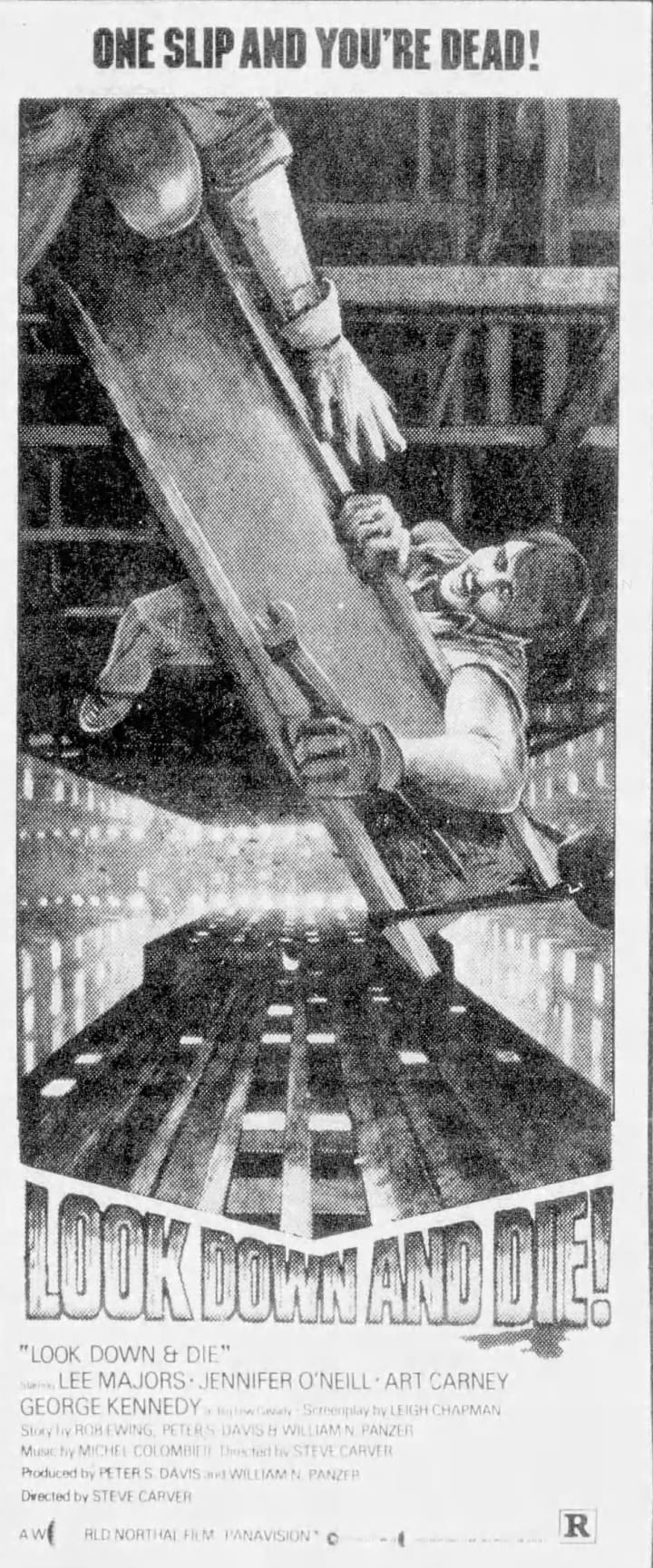
Then, in November 1980, in Los Angeles, Steel returned to theaters but not in a way that anyone who saw Steel back in August would recognize, at least in terms of the title and marketing. For reasons that only the producers can explain, Steel debuted in November of 1980, in theaters in Los Angeles under an unexpected and quite surprising new title: "Look Down and Die." The ads for Look Down and Die eschews the inspirational 'miracle' from Steel and instead touts "One Slip and Your Dead."
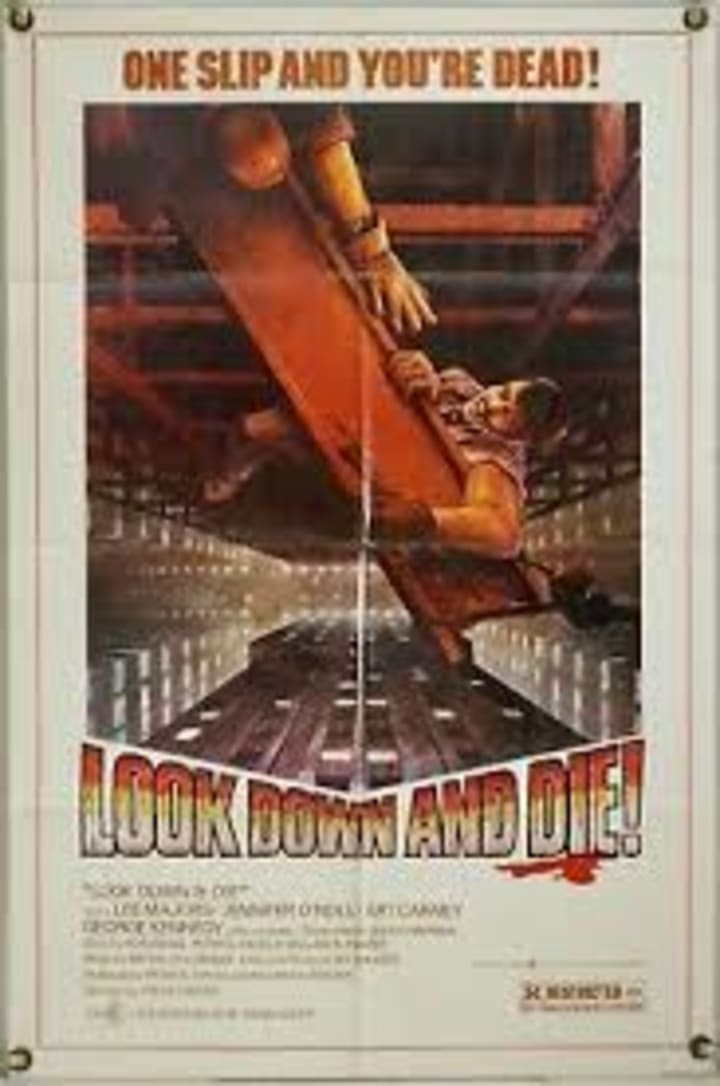
Now, of course, we know why this happened, Steel bombed at the box office in August. The box office tally for Steel is not known but history, and the AFI Catalog website, tells us that the film did not earn enough to cover its more than $5 million dollar budget, that included money raised by selling the film to both NBC and HBO, before it opened in theaters, and by an investment from star Lee Majors who is said to have dropped over a million dollars of his own money on the film.
Thus, using marketing to turn the inspiring story of plucky construction workers rallying to save a building for the plucky owner of the building, played by Jennifer O'Neill, morphed Steel into a terrifying exploitation thriller about the dangerous world of being a construction worker building high rises. Indeed, there is a big pl0t point in Steel that involves a character played by George Kennedy who falls to his death from the top of a high rise. It has nothing to do with him looking down and becoming disoriented before falling to his horrific death but, the shots of Kennedy's Big Lew Cassidy falling from the top of the building are pretty terrifying.
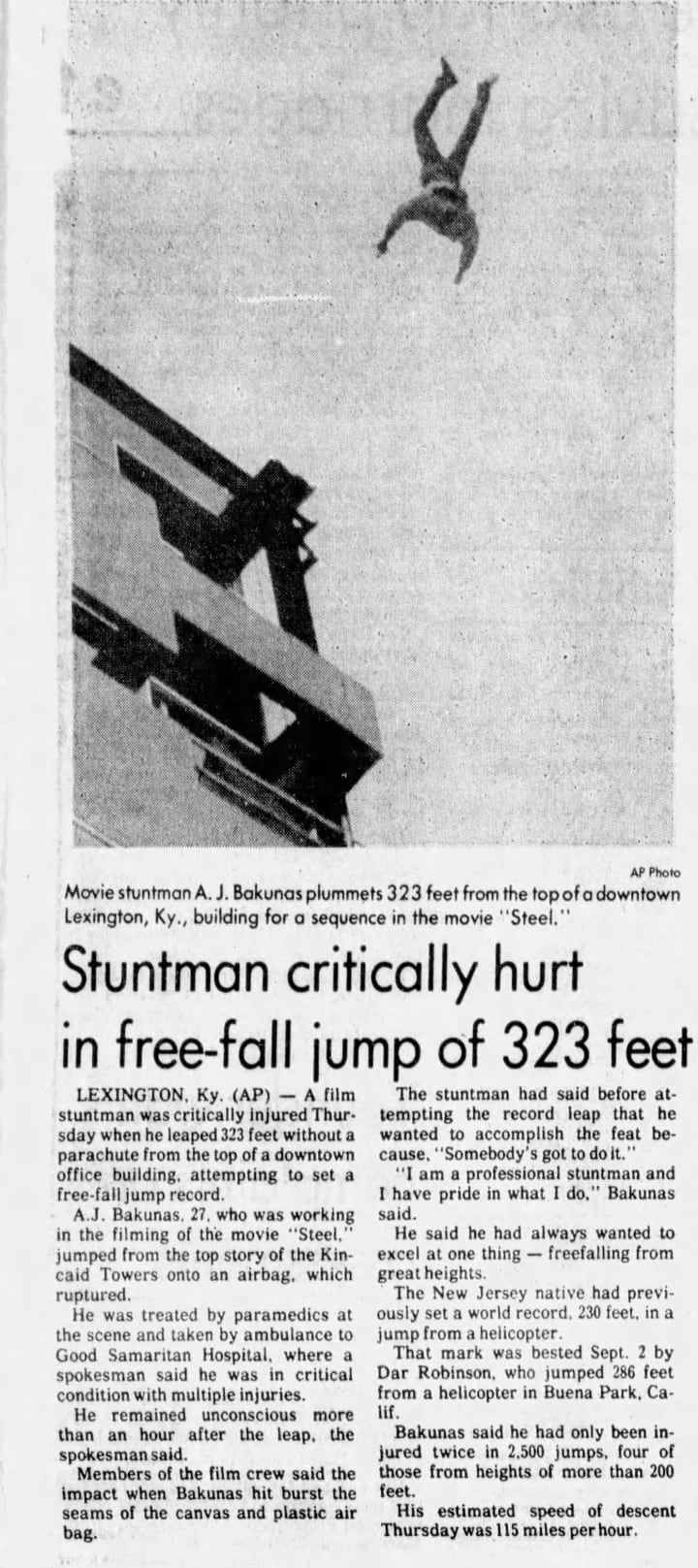
And do you know why this scene is so terrifying? Because audiences in 1980 were actually watching a man die on screen. In late August of 1978 as the film Steel was wrapping up production atop the Kincaid Towers in Lexington, Kentucky, which provided the perfect location for the film as it was under construction at the time. With production winding down, and the film seemingly complete, stunt man A.J Bakunas doubled for George Kennedy for the big scene where Kennedy's Big Lew falls to his death.
Though the scene was already in the can, via a fall from a much lower floor, Bakunas asked his friend and the fillm's star and producer, Lee Majors, if he could do the scene a second time from a much higher height. Earlier in 1978, stunt man Dar Reynolds broke Bakunas's record for the highest free fall stunt in history, 286 feet high. Eager to get his record back, Bakunas wanted to fall from 323 feet thus regaining his world record. Majors agreed and with a crowd of over one thousand people in downtown Lexington and members of the media everywhere on the set, A.J Bakunas ascended the top of the Kincaid Towers and with cameras rolling, he propelled himseff off of the top of the building.

Bakunas made the jump over the objections of the on set doctor, a local E.R doctor named Jud Chalkley. He was also in defiance of John Scurlock, an executive with Life Pack Air Safety Products. Scurlock had been attempting to get Hollywood stunt men to stop using Life Pack products for their dangerous falling stunts. The Life Pack Air Safety pad used by A.J Bakunas for his 323 foot fall had only been approved for falls of just over 100 feet. Bakunas modified the the Safety Pad with a second pad to try and make it safer. Nevertheless, the products were intended for rescue crews, rescuing people from burning buildings, and not for movie stunts or world records.
As you've likely surmised, A.J Bakunas died that day in 1978. Clocked at more than 115 miles per hour as he fell, Bakunas hit the safety pad which collapsed on his impact. The pad did break his fall enough for him not to die immediatetely but, the damage to his body from that fall would lead to Bakunas dying the following day, his lungs having been bruised so severely that he simply could not recover. It's a horrific tragedy that you can watch for yourself on YouTube. And, you can watch for yourself in the movie Steel, a.k.a Look Down and Die.
If you think we are desensitized to violence and death in 2024, audiences, at least those in Los Angeles in 1980, watched a movie called Look Down and Die which features actual footage of a man falling to his death. If you think I am kidding, I promise you, I am not. Asked the day following Bakunas' death, if the footage would be used in the movie, production spokesperson Carolyn Machado was quoted by the Associated Press as saying "Most assuredly, as far as we know, it will be." The film is also dedicated to A.J Bakunas. The movie Look Down and Die, aka Steel, is dedicated to a man who fell to his death.
Not only that, photos of Bakunas' fall to his death appeared in newspapers across the country in 1978. And then, 2 years later, footage of A.J Bakunas falling to his death was used in a movie, dedicated to his memory, that was also renamed to Look Down and Die and marketed as a horror thriller despite being little more than a forgotten inspirational drama and all of this is to squeeze a few more dollars out of a failed movie that was only notable because a guy died in the making of it.
Get more Movies of the 80s on our Movies of the 80s YouTube channel, linked here. Like and subscribe, we're creating videos about as many movies of the 1980s as we can find and we're nearly all the way through 1980 with nearly 200 movies that received some kind of theatical release. If you love the Movies of the 80s, this is the channel for you.
About the Creator
Movies of the 80s
We love the 1980s. Everything on this page is all about movies of the 1980s. Starting in 1980 and working our way the decade, we are preserving the stories and movies of the greatest decade, the 80s. https://www.youtube.com/@Moviesofthe80s
Keep reading
More stories from Movies of the 80s and writers in Geeks and other communities.
Movies of the 80s: The Incredible Release Debacle of 'Heaven's Gate'
Heaven’s Gate is a 1980 western written and directed by Michael Cimino, an Academy Award winner for The Deer Hunter. The film stars Kris Kristofferson, Isabelle Huppert, Christopher Walken, John Hurt, Jeff Bridges, and a vast array of well known character actors in an expansive western story about a deadly conflict between ranchers bent on taking over land in Montana and the settlers who claimed the land for their own. Amid the chaos, a love triangle breaks out between a hired killer, the local sheriff, and a local bordello owner and madam.
By Movies of the 80sabout a year ago in Geeks
Book Review: "Human Monsters: A Horror Anthology" by Various Authors
Yes, it's horror again. I'm feeling kind of down and whenever I'm down I read horror because it makes me feel better. Have you heard about that study that states people who are in depression should watch and read horror in order to make themselves feel better? Yeah, I checked it out some time ago - you should too. Human Monsters is exactly what you think it is, it is about monsters who are human - those who lurk in the normal world, not in the shadows, not in the darkness - they stand right in front of us. They are us. Let's go through my favourite stories in the anthology...
By Annie Kapur19 days ago in Geeks
Critics Choice Awards 2026 and the Stories That Stayed With Us
Every year leaves behind a certain feeling. Some years rush past in noise, while others settle quietly into memory. The year leading to the Critics Choice Awards 2026 belongs to the second kind. It was shaped by stories that did not beg for attention but earned it slowly. Films and shows sat with grief, love, faith, loneliness, and the simple act of surviving another day. Viewers did not just watch these stories. They carried them into their own lives. As awards season approaches, the Critics Choice Awards 2026 invite us to pause and reflect. Not on popularity, but on meaning. Not on numbers, but on moments that felt real enough to hurt.
By Muqadas khan7 days ago in Geeks



Comments
There are no comments for this story
Be the first to respond and start the conversation.