
Marilyn Monroe: Very Good Player or Fool for Love?
Master of Image, Victim of It

When people think of Marilyn Monroe, they often picture a platinum blonde with a breathy voice and a flirtatious smile. But behind the camera, Monroe was far more complicated than her public image suggested. A sex symbol on the surface, she was also a sharp strategist who navigated a brutal industry dominated by powerful men. Still, despite her ambition and intellect, Monroe’s personal life often reflected a woman desperate for love, stability, and validation—sometimes at a dangerous cost. So, was Marilyn Monroe a very good player or a fool for love? The answer might be: both.
Rising from Norma Jeane: The First Strategic Move
Born Norma Jeane Mortenson in 1926, Marilyn Monroe’s early life was marked by instability—an absent father, a mother committed to a psychiatric institution, and years spent in foster care. She married at 16 to escape the system, but the marriage didn’t last. What she lacked in traditional support, Monroe made up for in drive. She carefully constructed her own image, dyed her hair blonde, studied the angles of the camera, and used her charm as currency.
She wasn’t simply discovered—she created herself. While studios tried to mold her into another disposable starlet, Monroe studied acting at the Actors Studio in New York, read philosophy, and pushed back against being typecast. Her goal wasn’t just fame—it was respect.
Love and Power: Joe DiMaggio & Arthur Miller
Monroe’s most famous relationships often looked like fairy tales to the public but were far more complicated behind closed doors.
In 1954, she married Joe DiMaggio, the baseball icon. On paper, it was the perfect American couple. In reality, DiMaggio was jealous and controlling. He hated her sex symbol image, particularly after the infamous subway grate scene in The Seven Year Itch. The marriage lasted only nine months, but DiMaggio remained devoted to her until her death—he even arranged for red roses to be delivered to her grave three times a week for 20 years.

In 1956, she married playwright Arthur Miller, a man whose intellect she admired. She longed for a deeper connection, someone who saw beyond her public persona. At first, Miller was that man. But as time went on, he reportedly grew disillusioned with her emotional instability and pill dependence. She found his diary one day—he had written that he was embarrassed by her. It shattered her.
In both marriages, Monroe was not naive—she entered with hope, but also with a pattern: choosing men who symbolized strength, intellect, or protection, perhaps trying to fix what had been broken in her childhood. But she rarely found the love she gave in return.

Master of Image, Victim of It
Monroe understood the power of her image. She negotiated her own contracts, started her own production company (Marilyn Monroe Productions), and fought for roles with substance. Her performance in Bus Stop earned critical praise, proving she was more than a pretty face.
But she also became trapped by her persona. The dumb blonde image, the expectations of beauty, and the studio system’s control took a toll. She relied heavily on sleeping pills and stimulants to cope with anxiety and exhaustion. In private, she read Dostoevsky, kept journals, and wrote poetry—but few saw that side of her.
Not Just a Victim— and the Kennedy Connection
Monroe understood the power of her image. She negotiated her own contracts, started her own production company (Marilyn Monroe Productions), and fought for roles with substance. Her performance in Bus Stop earned critical praise, proving she was more than a pretty face.
But she also became trapped by the image she created. The dumb blonde stereotype, the expectations of beauty, and the studio system’s control took a toll. She relied heavily on sleeping pills and stimulants to cope with anxiety and exhaustion. In private, she read Dostoevsky, kept journals, and wrote poetry—but few saw that side of her.
And then there were the rumors of an affair with President John F. Kennedy.
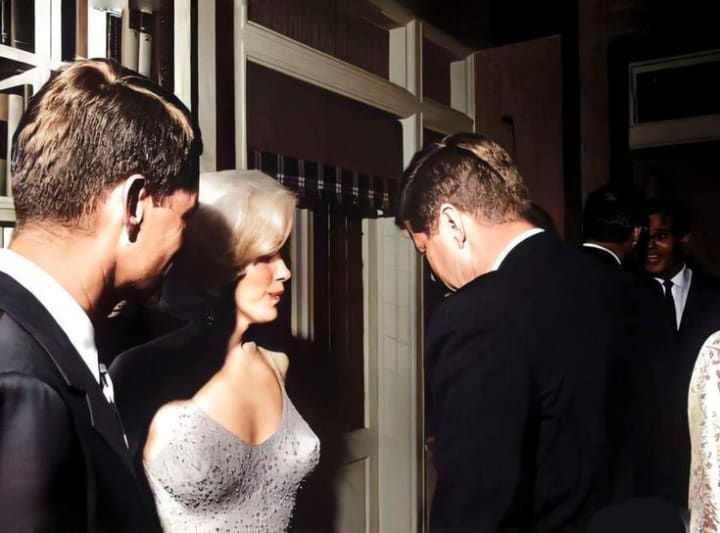
Monroe’s infamous performance of “Happy Birthday, Mr. President” at Madison Square Garden in 1962 added fuel to speculation that she was romantically involved with JFK—and possibly his brother, Robert Kennedy. Though the true extent of these relationships remains unconfirmed, sources close to Monroe described her as emotionally attached to JFK. Some say she genuinely believed they had a future; others claim she was being used, passed between powerful men who never intended to offer her more than a fleeting thrill.
Was she in love with Kennedy, or simply clinging to a fantasy—another powerful man who might finally choose her, protect her, see her?
It’s likely she was both emotionally invested and painfully aware of her position. The Kennedy affair, if real, wasn’t about ambition alone. It wasn’t a calculated career move—by then, Monroe’s star power was already global. Instead, it reflects a recurring theme in her life: a desperate search for permanence in a world that only ever wanted pieces of her.
About the Creator
Keep reading
More stories from Kristen Orkoshneli and writers in Geeks and other communities.
Molly’s Game: A movie every entrepreneur should watch
So I sat down to watch Molly’s Game, Aaron Sorkin’s directorial debut, and let me tell you — this movie doesn’t walk. It talks. And I don’t mean casual chit-chat. I mean rapid-fire, razor-sharp, caffeinated monologues that come at you like a machine gun wrapped in a designer dress. You could probably close your eyes, listen to the dialogue, and still get the full story. It’s like a podcast with perfect lighting and heels that cost more than my rent.
By Kristen Orkoshneli8 months ago in Geeks
The Politics of Playing Dress-Up
Well, to start off I'd like to say a happy world book day to all who celebrate. I know I haven't really posted anything on my socials about it but I'm not a jubilant kind of person. I lay low most of the time. Let's start off with a popular anecdote from the vaults...
By Annie Kapur3 days ago in Geeks
📢 Raise Your Voice Thread: 03/05/2026
Our “Raise Your Voice Threads” are hosted most alternating Thursdays at 12PM ET to offer creators more avenues to uncover exceptional stories on Vocal. As we are continuously searching for fresh creators and inspiring stories, this thread provides an opportunity to exchange and discuss the stories that have moved and motivated us on Vocal.
By Raise Your Voice by Vocal3 days ago in Resources



Comments
There are no comments for this story
Be the first to respond and start the conversation.