
Key Challenges in SaaS Software Development: How to Overcome Them
In this overview, we will look at some of the common problems that can trip up even the most experienced developers. We will also touch on regular mistakes that can become stumbling blocks and explain how to avoid them based on successful experiences.

What is SaaS software development?
To make it easier to navigate the topic, let's start with the basics: what is cloud-hosted solution implementation? It is the process of deploying a cloud algorithmic solution in any company. This way is very different from those troubled times when a special team had to install disks in one of the server rooms.
Now everything happens faster with the assistance of a SaaS software development company, you just register, log in and start using the service. But usually this smoothness only happens in commercials. Reality is a little more complicated and the dark side of this convenience can sometimes overshadow all the benefits and advantages of such a cool technology.
For SaaS to integrate smoothly with existing methods and systems, you need to take into account quite a few factors, and these obstacles are the ones that we will analyze in more detail today. This will allow you to enjoy scalability, cost savings, and automatic updates - in other words, all the bonuses that on-demand computing products offer.
Common challenges in custom SaaS software development
Analysts predict that the global software-as-a-service (SaaS) market size will grow from $315.68 billion in 2025 to $1,131.52 billion by 2032. And that is what convinces us that understanding the complexities of setup and learning how to eliminate them from your path is a task of utmost importance.
So, are you ready to write down the tricks of the trade from our gurus? Then let's conquer the difficulties and iron out the rough edges to make your experience enjoyable and rewarding. Explore each issue, even if you haven't encountered it before, because that way you'll be fully prepared for the future.
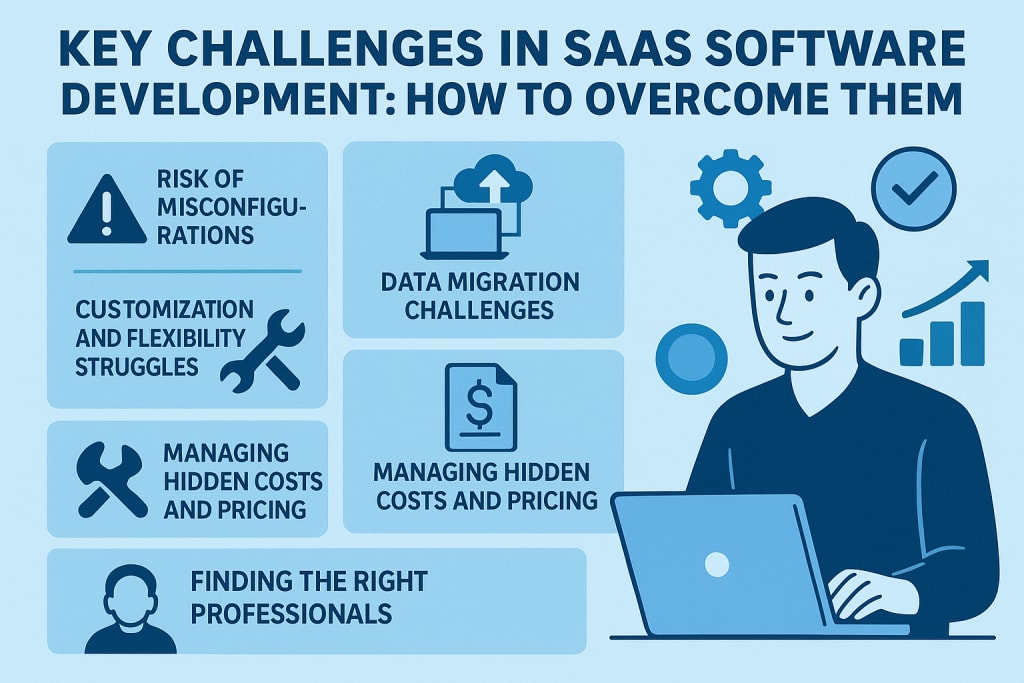
Risk of misconfigurations
A range of enterprises in the industry have identified software-as-a-service faulty setup as a major issue. Additionally, internal application configuration is becoming a major concern for security teams.
The appliance of increasingly advanced subscription-based digital utilities adds more layers of complexity to their architecture, thereby increasing the likelihood of improper forms. And it is not for nothing that we have brought this issue to the forefront, since even small configuration errors can affect the availability of the cloud infrastructure.
If you want to see how serious this aspect is, just remember how in February 2008, Pakistan Telecom tried to block YouTube in Pakistan due to some videos that were considered inappropriate content. Their attempt to create a fake route for YouTube made the platform globally unavailable for two hours.
Data migration challenges
The second, but no less important point, is moving inputs from the old framework to the updated one with advanced capabilities. It would seem that there should be more space, and everything should work more smoothly thanks to improved modules, but this is not always the case.
If a SaaS software development company does not take measures in time and does not foresee crucial aspects, then incompatible formats, incomplete reports or even so-called dirty records can interfere. So you get failures in the plan at a minimum, and at most - the loss of essential information.
Coordination and integration issues
And here we come to something that makes even seasoned developers twitch. The question is glaring: there is a new tool and a codebase that has been used for years with varying success. How to "make friends" between them without getting a complete collapse of all mechanisms instead of smooth and coordinated work?
One of the first steps is to find out whether your previous construct is outdated, then analyze the points of contact and only then consistently connect these two universes without causing failures.
Customization and flexibility struggles
Here it is worth remembering that most remote-access platforms are created for general adoption and this fact has both advantages and disadvantages. On the one hand, you do not overpay and exploit a universal product suitable for many areas and tasks. But on the other hand, this same thing can prevent you from tailoring the blueprint for yourself.
After all, each business has its own unique demands and if it is critical for you to take them into account when using this tool, this can cause additional difficulties and the need to attract a strong specialist with adaptation experience.
Managing hidden costs and pricing
If you don't want to feel the pinch, pay attention to this section. It may seem to you that the terms of the system execution are acceptable and even super-profitable somewhere. But do not rush to conclusions until you study all the nuances of pricing in this service, because they are sometimes even more confusing than thoughts on Monday morning.
But if you once figure out the costs of additional functions, customers and extra storage, then there will be no hidden surprises for you. You will be able to fully control your expenses without expecting every time that at the last moment a notification will appear that you must pay for another option just when you exhale and decide that now you will no longer spend but earn.
Finding the right professionals
And finally, winning strategies begin with winning people. But where and how can you find these unique specialists who are able not only to promise sky-high results, but also to implement plans on time and with minimal losses? After all, implementing SaaS software development services is not a purely technical task; it requires more universal skills, covering the spectrum from IT to project management.
You can get hold of those who have successfully installed the platform and enjoy its work and ask for contacts of providers who have provided such a smooth integration. Another good move may be to read reviews on specialized portals or study summaries on this topic.
Effective strategies in software as a service (SaaS) development
After examining all these obstacles, you are probably left with only one question: what to do with all this? We will try to provide some guidance on each of these points.
- Risk of misconfigurations. Erroneous setups lead to the loss of sensitive entries and insecure APIs, which cause unauthorized access to vulnerable metrics. For example, according to the Cloud Security Alliance (CSA), SaaS incorrect parameterizations accounted for up to 63% of protection incidents.
The complexity and scale of modern instances increase the risk of defense breaches, but knowing potential weak points can help prevent problems before they occur. Using automated mechanisms like Nmap or OpenVAS can help identify vulnerabilities.
Don’t leave the default settings when installing the product, as they are intended only for testing and are not suitable for production environments. Here, by the way, you can use Prowler, developed specifically for AWS environments. To automate update processes and seamlessly manage patches, it is worth turning to CI/CD methods.
2. Data migration. Start by cleaning up existing information and identifying what is critical and what should be prioritized for small-scale migration testing.
For example, when using ETL assets to quickly transfer heterogeneous digital content, pay attention to compatibility with services and open source code, which will allow you not only to tweak the work, but also to create bespoke containers. Today, there are several types of such instruments:
- components for enterprise digital grids,
- cloud interfaces from Amazon AWS, Google Cloud, Microsoft Azure,
- open-source facilities,
- purpose-built stacks.
Among the leaders today are Renta Marketing ETL, Stitch, Fivertran, Hevo Data, Skyvia.
3. Coordination and integration. Early in the build, create a plan to connect the new product to existing data engines. Take advantage of middleware or APIs to bridge compatibility gaps.
The integration layer will provide a communication channel and logs flow between the application layer and the operating architecture layer, while API gateways will become a decentralized entry point for managing client requests and redirecting them to the appropriate microservices. Integration can be simplified using connectivity modules such as Zapier, MuleSoft or Boomi.
When talking about API gateways, it is worth dwelling on their intermediary role between clients on one side and internal components on the other, acting as a reverse proxy server for receiving incoming requests. For example, the handling of the Kubernetes Gateway API in custom SaaS software development contributes to the movement toward standardization and interoperability.
4. Configuration and flexibility. Instead of extensive fine-tuning, focus on finding a balance between adaptation and using the platform’s default features without overcomplicating the core task.
And to ensure flexibility, call into play constant integration (CI) and continuous delivery (CD) kits. This deployment automation allows developers to focus on implementing business requirements, code quality, and safety. This way, you also provide the necessary mechanism for integrating and testing the changes you make.
5. Unexpected costs. Make sure you get a full breakdown of costs from your provider, including any potential user acquisition fees or additional storage. Keep an eye on your billing so you don’t miss out on paying for features you don’t need.
6. Hiring specialists. Consider outsourcing the project to third-party providers. They can often handle the project quickly and efficiently, while saving you money on hiring full-time staff.
This way, you will avoid the main stumbling blocks, and also ensure a more efficient and less stressful enactment path. Plus, with such a thoughtful and competent approach, your business will undoubtedly have a better chance of conquering new steps to success.
Best practices for software development for SaaS
For a smooth browser-accessible functionality realization, it is important to follow proven practices that will help set up workflows for long-term success. We have worked with a number of companies for many years, helping them overcome key operation concerns. Here are some examples of how we approach collaboration and overcome obstacles.
A case study for CoreSphere shows how we solved the problem of an inefficient framework that produced more errors than optimizations.
Challenge: an ineffective mechanism that generates more mistakes than enhancements.
Solution: we provided a higher-level setup, secured data migration and reduced costs through automation based on deep research.
Result: a 25% cost savings and a significant reduction in ineffective processes.
Another interesting example of effective software development for SaaS can be the case for the German retail chain Kaufkraft, where our team had to solve a number of problems from centralized databases to analytics.
Challenge: the impossibility of effectively and efficiently managing the comprehensive history of transactions and purchases, as well as inventory and other critical operational components, cannot be overlooked.
Solution: tailored attributes were developed that help control tactics with customizable notifications, the ability to view invoice records, and a common monitoring dashboard focusing only on vital and relevant features.
Result: a 20% increase in sales, as well as a higher level of productivity.
As you can see, any problem can be successfully overcome if you know specific techniques and turn to methods that have proven themselves in similar mechanisms.
The bottom line
In addition to the fact that implementing SaaS provides huge benefits, business owners should also consider the possible dilemmas that can cloud the successful use of this tool. However, knowing where to expect the catch and having strategies to prevent or solve these problems can maximize the benefits and minimize the risks.
The secret to success is to start small and move step by step, taking into account key aspects at each stage. You can benefit from one of the practices provided or recommendations for applying successful strategies.
About the Creator
Thomas Wayne
Pr manager at Limeup.io
Keep reading
More stories from writers in Geeks and other communities.
Book Review: "The Queen" by Andrew Morton
You're probably wondering why on earth I would read this book. It was free and it was a fair length. That was basically it at first. But another reason is because I enjoyed the show The Crown and so, it only makes sense to read a book that goes through separating facts from fictions - and to be fair, there aren't a lot of fictions about the show it seems. From the birth of the little princess and the way in which her father was reluctantly to become the king, all the way to meeting and marrying the veteran prince, Duke of Edinburgh and even down to the death of her father, queendom and beyond, this book actually gives us a lot about a woman who basically embodied the greatness and modernisation of the British 20th Century.
By Annie Kapur7 days ago in Geeks
Can you watch Super Bowl in UK?
Super Bowl, one of the most exciting sporting nights of the year, is now less than a month away and the excitement is already palpable. Scheduled on February 8, 2026 at Levi’s Stadium in Santa Clara, California, this will be the third Super Bowl held in the San Francisco Bay Area.
By David Cook5 days ago in Geeks




Comments
There are no comments for this story
Be the first to respond and start the conversation.