
Human Specimens: The Dystopian TV Show That Turns Humanity Into a Case Study
Inside a Biotech Empire Where People Become Data and Humanity Is the Experiment

In an era saturated with dystopian thrillers and high-concept science fiction, it’s rare for a new series to feel genuinely unsettling in a way that lingers long after the credits roll. Yet that’s exactly what the new hit show Human Specimens manages to do. Part psychological drama, part bio-tech noir, and part social allegory, the series takes the familiar anxieties of the modern world—surveillance, medical ethics, corporate power—and distills them into a narrative that is as gripping as it is disturbing.
At its core, Human Specimens explores a single haunting premise: What happens when human lives become data points, and people themselves become property? The show doesn’t just flirt with that question—it dissects it with surgical precision.
A Premise That Cuts Too Close to Reality
Set in the near future, Human Specimens imagines a biotech conglomerate called VitaGen Laboratories, a corporation that publicly brands itself as a humanitarian research institute. Beneath its polished advertisements and philanthropic facade, however, lies a darker truth: VitaGen literally collects people. Not in the traditional sense, but in a legal gray zone created by experimental medical contracts, non-disclosure agreements, and a labyrinth of corporate loopholes.
Individuals who sign up thinking they're joining paid research trials find themselves trapped in a sprawling, secretive facility. There, they are monitored, cataloged, and studied—living samples in a highly controlled environment. Their biological responses, emotional reactions, and interpersonal dynamics are harvested as data, all in the name of what VitaGen calls “Progress Through Understanding.”
The show’s choice of term—specimens—is no accident. It strips away humanity with scientific coldness. And as the viewer watches test subjects attempt to navigate life inside the facility, the chilling power imbalance becomes more apparent in every scene. You can watch complete show on Hulu in Australia.
Characters Caught Between Choice and Survival
A slow-burn character study drives the show forward, anchored by three central figures whose stories intertwine in compelling and often tragic ways.
Lena Ortiz
Once a paramedic struggling with medical debt, Lena signs up for what she thinks is a six-week pharmaceutical trial. Her arc is one of awakening and rebellion. She’s the first to notice the inconsistencies between what the researchers say publicly and what the subjects experience privately. Through Lena, the series poses an unnerving question: How far would you go to reclaim your autonomy once you realize it’s already been signed away?
Dr. Callum Reeves
A senior researcher at VitaGen, Dr. Reeves is the show’s most morally complex figure. He signed on believing in science, not exploitation. But as he becomes increasingly aware of the corporation’s true methods, he must confront the ethical decay happening around him—and the complicity of his silence. His storyline blurs the line between perpetrator and prisoner, making him one of the most compelling aspects of the series.
Elijah Ward
A young man raised entirely inside the facility, Elijah has never known a world beyond its walls. To him, VitaGen is not a prison but a universe. His innocence forces the viewer to grapple with a deeply uncomfortable truth: when someone’s reality is constructed for them, can they ever truly be free? Elijah’s arc becomes a haunting meditation on conditioning, identity, and what it means to be human.
Together, these characters create an emotional backbone that balances the show’s high-concept framework with nuanced storytelling.
A Visual Style That Mirrors the Theme
One of the show’s greatest strengths lies in its visual language. The facility that houses the “specimens” is sterile but not futuristic—clinical white corridors, muted greys, softly humming machines. The environment looks achievable, almost familiar, which makes the horror feel grounded rather than fantastical.
The cinematography makes heavy use of long, still shots that mimic observation footage. Scenes often linger several seconds past the point of comfort, creating the sense that the viewer is not only watching, but participating in the objectification of the characters. It’s a subtle but powerful technique: we, the audience, become complicit, mirroring the show’s central theme.
Conversely, outdoor scenes—rare as they are—burst with color. They represent not just freedom but possibility, contrasting sharply with the claustrophobic visual palette of the interior. When characters dream of the outside world, the imagery is vivid, almost too bright, as if an imagined paradise could never live up to the harsh reality waiting beyond VitaGen’s walls.
Ethical Questions at the Heart of the Plot
While Human Specimens delivers plenty of suspense and plot twists, what elevates it is the way it engages with real-world ethical dilemmas.
When does voluntary participation stop being voluntary?
The show digs into the fine print of consent—something we often overlook when clicking “I agree” on digital contracts or medical waivers.
Is data more valuable than human life?
This theme resonates strongly in our modern era of surveillance capitalism. In the show, bodies and emotions become commodities, mined for research or sold to the highest bidder.
What makes a person human?
By classifying people as “specimens,” VitaGen reduces individuals to biological assets. The series continually asks the viewer to consider where humanity resides—biology? feeling? choice? Something more?
These questions are not simply philosophical; they shape the narrative, influencing every character decision and plot development.
Why Human Specimens Stands Out
In a TV landscape filled with dystopian content, Human Specimens succeeds by grounding its horror not in fantasy but in plausibility. It doesn’t require advanced alien technology or supernatural forces. Its monsters are institutions, contracts, power structures, and the dangerous idea that progress is justified at any cost.
Rather than relying on shock value, the series unfolds like a cautionary tale for a society inching ever closer to trading autonomy for convenience. It taps into fears many of us already harbor: becoming a number, a file, a metric. Losing individual agency. Being watched, measured, and optimized until nothing uniquely human remains.
The show holds up a mirror to our times—and the reflection isn’t flattering.
A Final Reflection
Human Specimens is not an easy show to watch, nor is it meant to be. It is thought-provoking, uncomfortable, and profoundly human. It offers no simple villains, no straightforward escape, and no neatly tied conclusions. Instead, it leaves viewers questioning the ethics of scientific pursuit, the fragility of autonomy, and the slippery boundaries between progress and exploitation.
For Vocal Media readers seeking a series that does more than entertain—one that challenges, confronts, and ultimately transforms the way we think about ourselves—Human Specimens is a must-watch. It’s a story about captivity and resistance, about identity and control, and about humanity’s desperate fight to remain human in a world determined to turn people into data.
About the Creator
Keep reading
More stories from James S Pope and writers in Geeks and other communities.
Dark Waters and Hidden Motives: Why The White Lotus Season 3 Hits Different
When a series becomes a cultural moment, its next installment carries weight — expectations high, comparisons inevitable. Season 3 of The White Lotus arrives not just as another chapter, but as a tightrope walk between satire, sorrow, and startling introspection. With its signature blend of biting social commentary, lush cinematography, and morally complex characters, this season strikes a chord that resonates deeper and darker than ever.
By James S Pope3 months ago in Geeks
The Politics of Playing Dress-Up
Well, to start off I'd like to say a happy world book day to all who celebrate. I know I haven't really posted anything on my socials about it but I'm not a jubilant kind of person. I lay low most of the time. Let's start off with a popular anecdote from the vaults...
By Annie Kapur6 days ago in Geeks
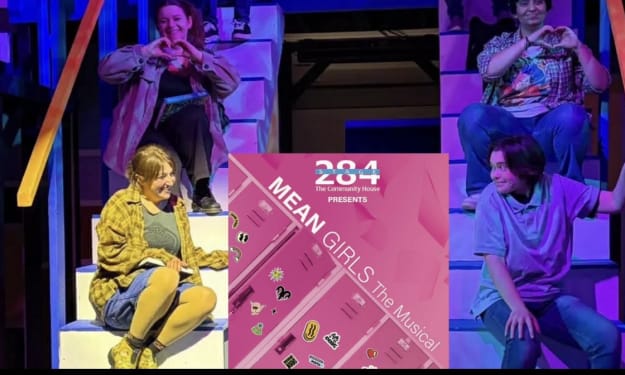
Stage 284's "Mean Girls" is a Totally Fetch Time!
On Wednesdays, we wear pink. Stage 284 presents “Mean Girls: The Musical,” based on the classic 2004 film. 16-year-old Cady Heron attends public school for the first time. While trying to fit in, she befriends ‘The Plastics,’ an A-list clique. Cady is a hit, until she falls for Aaron Samuels, the ex-boyfriend of Alpha plastic, Regina George.
By Marielle Sabbag2 days ago in Geeks
TUS NUA - ch 53
TUS NUA – ch 53 New Beginnings – Mia and Midnight (*)(*)(*) Finola knew Ali’s brother-in-law needed to put his mind at rest. She fed her arm through his and led him outside. “We’ll sit here. If you like, I can put a block around us so our conversation will be private.”
By Margaret Brennan3 days ago in Fiction



Comments
There are no comments for this story
Be the first to respond and start the conversation.