
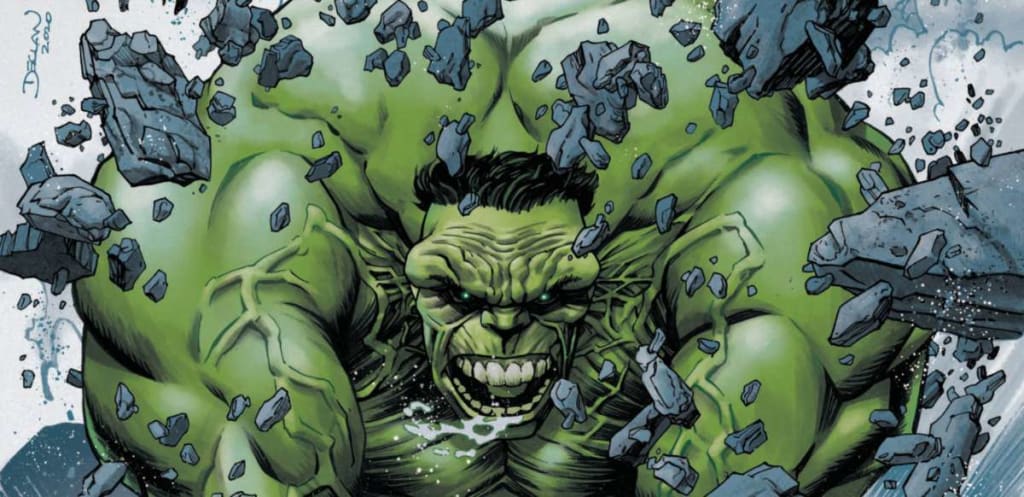
The Hulk, one of Marvel Comics' most iconic and complex characters, has undergone countless transformations throughout his long history. From the moment Dr. Bruce Banner was first exposed to gamma radiation in 1962, his life has been a constant struggle between the two sides of his existence: the brilliant scientist and the raging, indestructible green behemoth known as the Hulk. Over the years, the nature of the Hulk's transformations has been the subject of both awe and moral debate within the Marvel Universe and among its readers.
The immortality of the Hulk is a striking aspect of his character. Banner's gamma-irradiated alter ego possesses an extraordinary ability to endure anything thrown at him. He can withstand extreme physical trauma, including being shot, stabbed, or even blown up, only to heal and emerge stronger than before. This remarkable resilience has saved the world on numerous occasions, as the Hulk becomes an unstoppable force when the situation calls for it. His immortality, in this sense, can be seen as a moral good, a necessary protector against the countless threats that regularly beset the Marvel Universe.
However, the Hulk's immortality has also raised significant moral questions. When the green goliath loses control, as he often does, he becomes a rampaging force of destruction. Cities crumble, lives are endangered, and countless innocents are caught in the crossfire. In these moments, the Hulk's immortality takes on a darker shade, blurring the line between hero and menace. His indiscriminate rage and lack of accountability for his actions have led to legitimate concerns about the morality of his existence.
One of the central ethical dilemmas surrounding the Hulk is the question of responsibility. Should Bruce Banner be held accountable for the destruction the Hulk causes? Banner unleashed this power upon himself through his own recklessness in the pursuit of scientific discovery. On the other hand, it's clear that Banner himself is often a victim of the Hulk's uncontrollable transformations. He bears the burden of guilt for the destruction caused by his alter ego, even though he often has no control over when the transformation occurs.
Moreover, the Hulk's immortality has far-reaching implications for the larger Marvel Universe. Many superheroes, including the Avengers and the X-Men, have had to confront the moral dilemma of whether to trust the Hulk when he joins their ranks in times of crisis. Can they rely on him to fight alongside them, knowing that he might lose control at any moment? This moral uncertainty has led to tensions and conflicts among Marvel's heroes, adding depth to the stories and exploring the ethical complexities of dealing with an immortal, yet unpredictable, ally.
The Hulk's transformations also raise questions about the nature of power and responsibility in general. Is it immoral to possess such incredible power without the corresponding ability to control it? The Hulk's plight reflects the age-old adage, "With great power comes great responsibility," made famous by another Marvel icon, Spider-Man. In the Hulk's case, the question becomes whether it is immoral to wield such power when one cannot shoulder the responsibility that comes with it.
In conclusion, the Hulk's transformation is a narrative and moral rollercoaster that has captivated readers for decades. His immortality, while a source of great strength, also raises profound moral questions about accountability, responsibility, and the nature of power. The Hulk's struggle to balance his humanity with his unstoppable alter ego is a compelling and timeless story, a testament to the enduring appeal of this iconic character in the Marvel Universe. Whether seen as a force for good or a potential catastrophe, the Hulk's transformations continue to be a source of fascination and ethical contemplation for fans and readers alike.
About the Creator
Keep reading
More stories from Adrian Machen and writers in Geeks and other communities.
Infinity Gauntlet (1991)
In the rich tapestry of comic book history, few events have left as profound an impact as Marvel's "Infinity Gauntlet." Originally published in 1991 as a six-issue limited series, this monumental storyline, crafted by the creative genius of writer Jim Starlin and artist George Pérez, stands as the quintessential crossover event in the realm of comics. Its timeless narrative and remarkable amalgamation of iconic characters have solidified its status as the ultimate crossover event.
By Adrian Machen2 years ago in Geeks


Comments
There are no comments for this story
Be the first to respond and start the conversation.