
How Data Analytics Delivers Insights for Better Business Outcomes
Exploring the Role of Data Analytics in Driving Smarter Business Decisions and Improved Outcomes Across Industries


In the modern business landscape, data serves as the foundation for informed decision-making. According to a study by Statista, the global big data and analytics market is projected to reach $450 billion by 2026, reflecting its growing importance. Businesses increasingly rely on data analytics services to extract actionable insights and enhance outcomes. This article explores how data analytics enables better decisions, improved efficiency, and competitive advantages across industries.
What is Data Analytics?
Data analytics refers to the systematic process of examining raw data to identify patterns, draw conclusions, and support decision-making. It encompasses four main types:
- Descriptive Analytics: Provides insights into past performance.
- Diagnostic Analytics: Explains why something happened.
- Predictive Analytics: Forecasts future trends.
- Prescriptive Analytics: Recommends actions for optimal outcomes.
By leveraging data analytics consulting services, businesses can implement these methods effectively to drive growth and innovation.
Importance of Data Analytics in Business
Data analytics is pivotal for businesses striving to remain competitive in a data-driven era. Key benefits include:
- Enhanced Decision-Making: Real-time insights enable informed strategies.
- Increased Efficiency: Automation reduces manual tasks and operational inefficiencies.
- Improved Customer Experiences: Personalized solutions based on customer behavior data.
- Risk Management: Identifying and mitigating potential risks.
Table: Examples of Data Analytics Use Cases

How Data Analytics Services Work
Data analytics services involve multiple stages to ensure actionable insights:
- Data Collection: Gathering structured and unstructured data from various sources, such as CRM systems, IoT devices, or social media platforms.
- Data Cleaning and Preparation: Removing inaccuracies and standardizing data for analysis.
- Analysis and Modeling: Employing statistical methods, AI, and machine learning to derive patterns.
- Visualization and Reporting: Using tools like Tableau or Power BI to present data.
Example:
A retail business utilized data analytics consulting services to analyze purchase history and forecast demand. As a result, it optimized inventory and reduced stockouts by 30%.
Tools and Technologies in Data Analytics
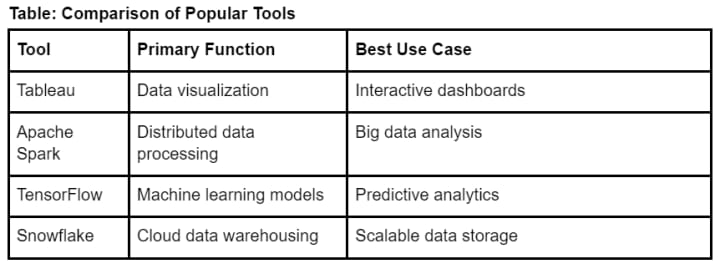
Modern data analytics relies on advanced tools and platforms to ensure accuracy and efficiency. Key tools include:
Data Visualization Tools: Tableau, Power BI, and Looker.
Data Processing Frameworks: Apache Hadoop and Spark.
Database Management: SQL, NoSQL, and Snowflake.
AI and Machine Learning: TensorFlow and Scikit-learn.
Table: Comparison of Popular Tools
Real-World Applications of Data Analytics
1. Retail
Retailers use data analytics to predict trends, manage inventory, and personalize marketing. For example, Amazon’s recommendation engine leverages predictive analytics to drive 35% of its sales.
2. Healthcare
Hospitals analyze patient data to improve treatment plans and reduce operational inefficiencies. Predictive analytics in healthcare has been shown to reduce readmissions by 20%.
3. Finance
Banks employ data analytics to detect fraudulent activities and assess credit risks. Fraud detection algorithms reduce false positives and save millions annually.
4. Manufacturing
Manufacturers use data analytics to predict equipment failures and optimize production schedules. For instance, GE’s Predix platform reduced downtime by 15% for its clients.
Challenges in Implementing Data Analytics
While data analytics offers immense potential, businesses face challenges, such as:
- Data Quality Issues: Inaccurate or incomplete data hampers analysis.
- Integration Difficulties: Merging data from disparate systems can be complex.
- Lack of Expertise: Skilled professionals are essential for effective analytics.
- Privacy Concerns: Ensuring compliance with data protection regulations.
Solutions:
Partnering with experienced data analytics consulting services providers helps overcome these hurdles. They offer expertise, tools, and strategies tailored to specific business needs.
Future Trends in Data Analytics
The field of data analytics continues to evolve with emerging trends, including:
- Augmented Analytics: Leveraging AI to automate data preparation and insight generation.
- Edge Analytics: Processing data closer to the source for real-time insights.
- Predictive Maintenance: Using IoT and analytics to prevent equipment failures.
- Data Democratization: Empowering employees with user-friendly analytics tools.
By staying updated with these trends, businesses can maximize the value of their data analytics services.
Conclusion
Data analytics has become indispensable for businesses aiming to achieve better outcomes. It enables data-driven decisions, improves operational efficiency, and fosters innovation across industries. Leveraging the expertise of data analytics consulting services ensures the successful implementation of strategies tailored to unique business needs.
Organizations investing in data analytics today are better positioned to adapt to market changes, mitigate risks, and unlock new opportunities. With the right tools, skilled professionals, and a clear strategy, data analytics serves as a powerful enabler for sustainable growth and success.
About the Creator
William Smith
I am an informative tech blogger exploring a wide range of topics, including web, mobile, IoT, etc.
Keep reading
More stories from William Smith and writers in Geeks and other communities.
Data Analytics Explained: A Comprehensive Guide to This Essential Business Tool
In today's fast-paced business landscape, data is the new oil. Over 2.5 quintillion bytes of data are created every single day, and companies that can efficiently harness and analyze this data have a significant competitive advantage. According to a 2022 report by McKinsey, 90% of businesses that use data analytics effectively see improvements in decision-making, operational efficiency, and customer satisfaction.
By William Smithabout a year ago in Geeks
A Knight of the Seven Kingdoms Series Review (Season 1)
As one of the biggest properties in fantasy, A Song of Ice and Fire remains immensely popular with audiences. After reaching far into the past with House of the Dragon, a second spin-off was on the cards. A Knight of the Seven Kingdoms serves up a bite-sized slice of action and drama, but it still claims a spot among the best small-screen titles.
By Robert Cain7 days ago in Geeks
Spongebob Review
The episode “Valentine’s Day” opens with a bright, sugar‑spun carnival setting that immediately signals the festive intent of the story, and the animators spare no effort in embedding every booth, ride, and cotton‑candy stall with heart‑shaped motifs that pulse with a playful, romantic optimism. SpongeBob, ever the eager romantic, is armed with a meticulously handcrafted valentine that he intends to deliver to Patrick, hoping to cement their friendship in a tradition that feels both sincere and mischievously earnest. Sandy, whose scientific pragmatism is juxtaposed against the sheer silliness of the holiday, offers a technologically enhanced “gift‑launcher” that can propel the valentine across the midway without the risk of accidental crushing by a rogue clown. The episode’s opening scenes are a masterclass in setting tone: the shimmering lights, the muffled carnival music, and the subtle background chatter of other sea‑creature patrons combine to immerse the viewer in a world that is simultaneously familiar and whimsically exaggerated.
By Forest Green6 days ago in Geeks


Comments
There are no comments for this story
Be the first to respond and start the conversation.