
How Amityville 3-D Tried to Save 3D—and Ended Up Killing It Instead
In 1983, Amityville 3-D promised cutting-edge 3D technology that would revolutionize movies. Instead, it delivered blurry images, projection disasters, and a sequel that helped end the early ’80s 3D boom. Here’s how a hyped new format backfired spectacularly.

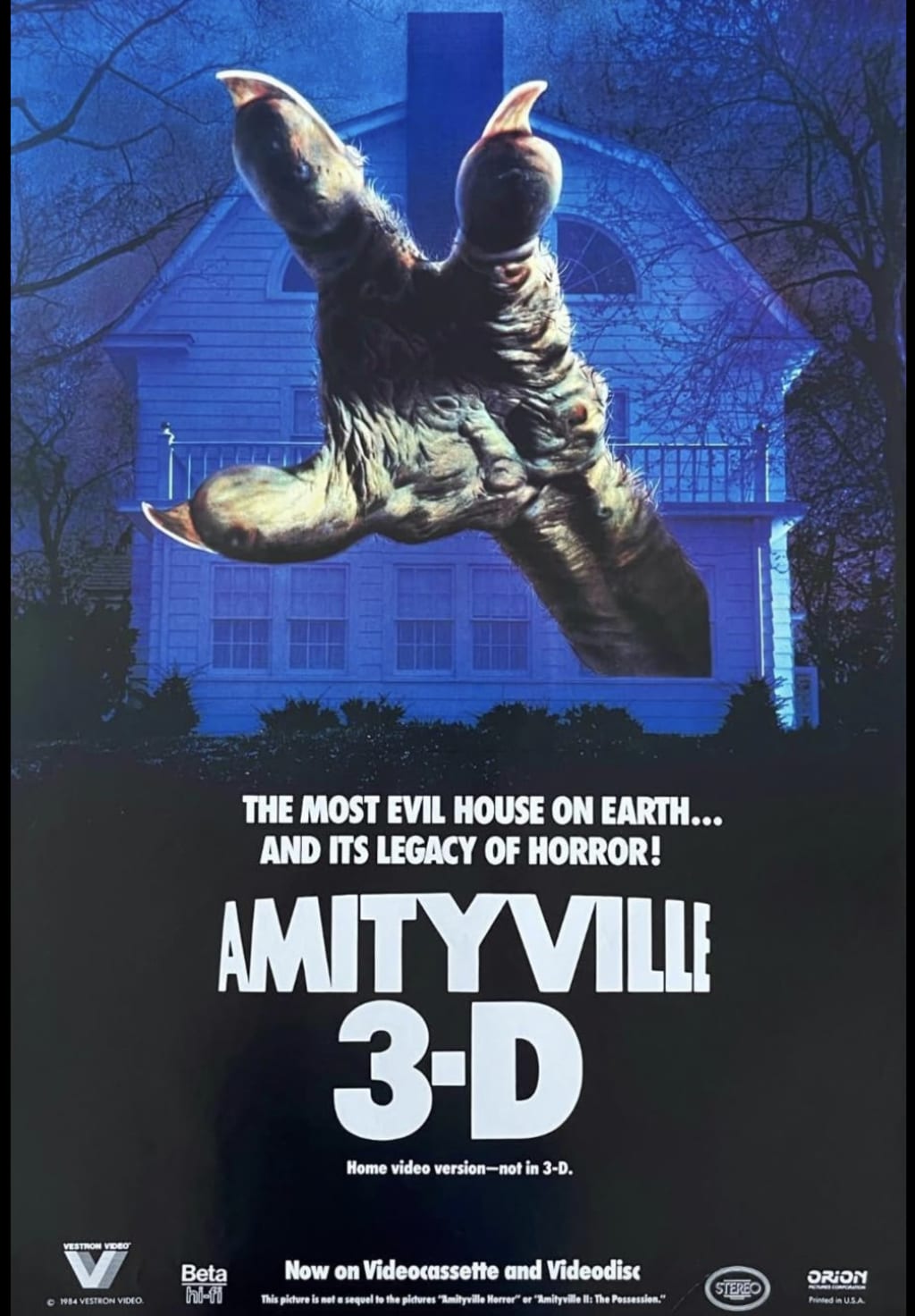
How Amityville 3-D Tried to Save 3D—and Ended Up Killing It Instead. A Movies of the 80s Feature
There are movies that define an era, movies that reinvent genres, and movies that push technology forward. And then there’s Amityville 3-D — a film that somehow managed to do none of those things, while still becoming a perfect time capsule of Hollywood’s endless optimism about “the next great cinematic format.”
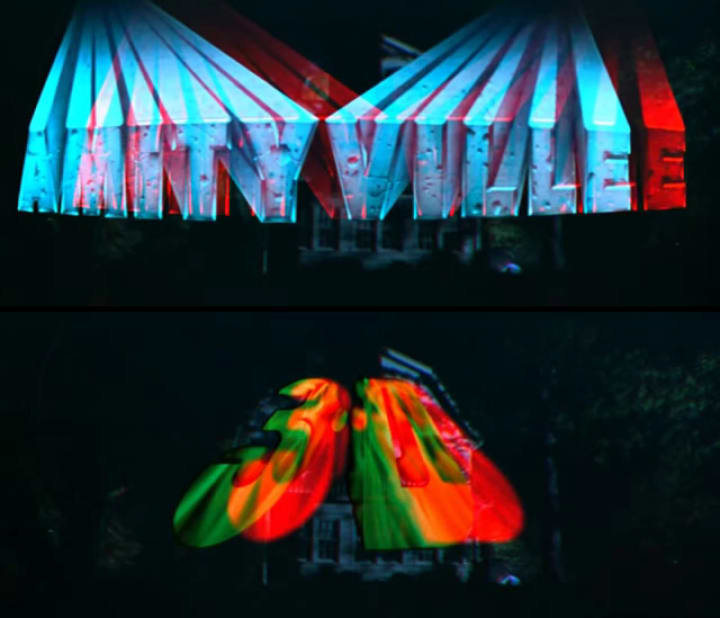
Released in 1983, Amityville 3-D wasn’t just another haunted-house sequel. Orion pitched it as a technological leap forward, a movie that would revive 3D by using the future of the format: Arrivision 3D, a supposedly sharper, cleaner, headache-free system.
Instead, it became a turning point — the movie that convinced a lot of theaters, critics, and audience members that maybe the 3D revival needed to be buried next to the Amityville ghosts.
The Big Idea: A Franchise Sequel Powered by a “Revolutionary” Format
By 1983, the Amityville series didn’t have much left in the tank. The “based on a true story” hook had already stretched past credibility. Lawsuits swirled. The haunted-house trend was cooling. Orion Pictures needed a boost — and fast. So they gambled on tech.
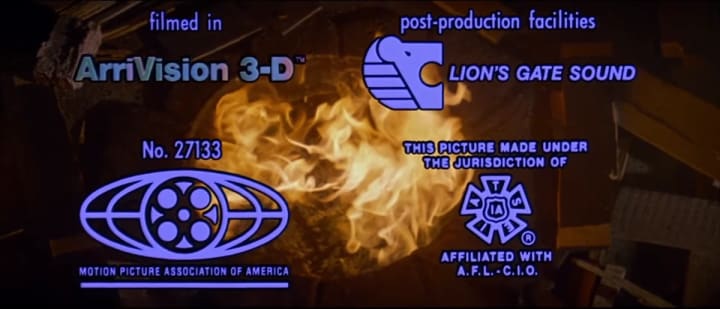
Arrivision 3D was marketed as a new era for three-dimensional filmmaking:
• Dual 35mm images on a single strip for perfect alignment
• Lightweight camera rigs
• Supposedly sharper, brighter 3D
• Promises of fewer headaches and less eye strain
This wasn’t just a gimmick. In the press, Orion pushed the idea that Arrivision could normalize 3D for the mainstream, turning it from a novelty into a standard filmmaking tool.
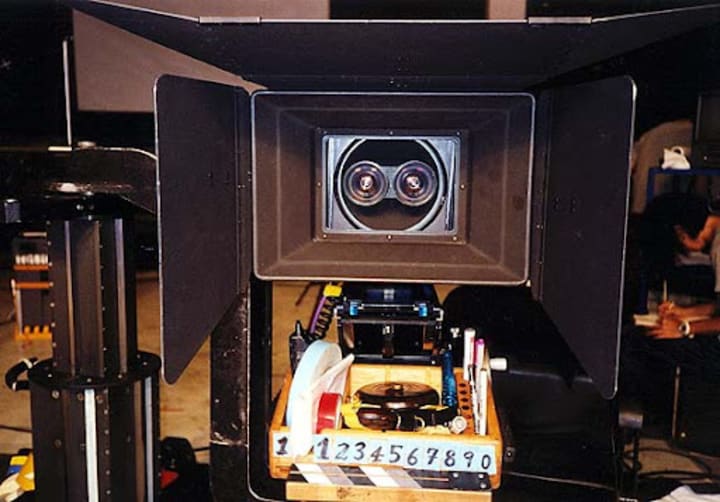
If it worked, they’d be pioneering a future industry trend.
But it didn’t.
Where It Went Wrong: The Tech Didn’t Deliver in Real Theaters
Here’s the thing about “revolutionary” filmmaking tech — it only works if every theater uses it correctly. And in 1983, most theaters didn’t. Across the country, projection booths became the film’s worst enemy:
• Poor calibration led to double images
• Misaligned lenses caused blur
• Low bulb brightness washed out the 3D entirely
• Some theaters didn’t even know how to project Arrivision correctly
The result? Many audiences saw a movie that was either flat, fuzzy, or downright painful to watch. The technology that was meant to save the film became the reason people walked out rubbing their temples.
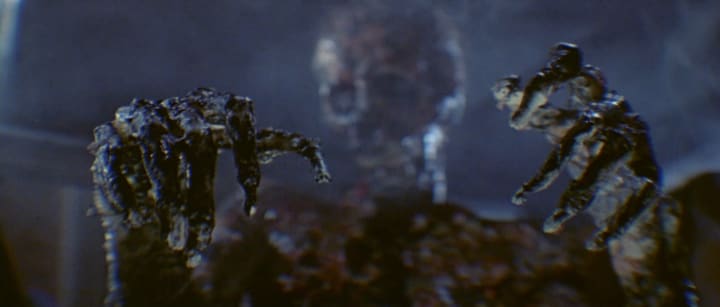
Even critics noted that entire sequences looked out of focus, while the big 3D “pop” effects — flies, poles, ghost tentacles — appeared muddy and indistinct. Arrivision didn’t change Hollywood. It couldn’t even survive Amityville 3-D.
Orion’s 3D Gamble Collides With Reality
Orion didn’t just want a hit — they wanted a pivot. After Friday the 13th Part III and Jaws 3-D, the industry sensed that audiences were ready for a renewed 3D craze. But Amityville 3-D was released right when the novelty was fading:
• Ticket buyers were getting tired of paper glasses
• 3D projection standards were inconsistent
• Theater owners hated the complexity
• Critics were increasingly skeptical of “gimmick filmmaking”
The film arrived with grand promises but ran head-first into 1983 logistics. The technology wasn’t ready. The infrastructure wasn’t ready. And the movie itself wasn’t strong enough to overcome any of it.
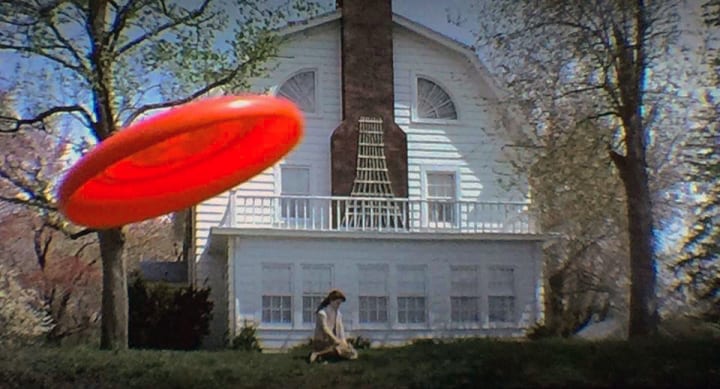
The Viewing Experience: Headaches, Confusion, and Unintentional Laughter
To be fair, some audiences did enjoy the movie — but not the way Orion hoped.
A typical screening experience included:
• Viewers lifting glasses up and down trying to “fix” the image
• Audiences laughing at effects clearly designed for gasps
• Complaints about dark, muddy visuals during the monster finale
• Kids complaining about sore eyes
• Adults wondering if the 3D was broken or if the film really just looked like that
The studio’s hope for a thrilling immersive experience instead became a communal experiment in frustration. Even in a format meant to enhance spectacle, the movie still ended up blurry.
Lost in the Gimmick: The Movie Beneath the Mess
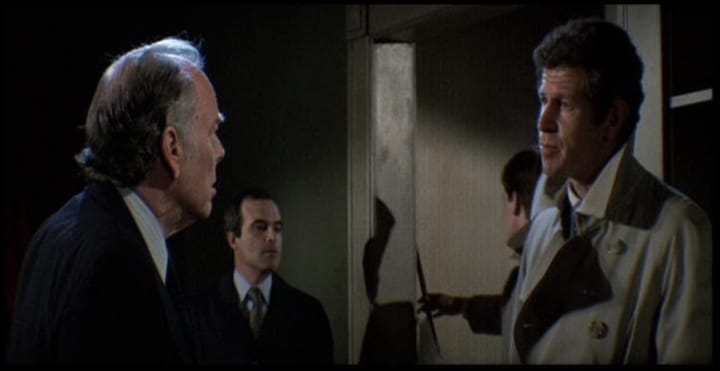
There is a movie under the 3D disaster — one with a surprisingly interesting premise. The protagonist, John Baxter (Tony Roberts), is based loosely on a real-life investigator who tried to disprove the Amityville haunting. That’s a great twist for the series. A skeptic in a horror sequel? That’s fresh.
But the movie can’t commit to the idea.
Instead, we get:
• Randomly inserted 3D moments
• A monster finale that feels out of a different film
• Future stars like Meg Ryan and Lori Loughlin wasted in tiny roles
• A plot that jumps from journalism drama to demon-in-the-basement chaos
In the end, Amityville 3-D isn’t remembered for its story — it’s remembered for the big swing that missed.
The Aftermath: The Movie That Helped End a Trend
The early ’80s 3D boom fizzled almost overnight, and Amityville 3-D was part of that collapse.
After its release:
• Studios backed away from big 3D productions
• Theaters stopped upgrading their equipment
• Arrivision 3D essentially disappeared
• The Amityville franchise drifted into increasingly wild territory (haunted lamps (No kidding), clocks, dollhouses…)
Just a few years earlier, filmmakers thought 3D was the future. By 1984, it was already a relic. And Amityville 3-D was the turning point — not because it was the worst 3D film, but because it was the one that made audiences say, “You know what? Maybe we’re good.”
Conclusion: A Time Capsule of ’80s Optimism (and Overconfidence)
You know what? Despite the problems, there is something almost endearing about Amityville 3-D. The ambition was real. The desire to innovate was genuine. And the idea of using advanced technology to revive a dying franchise? That’s pure 1980s Hollywood.
The film didn’t push the medium forward. It didn’t deliver the revolution Orion promised. But it did leave us with a strange, blurry, unforgettable artifact — the kind of misguided cinematic swing the ’80s excelled at, and the kind of movie we love revisiting decades later for exactly that reason.
Sometimes the misfires tell the story of an era better than the masterpieces. Amityville 3-D tried to look into the future. What it saw was the end of 3D… and maybe a demon or two.
About the Creator
Movies of the 80s
We love the 1980s. Everything on this page is all about movies of the 1980s. Starting in 1980 and working our way the decade, we are preserving the stories and movies of the greatest decade, the 80s. https://www.youtube.com/@Moviesofthe80s
Keep reading
More stories from Movies of the 80s and writers in Geeks and other communities.
Remembering A Christmas Story (1983): Where the Cast Went and the Wild Career Behind the Camera
Remembering A Christmas Story (1983): The Cast, the Director, and the Lasting Magic of a Holiday Classic There are Christmas movies, and then there are Christmas institutions. A Christmas Story (1983) didn’t just become a sleeper hit; it slid quietly into the cultural bloodstream, emerging decades later as a 24-hour-marathon, leg-lamp–selling, endlessly quotable tradition. But behind the nostalgia and BB-gun fantasies are a handful of working actors, a future behind-the-camera pro, and a director whose career ranged from legendary horror to raucous teen sex comedies to one of the most gentle and wholesome films ever made.
By Movies of the 80s3 months ago in Geeks
Goodbye, Mr. Duvall
It is turning out to be an interesting year. I was in the middle of teaching a class when a pop-up appeared on the screen announcing the death of Mr. Robert Seldon Duvall (yes, that was his full name). I was in the middle of a discussion on the obsession we have with winning when it comes to sports (the Winter Olympics was a theme), and I felt as though things were coming full circle. We had already lost Gene Hackman last year, and along with that titan, it feels though one particular golden age has closed off to be replaced by...?
By Kendall Defoe 26 days ago in Geeks



Comments
There are no comments for this story
Be the first to respond and start the conversation.