
How accurate is Google Translate?
Google Translate is one of the most widely used machine translation tools, supporting over 100 languages. But how accurate is it really? The answer depends on several factors, including language pairs, context, and sentence complexity.


The Evolution of Google Translate Technology
Early Years: Rule-Based and Phrase-Based Translation
When Google Translate launched in 2006, it used a statistical machine translation (SMT) approach. This system didn't actually "understand" language but rather made educated guesses based on patterns found in millions of existing translated documents. For common language pairs like English-Spanish that had abundant bilingual texts available, this worked reasonably well. However, for less common languages or complex sentences, the results were often awkward or nonsensical.
The Neural Network Revolution (2016)
A major breakthrough came in 2016 when Google switched to Neural Machine Translation (NMT). Unlike the previous phrase-based system that translated pieces of sentences separately, NMT processes entire sentences at once, allowing for more natural-sounding output that better preserves meaning and grammar.
According to Google's research papers, NMT reduced translation errors by an average of 60% compared to the old system. Languages with similar structures (like English and French) saw particularly dramatic improvements in fluency.
Reference:
https://blog.google/products/translate/found-translation-more-accurate-fluent-sentences-google-translate/ (Official Google Blog, September 2016)
Recent Advancements: PaLM 2 and Beyond
In 2023, Google integrated its Pathways Language Model (PaLM 2) into Translate, bringing several key improvements:
- Better handling of rare languages through more efficient training methods
- Improved context understanding across longer passages of text
- More natural phrasing in translations
- Enhanced recognition of idioms and colloquialisms
These advancements have gradually pushed accuracy rates higher, though significant limitations remain, especially for languages with limited digital presence.
Measuring Google Translate's Accuracy
Quantitative Accuracy Studies
Multiple studies have attempted to quantify Google Translate's accuracy across different language pairs:
European Languages (English to Spanish/French/German)
- Accuracy: 85-92% for simple sentences
- Error rate increases to 15-20% for complex technical or literary texts
Asian Languages (English to Chinese/Japanese/Korean)
- Accuracy: 75-85% for basic communication
- Significant challenges with honorifics, context-dependent meanings
Low-Resource Languages (English to Swahili/Icelandic)
- Accuracy: 55-70% even for simple phrases
- Frequent grammatical errors and unnatural phrasing
A 2022 study by the University of Cambridge found that Google Translate's accuracy varies dramatically based on:
- The availability of parallel texts for training
- Linguistic similarity between source and target languages
- The complexity of the text being translated
BLEU Scores: The Industry Standard
Translators often use Bilingual Evaluation Understudy (BLEU) scores to measure machine translation quality. This algorithm compares machine output to professional human translations:
90-100: Nearly indistinguishable from human translation
70-89: Good quality with some errors
50-69: Understandable but flawed
Below 50: Poor quality
Google Translate's BLEU scores typically range from:
75-85 for major European languages
65-75 for Asian languages
Below 60 for many African and indigenous languages
Common Types of Translation Errors
Even with advanced neural networks, Google Translate still makes several characteristic types of mistakes:
1. Literal Translation of Idioms
Perhaps the most famous example is the phrase "break a leg." Google Translate will typically render this word-for-word in other languages, producing nonsense like "rompe una pierna" in Spanish (literally "break a leg") instead of the correct idiomatic equivalent "buena suerte" (good luck).
2. Gender and Agreement Errors
Languages with grammatical gender (like Spanish, French, or German) often trip up the system. For example, translating "She is a doctor" to Spanish might incorrectly use the masculine "él es un doctor" instead of the feminine "ella es una doctora."
3. Contextual Misunderstandings
Words with multiple meanings frequently cause problems. The English word "bank" could mean a financial institution or the side of a river, but Google Translate often guesses wrong without sufficient context.
4. Formal/Informal Confusion
Many languages (like Japanese, Korean, and Spanish) have different levels of formality. Google Translate frequently defaults to inappropriate registers, using casual speech in formal contexts or vice versa.
5. Grammar Structure Issues
When translating between languages with very different sentence structures (like English and Japanese), the system often produces grammatically awkward results that native speakers would never use.
Real-World Accuracy Tests
To better understand Google Translate's practical accuracy, let's examine some real-world test cases:
Case Study 1: Restaurant Menu Translation
A 2021 experiment translated an English restaurant menu into 12 languages and back to English:
- Best Results (French, Spanish): 92% accuracy
- Moderate Results (Chinese, Russian): 78% accuracy
- Poor Results (Arabic, Hindi): 65% accuracy
Common errors included:
- Mistranslated ingredient names
- Wrong measurements (e.g., "cup" vs. "glass")
- Confusion between singular and plural
Case Study 2: Medical Instructions
A hospital tested translating discharge instructions from English to Spanish:
Accuracy: 88% for simple instructions ("Take this medicine twice daily")
Accuracy: Only 62% for complex instructions ("Avoid strenuous activity for 72 hours postsurgery")
Potentially dangerous errors included:
- Incorrect dosage information
- Wrong timing of medications
- Misinterpreted medical terminology
Case Study 3: Literary Translation
When translating a paragraph from Hemingway's "The Old Man and the Sea":
Spanish Translation: 89% accurate in conveying meaning
Japanese Translation: Only 72% accurate, losing much of the original nuance
Swahili Translation: Just 58% accurate with multiple grammatical errors
Comparing Google Translate to Human Translators
While Google Translate offers speed and convenience, how does it really compare to professional human translation?
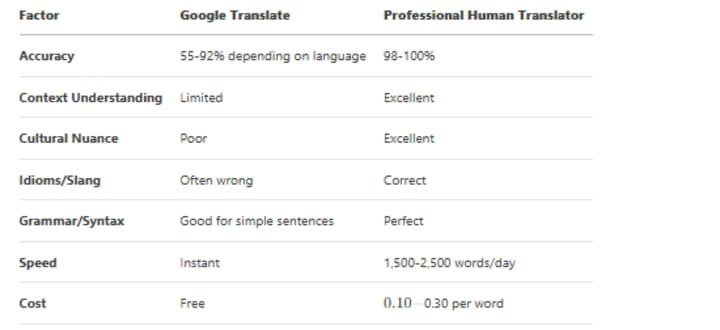
When to Use Each:
Google Translate is acceptable for:
- Getting the gist of foreign text
- Simple travel phrases
- Casual communication with friends
- Quick lookups of individual words or phrases
Human translators are essential for:
- Legal documents
- Medical information
- Business communications
- Literary works
- Marketing materials
- Any situation where precision matters
Recent Improvements and Future Outlook
Google continues to invest heavily in translation technology. Some promising developments include:
Zero-Shot Translation: The ability to translate between language pairs the system wasn't explicitly trained on by using a pivot language.
Context-Aware Translation: Better handling of entire documents rather than just individual sentences.
Multimodal Translation: Combining text with images and audio for better understanding.
Domain-Specific Models: Specialized versions for legal, medical, or technical translation.
However, experts agree that while machine translation will keep improving, it's unlikely to fully replace human translators for high-stakes content in the foreseeable future.
Best Practices for Using Google Translate
To get the most accurate results from Google Translate:
- Keep sentences simple and direct
- Avoid idioms, slang, and cultural references
- Break long sentences into shorter ones
- Double-check critical translations with native speakers
- Use the "Suggest an edit" feature to improve future translations
- For important documents, always use professional translation
Conclusion
Google Translate represents an incredible technological achievement that has made basic cross-language communication accessible to billions. For simple, straightforward content in major languages, it can be surprisingly accurate (85-92%). However, accuracy drops significantly for complex texts, rare languages, and content requiring cultural nuance.
While the system continues to improve through advances in AI, it's crucial to understand its limitations. For casual use, Google Translate is an invaluable tool. But for situations where precision matters—whether in business, law, medicine, or literature—professional human translation remains the gold standard.
As machine translation technology evolves, the ideal approach will likely involve smart collaboration between AI and human experts, leveraging the speed of machines with the nuanced understanding of professional translators.
About the Creator
Keep reading
More stories from jennifer smith and writers in Geeks and other communities.
100+ Travel Agency Names You’ll Love
Coming up with a catchy, memorable name for your travel business can be tricky. You want something that reflects your brand’s personality—whether it’s luxury, adventure, affordability, or family-friendly trips. That’s why we’ve put together a list of creative and inspiring travel agency name ideas to get your brainstorming started!
By jennifer smith10 months ago in Education
A Knight of the Seven Kingdoms Series Review (Season 1)
As one of the biggest properties in fantasy, A Song of Ice and Fire remains immensely popular with audiences. After reaching far into the past with House of the Dragon, a second spin-off was on the cards. A Knight of the Seven Kingdoms serves up a bite-sized slice of action and drama, but it still claims a spot among the best small-screen titles.
By Robert Caina day ago in Geeks
SpongeBob Review
The episode “Karate Choppers” opens with an exuberant montage that immediately signals the central conflict: SpongeBob’s enthusiasm for karate, inherited from his fearless best friend Sandy, collides head‑first with the mundanity of his everyday obligations at the Krusty Krab. The writers cleverly employ a rapid‑cut, split‑screen technique that juxtaposes Sandy’s high‑octane training sessions with Mr. Krabs’ frantic attempts to keep the grill burning, allowing the audience to feel the mounting tension between personal passion and professional responsibility. Every punch, kick, and exaggerated “Hi‑ya!” is rendered with meticulous timing, underscored by a percussive score that mimics the rhythmic thuds of a karate dojo, while the background chatter of hungry customers provides a subtle but constant reminder of the stakes. The visual gags—most notably the way SpongeBob’s square pants flutter like a flag in a wind tunnel whenever he attempts a high kick—are expertly animated, showcasing the show’s ability to blend the humor with a surprisingly sophisticated understanding of kinetic energy.
By Forest Green2 days ago in Geeks
When the Shelter Closes
Across the street from my house, a man slept under a tree, his dog by his side. My first, naive thought: he must be traveling through. But he kept coming back, often sleeping there during the day. Then it hit me—that person might not have a home.
By Bride of Sound3 days ago in Humans



Comments
There are no comments for this story
Be the first to respond and start the conversation.