
Game of Thrones: A Retrospective (Part I)
One year later, does the show still stand tall as one of the greats?

(SPOILERS FOR ALL 8 SEASONS OF GAME OF THRONES)
The day was April 17th, 2011. At approximately 9 PM on HBO, people were greeted with a brand new TV show. It opened on three men on horseback riding past an open gate into a dark tunnel, only to emerge into a wintery wasteland. They encountered mysterious creatures, which proved to be their demise, and only one of the men survived. He fled from the scene, terrified, but eventually suffered the same fate as his comrades as he was executed for deserting his post. The man who sentenced him to death was also his executioner, and he told his son, "The man who passes the sentence should swing the sword", after the deed was done.
The audience looked up in awe at this man, and they instantly knew that this show would revolve around him - and they were right. The plot of every subsequent episode involved him - he was the main character, after all.
Until he died, merely eight episodes after he was introduced, betraying multiple tropes of fantasy storytelling in a single second.
It was perhaps at that point that the audience had an inkling for the kind of show they were getting into - the kind where death was right around the corner. No character was safe - it was a story where anyone, irrespective of their royalty or importance to the plot, could be killed at the drop of a hat. This was different from every single TV show that came before it - this was Game of Thrones.
Writing about Game of Thrones has always been something I enjoy; my very first article on vocal.com was about the various problems the show was likely to struggle with after its first seven seasons. Back then, I was convinced that the eighth and final season would bring a close to all the numerous plot threads that the earlier seasons had set up. Each season of the show wrapped up stories; only this time, it wasn't the wrapping up of a seasonal arc - it was the series finale. The showstopper. The endgame. And how did it fare?
Well......

Yeah...it wasn't exactly a perfect ending.
How could something so successful fall so hard, so fast? It's almost surreal if you think about it. In just one year, the show went from being the most popular TV show on the planet to the topic of absolute ridicule and scorn from everyone who'd ever watched it. Even now, an entire year later, people are still not over how the show fell from grace, and I can completely understand why.
Since I live in India, each episode of season 8 would premiere at 6:30 AM, and every Monday, I would get up early and tune in. The first two episodes were fine - the second one, in particular, was a standout - the character interactions were on point, and it did a fantastic job of conveying the sense of dread and hopelessness that all the characters felt as death came closer and closer.
Sadly, however...

Was such a fall inevitable? Were the signs already there, begging to be noticed, but we just shoved it aside in hopes of getting the closure we wanted for so long? In this retrospective, I’m going to take a long, hard look at season 8, and how, on this day, one year ago, a worthy conclusion to the show we all knew and loved was stolen from us. This is going to be a long one, so brace yourselves. Without further ado, let’s jump right into it.
The Unexpected Fall
Game of Thrones wrapped up its 5th season in 2015, and despite it deviating from the source material far more than in previous seasons, people were generally happy with how the season progressed. (A 93% on Rotten Tomatoes and an 8.61/10 rating on IMDb is certainly nothing to scoff at) With the showrunners David Benioff and & D.B Weiss (D&D) moving forward with purely original content (with a few cliff notes from GRRM) for the rest of the show, people were anxious as to how the following seasons would hold up. Thankfully, season 6 was anything but a disaster, holding an approval rating of 94% on Rotten Tomatoes and 8.28 on IMDb. Things were looking good for the show; even though the books were still incomplete, we'd seen that there was potential for an ending that would be satisfying in its own right.
When season 7 was confirmed to have only seven episodes, I was a little skeptical as to how they would utilize each episode effectively. Still, I wasn't too worried as they had done an excellent job with the content in season 6. Unfortunately, however, this is precisely where the descent started. The shortcomings in having a shortened season began to show - rushed plotlines, baffling leaps in logic, and the increasingly rigid plot armor made the show seem more and more like every other fantasy show that preceded it.

It was at this point that many were predicting that Game of Thrones would no longer be the standout among the fantasy genre it had been for the past several years. However, it still had some of the best visual effects on television, and it wasn't obvious where the story was going, so no one was actively gunning against it.
At least...until season 8 came along.
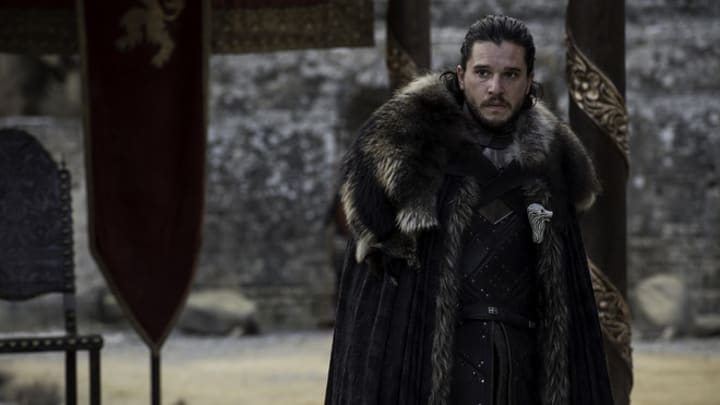
It became clear from the first two episodes that elements of the show that could previously be fleshed out and adequately explored had to be condensed. There was no time to show travel between two places - a journey that took Robb Stark a couple of seasons took Jon barely a couple of minutes. The writing was substantially less engaging - characters that, before, were teeming with life were reduced to mere husks of their former selves. The characters that lost the most on this front were Tyrion, Jon, and Varys, and I'd argue that even Cersei was extremely underutilized.
Unfortunately, as much as I would love to talk more about the bad writing, I'm afraid I'm going to have to come back to that. There have already been tons of videos and articles dissecting multiple things that went wrong in season 8, so I'm going to try and be as brief as possible when talking about the things that I found most vexing in the season. Let's kick this off by talking about the war against the Night King and the army of the dead.
Winter is Here - for 82 Minutes

The battle against the Night King was built up since the first episode of Thrones; the opening scene in the series showed members of the Night’s Watch getting killed by wights after coming across a cryptic pattern made out of body parts. After a constant back and forth with the White Walkers across seven seasons, in the finale to season 7, the Night King arrived to wreak havoc on Westeros in style - riding in on the back of the recently deceased Visirion, he absolutely demolished the Wall and led his army onward. This was the conflict that almost everyone was waiting for throughout Throne’s entire lifespan - after all, doesn’t a squabble over who got to sit in a pointy chair fade into oblivion against the impending threat of death itself? To quote Jamie Lannister,
This isn’t about noble houses - this is about the living and the dead.
Right after season 7 ended, I thought that there would be a battle at Winterfell in the first half of the next season and that the army of the living would have to fall back and retreat further south. Not only would this devastate Westeros, but it would also bring winter right to Cersei's doorstep, likely forcing her to fight the army of the dead. Furthermore, it would serve as a means to get everyone to King's Landing, where the show's climax would naturally be. However, when I learned that season 8 would only have eight episodes, I knew this probably wouldn't happen, but I was still eager to see what D&D would come up with. After all, it had been built up for so long - surely, it would be concluded in a meaningful and epic way, right?
The third episode of the season, ‘The Long Night,’ completely closed the book on the battle against the Night King and the White Walkers, and, well…it wasn’t great. The first time I watched it, I didn’t find much wrong with it (except for ONE thing) and was whooping and cheering at all the clutch moments. However, with the benefit of hindsight, this episode was pretty underwhelming.
Let’s get the obvious problem out of the way first - the darkness. It’s clear that director Miguel Sapochnik (who also directed both Hardhome and Battle of the Bastards) wanted to emulate what he did in season 6’s penultimate episode - create a muddy, grimy effect that thrust the viewer into the heart of the battle. This worked well previously, but with this battle happening at night, virtually nothing could be seen for the majority of the episode, even with the brightness turned up. Until the dragons used their fire and Melisandre lit the trenches, we were left to squint and guess as to what was happening on screen - something I didn’t expect from this episode. While I respect the creative choice behind it, at the end of the day, people can’t enjoy what they cannot see.
Another one of the things I was excited about was to see who would die in the battle. For the past couple of seasons, the show had been rather conservative in deciding who got the axe due to the plot zeroing in on the final confrontations. Still, a battle of this magnitude had to have some serious consequences, right?
....right?
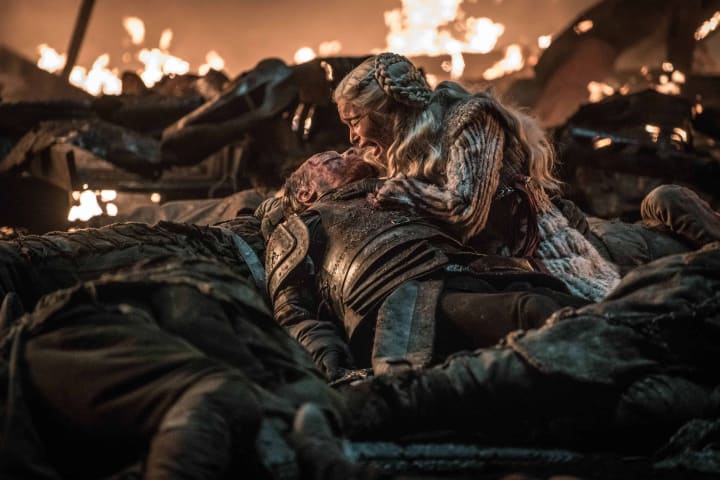
Somehow, almost ALL of the main cast survive this battle, and this is AFTER seeing them being overwhelmed multiple times throughout the episode. There was a scene near the end of the episode where it pans to Brienne, Jamie, Gendry, Tormund and Sam overrun and slowly overcome by Wights, and yet, somehow, by the next episode, they're all okay! Maybe a few minor scratches here and there, but nothing more. This is not what I expected - based on the previous episode, I fully expected Brienne, Greyworm, and Theon to die because their character arcs had been more or less complete. Plus, each of them dying would have affected our main leads - Sansa would be shaken up over Theon’s death, Brienne dying (which I thought would happen while saving Jamie, kind of a callback to the fight with the bear back in season 3) would finally sway Jamie to fight against his sister once and for all, and Greyworm dying would cause problems for Dany and the Unsullied.
Instead, we got Jorah's death, which was admittedly a sad moment thanks to both Emilia Clarke and Iain Glen, who acted superbly, as well as Ramin Djawadi's beautiful score. Theon's death was another great moment for the episode - a fitting conclusion to his character arc. The others who died (Melisandre, Beric Dondarrion, Edd, Lyanna Mormont) - meh. Their deaths were sad, sure, but the fact that no significant character died was a blatant bid to keep them alive for the final conflict against Cersei.
And finally, the biggest problem of this episode: the Night King himself and the ending.
Before this episode, we got several glimpses of the army of the dead in different contexts: wights leaving cryptic messages using body parts, an initiation ceremony for becoming a White Walker, the birth of the Night King, and tidbits here and there given by the previous Three-Eyed Raven. With so much buildup, the audience was left to assume that it would all mean something in the end. However, 'The Long Night' doesn't give us any answers - in fact, Bran and the Night King barely get any significant screentime throughout the episode.
Soon after the battle commences, we see Bran warg into some ravens, which fly above the clouds and come into direct contact with the Night King, who’s riding Visireon. I expected Bran to lure the Night King closer to him, distract him somehow, or do SOMETHING - he is the Three Eyes Raven, isn't he? But no - he just kind of sees him, and then the scene cuts away as if nothing happened. Bran isn't seen a lot after that. The same goes for the Night King - he briefly confronts both Daenerys and Jon once before taking a stroll to where Bran is. Naturally, this brings me to the ending of the episode: Arya whizzing through the army of White Walkers and wights to sucker-stab the Night King, killing all the dead instantly and winning the battle for the living.

When I first saw this scene unfold, I cheered and clapped like crazy. It was admittedly a badass moment from the youngest Stark, but the main problem comes after the actual kill occurs. Let me be clear: Arya being able to kill the Night King isn't that big of a problem - although the show frustratingly didn’t tell us how she snuck past THAT MANY White Walkers and wights. The problem is that he dies without the show answering a multitude of questions surrounding him. What did the Night King want to do with Westeros? What did all of those symbols mean? What role did the Lord of Light prophecy have to play in this? Why does the Night King hate the Three-Eyed Raven?
If the Night King and the entire army were going to die in one episode, why was it built up SO MUCH?!
I can’t be the only one in thinking that there was supposed to be some reason behind all of this - all the symbols, the connections with the Three-Eyed Raven, the Lord of Light - none of it mattered in the end! It honestly felt like they just wanted to wrap up everything as quickly as possible, which, quite frankly, makes sense given how the next couple of episodes go....
Overall, 'The Long Night' was a disappointment. There were so many things I didn't get the chance to touch on: the battle strategy of sending the Dothraki out into the darkness, the placement of the catapults and trenches, the fact that while fighting a being who could revive the dead, Tyrion thinking that the CRYPTS would be the safest place...I could go on - there are so many instances of baffling logic in this episode that it honestly takes away from the spectacle of the battle itself, which is a shame because when you could see what was happening, it looked excellent. In the end, this battle doesn't stack up against Thrones' epic clashes in the past seasons - for all the hype, and all the buildup of the Night King and his army, it just wasn't good enough.
And that's it for Part I, which covers the first half of the season (loosely). I still have so much more to say, but I didn't want to make this article any longer than it already was, so stay tuned for Part II, which is coming very soon!
About the Creator
Arvind Pennathur
I'm a graduate law student with a love for the quieter things in life. I write on a variety of topics, along with the occasional short story or poem. My perfect evening? Give me a rainy day, a cup of coffee, and a place to sit and write.
Keep reading
More stories from Arvind Pennathur and writers in Geeks and other communities.
The Half of It: A (Mostly Full) Experience
Coming of age movies that center around young adults always intrigue me. They're one of my favorite genres of movies not only because of their unbelievable degree of relatability, but their capacity to tell wonderful stories about the range of emotions people can experience. Teenagers are volatile, for better or worse - they make wild decisions, try so many new things and can be very emotional, and these movies reflect that - be it the incredibly heartfelt journeys seen in movies like The Perks of Being a Wallflower, or the narratives that are intertwined with comedy, such as Superbad or Booksmart.
By Arvind Pennathur6 years ago in Geeks
A Knight of the Seven Kingdoms Series Review (Season 1)
As one of the biggest properties in fantasy, A Song of Ice and Fire remains immensely popular with audiences. After reaching far into the past with House of the Dragon, a second spin-off was on the cards. A Knight of the Seven Kingdoms serves up a bite-sized slice of action and drama, but it still claims a spot among the best small-screen titles.
By Robert Cain7 days ago in Geeks



Comments
There are no comments for this story
Be the first to respond and start the conversation.