
Frozen Fear, Blazing Hope: How a Night in -40°C Sparked a Revolution in Clean Energy
A Tech Pioneer’s Quest to Power Adventures and Protect the Planet

The Saskatoon wilderness.
-40°C.
A blizzard tearing through the night like it was trying to rip the world apart.
I’m Roc, founder of Sodium Frost Glow, and on that night, I was huddled in a nylon tent, buried under snow, my fingers numb, my breath freezing midair. The heater had gone silent. Our phones were lifeless—lithium-ion batteries, the so-called gold standard of power, had surrendered to the cold. The wind howled like a wounded beast. And for the first time in my life, I truly felt fear—not just of frostbite, or hypothermia, but of how fragile our modern lives are when nature bares its teeth.
I wasn’t just a weekend camper caught unprepared. I’d spent over a decade at the forefront of technology—building smart hardware, crafting AI algorithms, solving problems at the edge of innovation. But that night, none of it mattered. All our cleverness, all our code, failed to produce a single spark of heat.
That night didn’t break me.
It ignited me.
As a product architect, I’ve led teams through impossible timelines, built systems that scale to millions, and shipped devices that shape how people live. But that frozen tent—that primal experience—cut deeper than any technical problem ever had. It wasn’t just discomfort. It was betrayal. The very tools we trusted, that we built our lives around, had failed us when we needed them most.
The culprit? Lithium-ion batteries.
Ubiquitous, yes. Reliable—until you dip below -20°C. Dangerous—prone to fire if mishandled. Destructive—dependent on rare mineral mining that scars the Earth. That night, as the wind screamed and the cold pressed in, I made a vow: to build a power source that could survive the harshest cold, protect the people who brave the elements, and honor the planet we all share.
That promise became Sodium Frost Glow.
The road wasn’t easy. It never is when you’re trying to rewrite the rules.
Sodium-ion battery technology offered a solution—but transforming that into a rugged, real-world product meant starting from scratch. I spent night after night in the lab, iterating, testing, failing. And then: back into the wild. On Saskatoon’s frozen plains, I field-tested our prototypes in brutal -45°C storms. I watched heaters hum to life, radios crackle with signal, tents glow with warmth.
That moment—seeing light push back the dark, hearing life return to silence—that was everything. It wasn’t just electricity. It was hope.
Our final prototype didn’t just survive. It thrived.
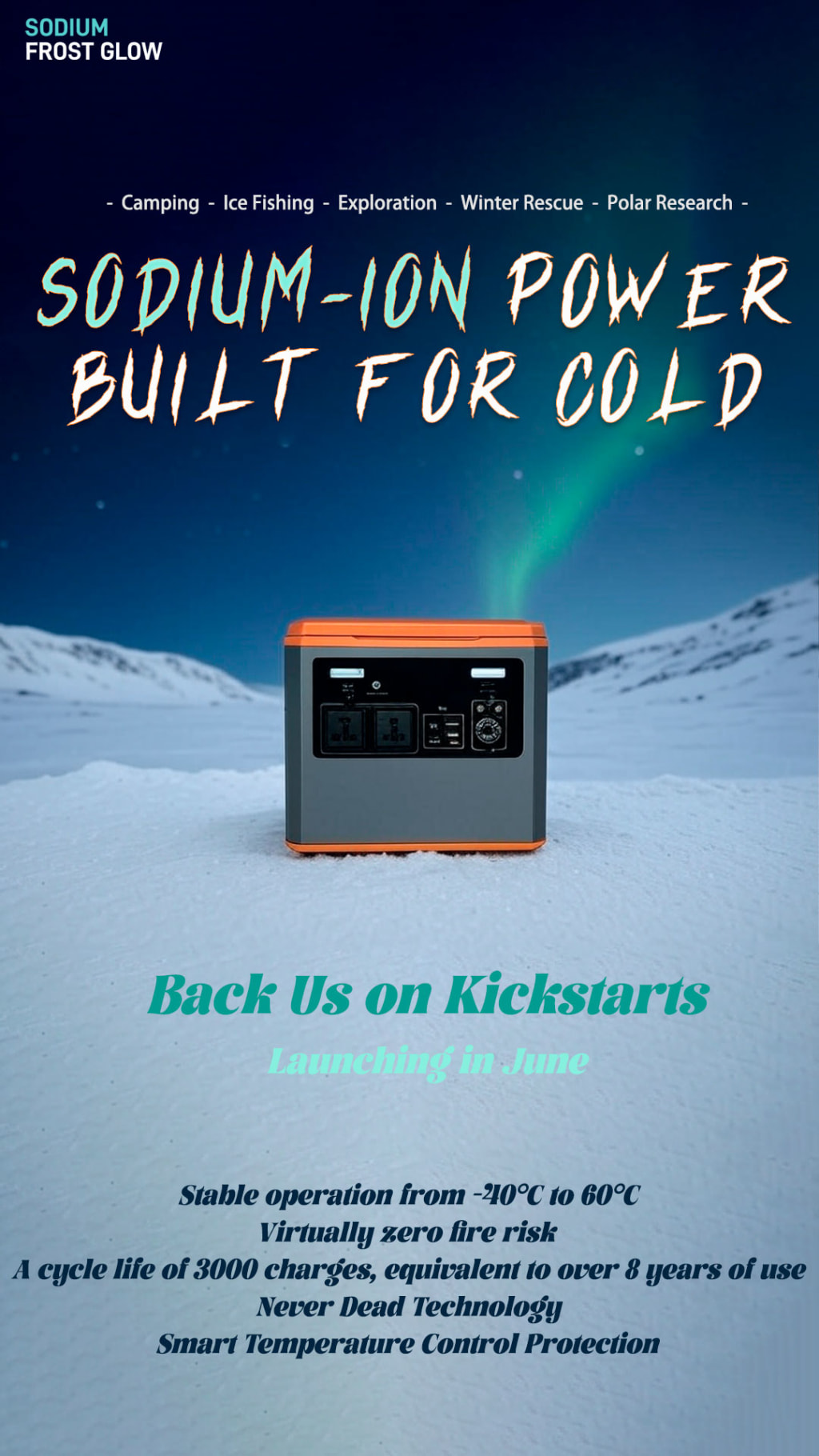
Sodium Frost Glow operates reliably at -45°C, where lithium falters. It powers Arctic expeditions, mountain rescues, polar research, and yes, that desperate family waiting out a winter blackout. And with our Always Powered, Never Toast! technology, it charges from 0 to 100% without degrading performance—no babying your battery, no surprise shutdowns. Just clean, steady power in the harshest places on Earth.
Safety became an obsession.
In a remote wilderness, a battery fire isn’t just a hazard—it’s a death sentence. Sodium-ion eliminates that risk entirely. No flammable electrolytes. No runaway reactions. Just peace of mind, when peace is hard to find.
Durability? It’s built to last.
3,000 charge cycles. That’s eight years of rugged use.
No more replacing batteries every other year. No more waste piling up in landfills. This is performance that respects your wallet and the world.
And its soul is green.
Our sodium is derived from sea salt, not strip-mined from sacred land. Our supply chain reduces rare metal mining by up to 80%, shrinking our ecological footprint without sacrificing function. From avalanche beacons in snowstorms to medical tents in Antarctica, Sodium Frost Glow is built not just for survival—but for stewardship.
This journey changed me.
It’s easy to believe innovation lives only in labs and launch events. But I found it instead in frozen silence, in the raw, humbling vulnerability of nature. I found it in every line of code rewritten by moonlight, every circuit board tested in the snow, every failure that led to a stronger design.
Now, as we prepare to launch our crowdfunding campaign, I’m overwhelmed—not by stress, but by a sense of purpose. This isn’t just a product. It’s a movement.
Picture this:
A filmmaker capturing the northern lights at -50°C.
A glaciologist monitoring melt rates on an ice shelf.
A father keeping his family safe in a power outage.
That’s the future we’re powering.
So join us.
Support our crowdfunding launch. Share our story. Be part of the spark that lights up the coldest, darkest corners of the Earth.
Sodium Frost Glow isn’t just my dream. It’s yours, too.
👉 Discover more and fuel your next adventure: https://sodiumfrostglow.com
About the Creator
roc chiang
I'm a tech enthusiast and entrepreneur based in Vancouver. I share original articles on technology, business and other related topics on social media to showcase my passion and insights.
Editor-in-Chief:fengtou.ca
Keep reading
More stories from roc chiang and writers in Geeks and other communities.
Sodium Frost Glow: The Sodium-Ion Outdoor Power Secret for Icy Adventures
Deep in a snowbound wilderness, where temperatures plummet to -45°C (-49°F) and howling winds carve the night, adventure beckons. But for power gear, it’s a merciless crucible. Traditional lithium-ion batteries falter in such cold, draining fast or failing entirely, leaving phones, cameras, or heaters lifeless. For polar trekkers, winter adventurers, or skiers, explorers, reliable power is more than a luxury—it’s survival. Enter Sodium Frost Glow, a sodium-ion outdoor power station that holds the secret to unstoppable energy in the iciest extremes, blending rugged performance with a bold eco-friendly mission.
By roc chiang8 months ago in Geeks
The Rachels - 2025
Much to my surprise, I have kept a list of the films I‘ve seen this year. I daresay it isn’t complete. There will be films that snuck in on a late night in front of the TV that I would’ve forgotten to note. Or others, that I went to watch at the cinema, but then had a red wine and promptly forgotten about. But it’s not a bad approximation of the films I’ve seen this year. In total, there are 53 films listed, so an average of one a week and one for good luck.
By Rachel Robbins25 days ago in Geeks
Grant Gustin's Chances Of Returning As The DC Universe's Flash Have Just Increased After New Update
The Flash has yet to be cast for the new DC Universe, and after a new update, the rumors of Grant Gustin's return as Barry Allen in the new franchise have gained strength once again. Gustin made history by playing Barry for The Flash's nine seasons. The actor also starred in multiple Arrowverse crossovers, becoming one of the franchise's fan-favorites.
By Dena Falken Esq6 days ago in Geeks
Ludacris and Nelly draw backlash over bookings at MAGA-coded music festival
Ludacris and Nelly headlining a mostly right-wing event is good for them. It’s also great for the genre of hip hop. The two rap veterans have showcased their talents on other stages. Why can’t they perform for mostly MAGA folks and grab that bag?
By Skyler Saunders6 days ago in Beat


Comments (1)
That's quite a story. It's crazy how quickly things can go wrong in extreme cold. I've had my fair share of tech failures in tough conditions. It makes you realize how much we rely on these batteries. I'm curious, what were the biggest challenges in developing a battery that could stand up to such cold? And how did you ensure it was safe and environmentally friendly? Can't wait to hear more about Sodium Frost Glow.